
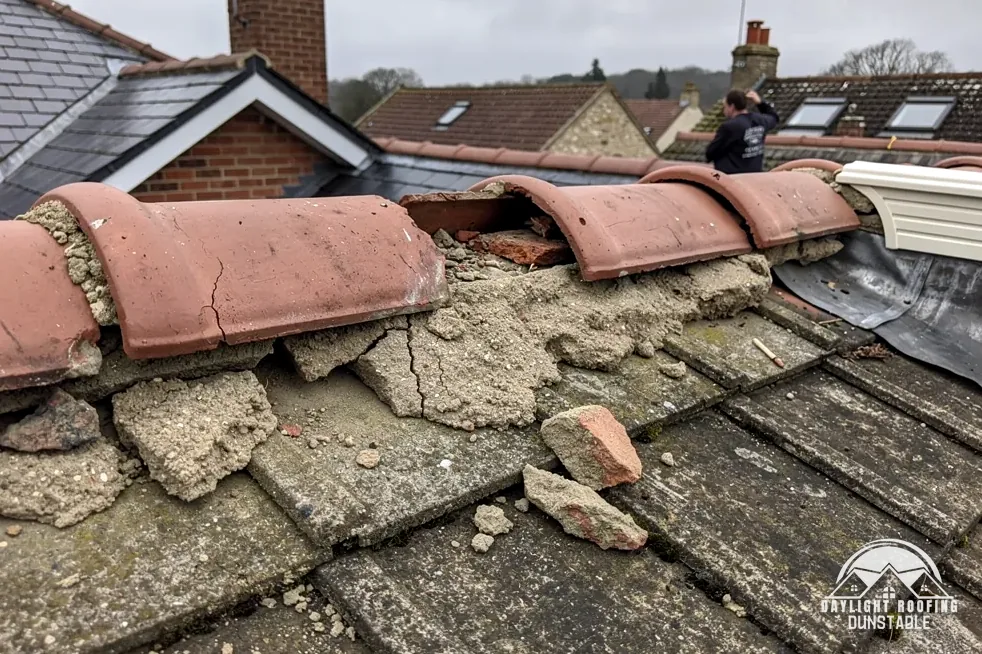
A written quote that ends in one total
The first document to ask for is a written quote, and the figure at the bottom of it carries the most weight. One total for the whole job lets you compare like with like. A quote cut into several small figures can look cheaper on the first page and leave the real cost for later, so a single figure covering the whole job is what to look for. Our own quotes are written that way, with the survey first and then one total price.
A quote's figure rests on how closely the roof was looked at. A number given down the phone is a guess about a roof nobody has seen, and a firm that quotes without a survey is pricing blind. A photo sent over WhatsApp makes a useful first step, because it shows a firm what is going on, and after a survey the single written total follows.
Read the description of the work as carefully as the price. It should say which slopes or sections are covered, what is being fitted and what is coming off. If part of the roof is left out, or a repair is mentioned only in passing, ask for it to be written in. Vague wording is where later disagreements begin.
- one total price, in writing
- the part of the roof the work covers, named
- what the total takes in, with scaffold and waste checked
- the business's name, phone number and email
A named business you can reach
Every quote should say who is behind it. That means a business name, a phone line that gets answered and an email that works, all written on the quote and not only given in conversation. A firm that is easy to reach before the job is easier to reach when something needs adjusting during it.
Call the number before signing anything. A working phone line and a reply to an email show that the details on the paper lead somewhere. Ours are 01582 935272 and info@daylightroofingdunstable.co.uk, with WhatsApp on 07880 284133 for a photo of the roof.
A service-area business may not publish a premises address, and that is no fault in itself. What should never be missing is a way to reach the people doing the work, and a record on paper of who the contract is with. Ask for the legal name of the business if the quote carries only a trading name.
Ask who will actually be on the roof. The business signing the quote and the people doing the work can be the same or different, and either is workable once you know which applies. The point is that the name on the contract, the name on the van and the name of whoever answers the phone should add up to something you can follow, and a quote is the place to settle it.
Who deals with Building Regulations
A job that needs Building Regulations approval needs someone to take charge of getting it. Ask the firm which route applies and who deals with it: the council's building control team, or a registered building control approver. For re-roofing the Planning Portal says "In most situations, this work will need Building Regulations approval", which makes the question reasonable for any re-roof.
The route also settles what lands in your hands at the end. Completion is the council's word, and final is a registered approver's. Whichever you hold, it is the proof that the finished work met the regulations, and a later buyer or surveyor may ask to see it. A firm with no answer to the question has told you something useful.
Some jobs sit outside approval altogether, because they fall within the limits in the Planning Portal's test. Those limits, the weight rule and the chimney breast rule are all set out in Building Regulations for roof work. A roofer who knows the limits can tell you in a sentence which side of them your job falls on.
Where approval might apply, the route is raised with the council early. That is the step to expect from any firm: a call to building control before the work, in place of a hope that nobody asks afterwards.
Planning, listed homes and Article 4
Re-roofing a house is normally permitted development under Class C of the planning rules, so an application is not the starting assumption. The word is the government's own, and a few situations change the picture. Ask the firm to say which of them, if any, applies to your house.
A listed home keeps its permitted development rights for roof work. Listed building consent comes into it when the work reaches the home's character, which the law puts as "in any manner which would affect its character as a building of special architectural or historic interest". A flat has no householder permitted development rights at all. Dormers need planning permission in a conservation area or in a National Landscape such as the Chilterns.
An Article 4 direction can "withdraw specified permitted development rights across a defined area", in GOV.UK's words. Councils publish their conservation areas and Article 4 directions, and the council for your address is the authority on both. Each council's list covers different works, so a firm should not assume that what applied on one street applies on the next. The full tests are in planning permission for roof work.
The question to put to a roofer is short: has the planning position for this house been checked, and with whom? The council is where we check the planning route before work starts. An answer that names the council can be followed up, while an answer of "it will be fine" cannot.
Scaffold, asbestos, wildlife and site duties
A roof job brings in rules outside the roofing itself, and a firm should be able to speak about each one.
| Ask about | The rule behind it |
|---|---|
| Scaffold over a road or footway | Highways Act 1980 s169 licence |
| Older roofs | HSE: assume asbestos in a building "built or refurbished before 2000" |
| Protected species | Offences set out in the paragraph below |
| Safety on site | CDM 2015 duties move from the homeowner to the contractor |
Section 169 of the Highways Act 1980 bars anyone from erecting or retaining on or over a highway "any scaffolding or other structure which obstructs the highway" without a licence, and we arrange the licence with our scaffolder. Asbestos needs its own care. HSE says "AC roofs are always fragile" and "Use a lockable skip for asbestos", and the household consignment-note exemption is "other than asbestos waste".
Wildlife law has two edges. Under the Wildlife and Countryside Act 1981 section 1, a person who intentionally "takes, damages or destroys the nest of any wild bird while that nest is in use or being built" commits an offence. A bat roost is covered differently. Regulation 43(1)(d) of the Habitats Regulations 2017 reaches anyone who "damages or destroys a breeding site or resting place of such an animal", with no word about intent. GOV.UK names "repairing or replacing a roof" as roof work that can need a Natural England licence.
On site safety, CDM 2015 moves a domestic client's duties to "the contractor for a project where there is only one contractor", and to the principal contractor when there are several. A homeowner is not left holding site safety, and a firm should be able to say who is.
Signing at home and your 14 days
Face-to-face deals struck anywhere except the trader's own business premises count in law as off-premises contracts, and a contract signed at your own home following a survey is one of them. The no-reason cancellation right lasts until "the cancellation period ends at the end of 14 days after the day on which the contract is entered into".
The 14 days begin counting on the day following the contract date, so the day of signing is not day one. A request to start work sooner has to be made in writing. It does not cut the cancellation right, and payment for the part already done can still be due, so an early start is a decision to take with the cost in mind.
The exception is narrow: "the consumer has specifically requested a visit from the trader for the purpose of carrying out urgent repairs or maintenance". Think of a leak you have phoned about. That is why the gap between a planned job and an urgent one matters before you sign anything.
Separately, the Consumer Rights Act 2015 expects "Service to be performed with reasonable care and skill". The duty covers roofing like any other service, and gives you a footing if the finished work falls short of it.
If a job goes wrong
Start with a written note to the firm. Say what is wrong, when it was found and what you want done, and keep a copy together with photographs. A dispute is easier to settle when it rests on a dated record than when it rests on memory.
For independent advice, call the Citizens Advice consumer helpline on 0808 223 1133. Trading Standards does not advise individuals, so the helpline is the place to get advice. Since 6 April 2026 a trader must also tell the consumer about any alternative dispute resolution arrangement available if the consumer is dissatisfied, under section 308 of the Digital Markets, Competition and Consumers Act 2024.
Where weather caused the damage and an insurer is involved, a different route applies, and it runs through the Financial Ombudsman Service. That route has its own steps and time limits, which are covered in roof damage and home insurance.
The checks in this guide all point one way: get the details in writing before the work starts. One written total, a named business, an answer on regulations and a clear idea of your cancellation rights make up a good share of the protection a homeowner can arrange alone. The firm's own details are on the Daylight Roofing homepage.