
Call 01582 935272

Milton Keynes · 16 road miles north-west

Roofers in Milton Keynes

Milton Keynes, a city reached by a 16.3-mile drive north-west from Dunstable, has Grade II civic buildings and a heritage register that leaves householders' rights intact, and a roof job in the city ends with a single price on paper.

Get a written quote

Call 01582 935272WhatsApp us

Council
Milton Keynes City
Road miles
16
Building control
Milton Keynes Council

Roofs in the Milton Keynes of the New Towns Act

Driving from Dunstable to Milton Keynes takes about 25 minutes, over 16.3 road miles heading north-west. Milton Keynes lies in Central Milton Keynes parish, which had 4,704 usual residents at the 2021 Census. Applications for roofs and extensions go to Milton Keynes City Council. Its New Town Heritage Register FAQs call the city "the last, largest and most ambitious of all the settlements to be created under the 1946 New Towns Act". On conservation areas, the council states "Milton Keynes has 27 conservation areas".

Conservation areas at Loughton, Shenley Church End, Bradwell and Woughton-on-the-Green lie close to the city, though not on it, so for an address, check with Milton Keynes City Council. The council's Article 4 list includes directions on offices in the Central Business District and on houses in multiple occupation, and both control changes of use, so check whether anything else applies to a roof at your address. Listed buildings are Octo sculpture and reflecting pool (National Heritage List entry 1432576), Central Library (1424282) and Shopping Building (1393882), each Grade II. See the planning guide, flat roofing and commercial roofing pages.

  1. 01Heritage Register homesBeing on the New Town Heritage Register leaves a house's existing permitted development rights intact and unchanged.
  2. 02Flat roof outletsA flat roof drains through outlets and overflows, and a blocked outlet can leave water standing across the surface.
  3. 03Civic Grade II roofsCentral Library and the Shopping Building are Grade II, so their roofs are judged on the effect of any change on the listing.
  4. 04Scheduled moundSecklow Hundred mound is a scheduled monument, which follows a consent route of its own and not listed building consent.
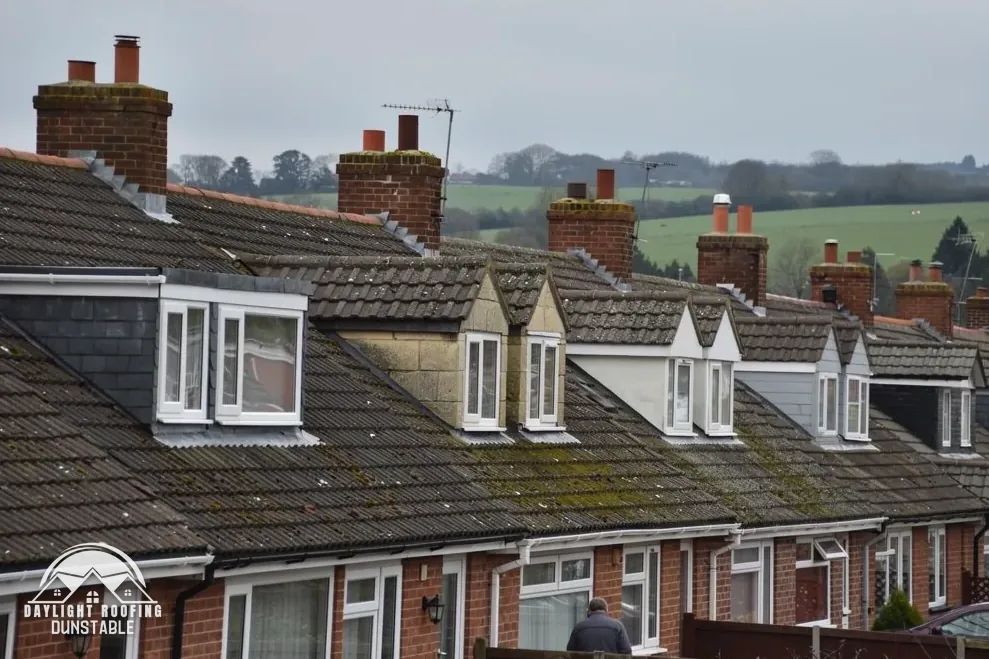
Concrete tiled estate rooftops towards green hills

The roof, in plain words

NTHR
The New Town Heritage Register kept by Milton Keynes City Council.
Scheduled monument
A protected archaeological site with its own consent regime.
Overflow
A spare outlet set above the main one, to let out water if it blocks.
Parapet
A low wall at a roof edge standing above the roof surface.

The plain-as-day roof check

Four ways Milton Keynes roofs differ from a village's

4 checks about 3 minutes to read

  1. The New Town Heritage Register
  2. Scheduled is not listed
  3. Roofs on civic buildings
  4. Outlets and overflows

01 The New Town Heritage Register

Milton Keynes City Council keeps a New Town Heritage Register of buildings and places that tell the story of the city's creation. Its FAQs say: "Being on the NTHR leaves any existing permitted development rights intact and unchanged." For a house on the register, a re-roof is therefore not made harder by the entry itself.

Whether a house is on the register is a question for the council, and so are the questions of a conservation area or an Article 4 direction. The Central Milton Keynes direction stops offices in the Business District being turned into flats without an application, which is a change of use and not a roof control. Ask for the answer on paper, and say which covering you have in mind. The register is a heritage list and not a planning control, which is why the council's own wording stresses that rights are unchanged.

02 Scheduled is not listed

Secklow Hundred mound, a moot at the junction of North Row and North Ninth Street, is a scheduled monument (National Heritage List entry 1007940). It stands in Central Milton Keynes parish. Scheduling is a separate protection from listing, and where a structure is scheduled, the listed building consent regime falls away.

A scheduled monument is protected by the Ancient Monuments and Archaeological Areas Act 1979, under which works are allowed only if authorised. The Secretary of State grants scheduled monument consent, with the application made to Historic England, whereas listed building consent is a council matter. A house near a monument is not itself scheduled, so its roof follows the ordinary routes. If your house sits on a road named for the mound or its surroundings, that tells you nothing about its status, and the list entry is the only reliable guide.

03 Roofs on civic buildings

Central Library (entry 1424282, first listed on 30 April 2015) and the Shopping Building (entry 1393882) are Grade II, and so is the Octo sculpture and reflecting pool (entry 1432576, first listed on 19 January 2016). Under the Planning (Listed Buildings and Conservation Areas) Act, consent is needed for works "in any manner which would affect its character as a building of special architectural or historic interest".

Large roofs on large buildings are surveyed in sections, with access planned before anyone climbs. A roof on a public building has many outlets, vents, lights and edges, and a change that alters its appearance is a conversation with the council first. Shop and office roofs vary too much in area, covering and drainage for a guide figure to fit, so a shop or office roof is priced only once it has been surveyed, as one written total. Access is part of that survey: whether a lift, a tower or a scaffold is needed is decided early, because it changes how long and how safely the work can be done.

04 Outlets and overflows

A flat roof sheds water through outlets, and one designed with care has an overflow a little above the main outlet. If the main outlet blocks, the overflow takes the water out through a parapet or an edge before the roof fills. A roof with one outlet and no overflow has nothing to fall back on when that outlet clogs.

Look at each outlet for leaves, silt or a cover that has slipped, and at the overflow for an opening that is clear. NFRC reports that BS 6229:2025 sets "a minimum 1:80 finished fall for general roof areas and internal gutters". Standing water close to an outlet suggests that the fall is short of it, or that the outlet has settled below the surrounding surface. A leaf guard or a basket over an outlet keeps the debris out of the pipe, and it needs lifting and clearing from time to time.

The dashed ring takes in the nearest towns and villages we cover around Milton Keynes. Map tiles © Esri; map data © OpenStreetMap contributors.

Roof questions in Milton Keynes, answered

01How should outlets and overflows be arranged on a Milton Keynes flat roof?

Every flat roof needs at least one outlet at the low point of its fall, and a roof designed with care also has an overflow set a little higher. If the outlet blocks, the overflow lets the water leave before it builds up. IKO says "To achieve a 1:80 fall, the code of practice says that the roof should be designed for a fall of 1:40". Check outlets for silt and leaves, and make sure the overflow opening is clear and has not been painted shut or covered over. A photograph of each outlet, with the date, is a good first record. Where an overflow discharges through a parapet, see where the water lands: it should clear the wall and the footway below.

02Does the New Town Heritage Register stop me changing the roof covering on my Milton Keynes house?

No, and the reason is plain. The council's FAQs say: "Being on the NTHR leaves any existing permitted development rights intact and unchanged." A house on the register keeps whatever rights it already had. A conservation area, an Article 4 direction or a listing is a separate matter, and so is the question of whether your own house is on the register at all. Ask Milton Keynes City Council about your address. Our planning guide covers the position for a house in general.

03How does consent work for the Secklow Hundred mound near Milton Keynes?

The mound is a scheduled monument (National Heritage List entry 1007940), and works to it are lawful only if authorised. The Secretary of State grants the consent, and the application is made to Historic England. That is a different system from listed building consent, which does not apply to a scheduled monument. The mound sits at the junction of North Row and North Ninth Street. Ask Historic England about works on the monument itself, and the council about anything on land beside it. A roof on a house close by follows the ordinary routes, and the monument's consent system has no say in it. A neighbour's house is not made scheduled by sharing a road with the mound.

04Is Milton Keynes in a conservation area, and what are the Article 4 entries?

Conservation areas at Loughton, Shenley Church End, Bradwell and Woughton-on-the-Green lie close to the city. Close is not inside, so for your address, check with Milton Keynes City Council. The council's Central Milton Keynes and HMO directions deal with changes of use, offices to flats and homes to shared houses, rather than roofs. The council can say whether anything else touches roof work at your address, and its written reply belongs with the deeds. Give the address in full, with the postcode, and name the covering you intend, so that the answer relates to your roof and not to the area in general.

05Which team provides building control for a Milton Keynes re-roof?

Milton Keynes City Council's own building control team is on 01908 252721 in office hours, and on 01908 226699 out of hours. The council's main line, 01908 691691, is not the building control number. The Planning Portal says "In most situations, this work will need Building Regulations approval". A registered building control approver may do the same job, issuing a final certificate, where the council would issue a completion certificate. Ask at the start which of the two applies to your job, and keep the certificate that follows, since a buyer or a lender may want to see it.

06What is the council's scaffold fee in Milton Keynes?

For Milton Keynes City Council, a scaffold licence for up to 1 month is £189 and complex scaffolding is £694, and every fee quoted is excluding VAT. Section 169 of the Highways Act 1980 requires a licence wherever a scaffold blocks a footway or the road. We arrange the licence with our scaffolder. City roads with redways, bus stops and loading areas need thought, so describe where the building stands when you ask about the job, and say whether the access is shared with a neighbour. A scaffold on a redway or beside a bus stop needs more thought than one in front of a house, so mention either when you write.

07What do cost guides say about replacing a flat roof in Milton Keynes?

Which? Trusted Traders give £1,400 to £3,500 for felt, and £1,950 to £4,000 for a PVC or rubber covering laid on new boards, on a 6m x 3m single garage and excluding VAT (November 2025). MyJobQuote writes "In 2026, the average flat roof replacement costs between £1,500 and £6,000." A shop, an office or a block roof is a larger job than a garage. Commercial roofs are surveyed first, because area, covering, drainage and access change the work, and the written total follows the survey. A flat roof with plant, lights and several outlets takes longer to read than a plain deck, which is a reason to describe it carefully at the outset.

08What do the Grade II listings of Central Library and the Shopping Building mean for their roofs?

Both are Grade II listed: Central Library is National Heritage List entry 1424282, first listed 30 April 2015, and the Shopping Building is entry 1393882. Under the listing, consent covers any works affecting their character as buildings of special architectural or historic interest. A change to a covering, a rooflight or a drain can do that. Historic England publishes each list entry, and an owner asks the council about consent before commissioning a survey. Because the roofs are so large, a survey of one runs section by section, with each section's access arranged first.

09Which places near Milton Keynes have roofing pages of their own?

Wolverton, Bletchley, Newport Pagnell, Whaddon and Stony Stratford do. The page for each of them is written for that place, with its own council named. If your Milton Keynes roof has run its course, roof replacement describes how a new covering goes on, section by section, from the old covering being lifted to the new membrane or tiles being laid. Milton Keynes City Council's building control team and scaffold licence apply across the city, while a place outside it has its own council and its own numbers.

Get a written price for your roof

10-year workmanship guarantee, in writing

Tell us about your roof

Call WhatsApp Written quote