
How the ombudsman describes a storm
Storm damage is the claim most roof owners think of first, and the word storm is not left to guesswork. The Financial Ombudsman Service, the free body that settles disputes between consumers and financial firms, publishes how it reads the term on home insurance complaints. In its words: "We say that a storm usually involves violent winds, usually with rain, hail or snow."
The same page adds a second sentence that widens the picture: "Rain, hail or snowfall by itself can constitute a storm." Wind need not be involved at all. The Beaufort Scale also figures in its assessment, so it looks at the conditions on the day and does not work from a single number.
That wording is the ombudsman's approach to a complaint, and an individual policy has its own definition and its own list of exclusions. Policy documents differ, so the schedule and the wording that came with the policy are the starting point for any claim, and the ombudsman's description is the yardstick used if a dispute reaches it.
A roof that has lost tiles after a night of high wind, or a ceiling stained after heavy snow melts, is exactly the kind of case in which the question comes up. The rest of this guide covers what to do in the first hours and days, so the evidence is there if the question is asked.
Photograph before anything is moved
Photographs cost a homeowner nothing and are the first evidence to create. The Financial Ombudsman Service says it will usually look at expert reports and photos, which is why the first job after damage is to record how things look before anything is moved, cleared or patched. A picture taken before a repair cannot be taken again afterwards.
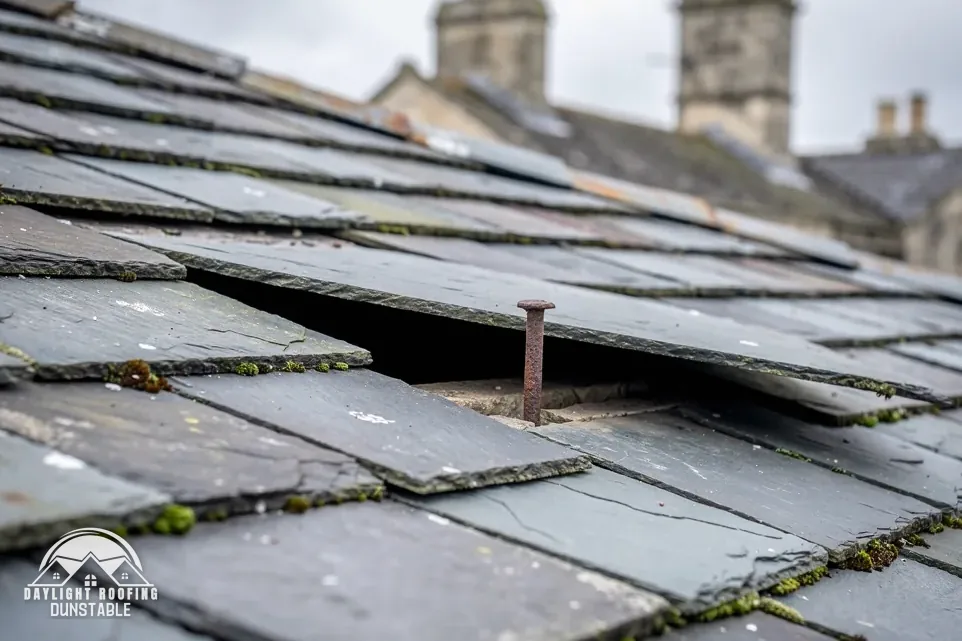
Shoot from ground level and from indoors. From the ground, cover each elevation of the house, with a wide shot first and then closer ones of anything that looks wrong: gaps in a tiled slope, a displaced ridge, a hanging gutter, debris on the ground below. From inside, cover the ceiling and walls beneath, the loft floor where it is safe to go up, and any drips or damp patches.
- wide shots of each side of the house
- close shots of missing or moved tiles, ridge and flashings
- fallen material on the ground, left where it landed
- stained ceilings, drips and damp patches inside
- the loft, where it is safe to go up
Keep your feet on the ground when you photograph the roof. A phone with a zoom, or a pair of binoculars, will do the job from the ground. Switch on the date stamp or keep the original files, so each picture carries its time. A photo can also be sent to us on WhatsApp on 07880 284133, and we will look at it.
Tell the insurer early
The second step is to tell the insurer. Policies set out how and when a claim should be reported, and the claims number is on the policy documents. Reporting soon means the insurer hears about the damage from you, with your account of what happened, and not months afterwards.
Say what you saw and when. Give the date the damage was noticed, the weather that came before it, and what has been affected inside the house. Write down the name of each person you speak to and what was said, with the reference number you are given. Ask what the insurer needs from you, such as photographs or quotes, and what it wants done about any temporary protection.
Temporary protection is a real question, because a hole in a roof lets in more rain. Check with the insurer whether it would like to see the damage before a temporary repair is made, and keep every receipt if you pay for one. The photographs from the previous step cover the period before the work.
The claim itself sits with your insurer, and nobody outside that process can say what the outcome will be. A roofer can explain in plain terms what has gone wrong with the roof, and your own dated photographs are the evidence to keep.
The surveyor's report and who has to prove what
An insurer may send a surveyor. On this, the ombudsman's page is direct: "Your insurer will normally ask a surveyor to write a report." The report is one of the pieces of evidence the ombudsman says it will look at, together with the photographs. Ask for a copy of the report once it exists.
The ombudsman's page also speaks to who carries the burden when a claim is turned down because of an exclusion in the policy. "The insurer has to prove that the exclusion applies - for example, with an inspection report." An insurer that refuses a claim because of an exclusion therefore needs something to point to, and a report is the example the ombudsman gives.
This is where your own photographs and a roofer's written account can matter. They give a second record of the roof from the time of the damage, against which any report can be read. If the report and the photographs disagree, say so in writing and send the photographs.
A roofer's survey is a separate thing from an insurer's surveyor. Ours is carried out so that the roof can be priced, and it ends in one written total. It tells you plainly what was found, other findings included, and that account is yours to use as you choose.
What roof repairs cost, from published guides
Whether to claim at all can depend on the size of the repair against the policy excess, and published cost guides show the territory. Their figures come from outside firms, and every one carries its own date and basis, so a roof of your own needs its own survey.
| Job | Figure | Page date |
|---|---|---|
| Emergency call-out | "typically range from £150 to £300" | 22 October 2026 |
| Extensive storm repairs | "can cost £1,200 or more" | 22 October 2026 |
The table's figures are from MyJobQuote, and the £1,200 figure applies only to the extensive storm damage repairs that page describes. For smaller jobs, Which? Trusted Traders, surveying 11 traders in November 2025, gave £75 to £400 where one to six tiles are replaced, and a ridge tile at £80 to £300, with VAT excluded. MyJobQuote's average roof repair, in a page dated 6 October 2026, is around £650.
The price for a real roof follows a survey and is one written total. A published range helps judge whether a quote is in the right territory, while the quote itself is the price that applies to the job. When you pass a figure to an insurer or another firm, name the source and the date with it, since a bare number carries no weight. Read an emergency call-out figure as the cost of a visit, and the storm figure as the cost of a bigger repair, because the two describe different jobs and are not added together.
If the insurer says no
Start by complaining to the insurer. The ombudsman says that "For most complaints, a business has up to 8 weeks to consider a complaint." Only after that period, or after a final response, does the Financial Ombudsman Service come into it, and the service says on its pages how to take a complaint forward.
There is also a time limit on the way out. The ombudsman's page on time limits says: "You have 6 months from the date on the final response". That limit is counted from the date printed on the insurer's final response. It is a separate matter from the eight weeks the insurer has to consider the complaint, and the two are not added together. Check the date on the letter, and note it in your folder on the day it arrives.
Keep everything in one folder: the policy, the claim reference, the photographs, the surveyor's report, the insurer's letters and any roofer's written account. A complaint that is easy to follow is easier to assess. The Financial Ombudsman Service can be reached on 0800 023 4567.
Nothing here predicts whether a claim will succeed. The ombudsman looks at each complaint on its facts, and the evidence it names, reports and photos, is the evidence worth gathering from the first day.
Working with a roofer while a claim is open
A roofer can inspect the roof and tell you what is wrong with it. That is separate from the claim, and the repair and the claim can go ahead at the same time: the insurer decides the claim, and you decide who repairs the roof. Where an insurer asks for a quote, a written one with a single total is what to supply.
Compare quotes with care, since a claim does not change the checks that apply to any roofing job. The questions to ask of a firm, from who is named on the quote to your cancellation rights, are in choosing a roofer. The money side is in roofing costs explained.
Keep the damaged materials where the insurer asks, and tell the roofer what the insurer has said about work before a visit. Doing it in that order prevents a repair from removing the very evidence the claim depends on. If the insurer has named a surveyor, mention the name, so the roofer knows whose visit comes first.
Outside a claim, a good defence against a surprise is a glance up at the roof from the pavement, and the roof maintenance checklist shows what to look for. More about the firm is on the Daylight Roofing homepage.