
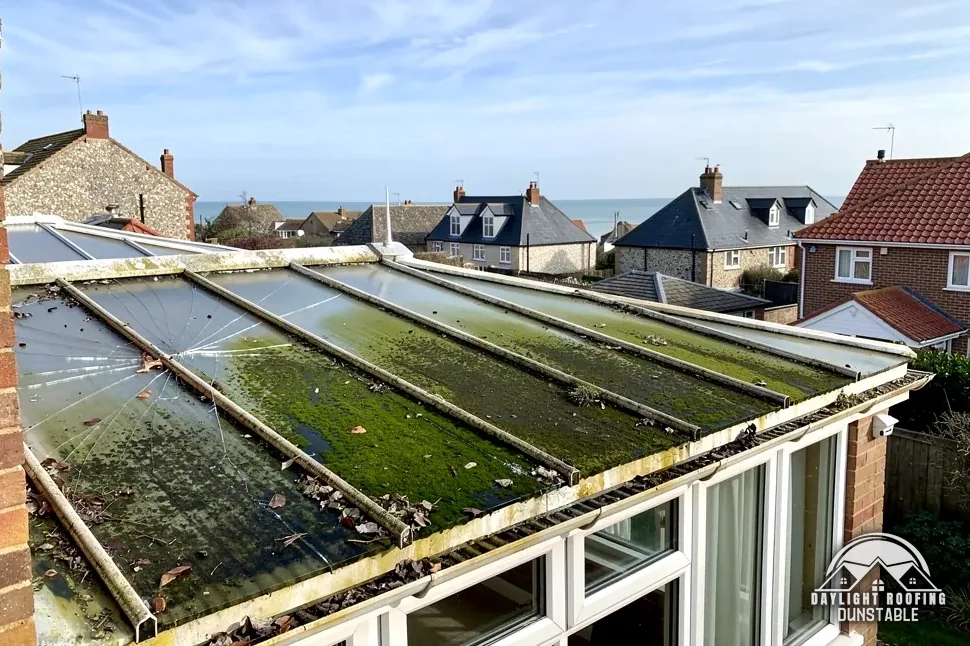
Start from the ground
The safe way to look at a roof is from below. Stand back far enough to see each slope as a whole, then look closer through a pair of binoculars, or a phone with a good zoom. Walk right round the house, because a roof has several faces and the one you can see from the front door is only one of them. A neighbour's garden or a side path can give a view that your own plot does not.
Look for lines before looking for faults. A healthy slope reads as even rows of tiles or slates, a straight ridge along the top and a clean edge at the eaves. Anything that breaks the pattern is worth a closer look: one tile hanging below its row, a dark gap, a ridge that dips, a gutter that sags away from the wall.
- tiles that are slipped, cracked or missing
- a ridge line that is no longer straight
- flashings that have lifted or split
- gutters that sag, overflow or leak at joints
- stains running down the wall below the eaves
Keep a few photographs of each slope taken from the same spots. Pictures from today give a comparison later, and they are the records that count if damage ever has to be shown to an insurer. Staying on the ground costs nothing and removes the risk of a fall from a roof.
Tiles and the ridge
A slipped tile sits lower in its course than the tiles either side, leaving a gap above it. A cracked one shows as a dark line across the face, and a missing one as a gap where the batten underneath is visible. Each lets rain reach the layer beneath, so each is worth noting with a photograph and the slope it is on.
The ridge sits at the apex of the roof, and its tiles are fixed on top of the covering. Marley notes that since the 2015 amendments to BS 5534, mortar "could no longer be relied upon as the only means of securing the roof covering". Its wind guidance adds: "In all cases, ridge or hip tiles should be mechanically fixed to resist the calculated wind uplift force." A ridge that looks cracked, bedded in loose mortar or out of line deserves a roofer's attention.
Moss and lichen grow on a covering without necessarily harming it, so a green patch calls for a closer look and settles nothing by itself. What matters is whether the surface beneath is sound. Chips, flaking and tiles that have gone soft at the edges are signs that a covering is wearing.
Coverings have lifespans, and the figures depend on the material. HomeBuilding's approximate figures are 60-80 years for clay tiles and 40-50 years for plain concrete tiles. Marley says "Typically, roof tiles are expected to last for around 60 years" and adds "This is not a guarantee or warranty of its longevity." The sources differ, and only a survey of the actual roof shows its condition.
Flashings, chimneys and valleys
Flashings seal the places where a roof meets something else: a chimney, a wall standing proud of the slope, a dormer cheek or a roof window. They can be lead, another metal or a bonded product, and they carry the strain at a joint where movement and water meet. From the ground, look for a strip that has lifted away from the masonry, a crack at a fold or a gap where sealant has failed.
Lead has a long life when it is correctly installed. MyJobQuote says that correctly installed lead flashing "can last for over 80 years". Lead sheet is made to BS EN 12588 in codes 3 to 8, and code 4, for example, is 1.80 mm thick. Which code goes where is a decision the job's specification makes, detail by detail, so a thickness cannot be judged from the ground.
Chimneys deserve a careful look. Check the stack for loose or missing mortar between the bricks, a leaning outline and a crack in the render. A chimney is also the highest part of the house, and a defect there gets worse once water is in. Valleys, at the internal angle between two slopes, carry the runoff of both, and a stain or a sagging line along one is worth noting.
On chimney leadwork, MyJobQuote's page dated 22 September 2026 gives around £200 for patching a flashing and around £570 for replacing it in full, and a range of £350 to £920 for replacing the leadwork in full, the spread tied mainly to scaffolding. Chimney leadwork is all those numbers describe.
Gutters and downpipes
Gutters take the water clear of the roof and the walls, and a fault in one can look like a roof fault. After rain, look for overflow at the front edge or at a corner, water running down the wall instead of the downpipe, damp or green staining on the brickwork below and plants growing from the gutter. Any of these means water never gets to the outlet.
A gutter works by sloping. Brett Martin gives the fall for installing guttering as "1mm for every 600mm" towards the outlet. That is a very small slope, and a bracket that has dropped or a section that has sagged can reverse it, leaving water standing in the run. Standing water in a gutter, with a rim of stain, shows the fall has gone.
| Sign | What it points to |
|---|---|
| Overflow at a corner | Blocked outlet or lost fall |
| Drips at a joint | Failed seal between sections |
| Green wall staining | Water running where it should not |
| Sagging run | Dropped bracket or fixing |
Plastic gutters and fascia boards wear out slowly. A retailer states that uPVC fascia boards "can typically maintain reliable performance for between 20 and 40 years" when installed correctly. For clearing gutters, Which? Trusted Traders gave £75 to £350 in a survey of 11 traders in November 2025, excluding VAT.
The loft and the ceilings below
If the loft can be reached safely, it is the place to find a leak. Shine a torch up at the roof's underside. Dark stains on the timber, wet or flattened insulation, drips, and any chink of daylight through the covering are things to photograph. Weight goes on the joists or on fixed boarding, never on the ceiling between them.
Ceilings and upper walls tell the same story from inside. A tide-mark that widens after rain, flaking paint or a patch that darkens in a wet spell can point to a roof defect, though plumbing and condensation make similar marks. The loft above the stain is the place to see which it is.
Ventilation matters for the health of the roof structure. Where a cold roof uses a high-resistance underlay, Marley's table asks for 25 mm of eaves ventilation along the length at 15° or less, and 10 mm above 15°. The underlay in that arrangement is not vapour-permeable. An eaves gap is worth checking whenever insulation is added or replaced, because it can be covered by accident.
Insulation gets wet if water enters, and wet insulation loses its job. Note any area that looks damp or compressed and where it is, so a roofer can go straight to the right slope.
What not to do on a roof
Do not jet wash the roof. Marley says "The use of high powered jet washes is not recommended as it can damage the surface of the slate or tile, thus reducing its expected life considerably". Checkatrade's guide from April 2026 says roof cleaning typically costs £8.50 to £14 for each square metre, a unit price that is no use as a total.
Do not walk on a roof you cannot identify. HSE advises that "If the building was built or refurbished before 2000, assume that there is asbestos in it", and that "AC roofs are always fragile". A fragile sheet can give way under a person. Do not scrub, drill or break a sheet either, and call for advice before any work.
Do not disturb a bat roost or an occupied nest. Under the Wildlife and Countryside Act 1981 it is an offence to intentionally take, damage or destroy "the nest of any wild bird while that nest is in use or being built", and a bat roost stays protected even where no harm was meant. If something is living under the tiles, stop and ask a roofer.
Do not climb a ladder onto the roof to fix a tile. A fall is the danger on any roof job, and a do-it-yourself repair puts a person up there for the sake of one tile. Photograph the fault from the ground and pass it to a roofer instead.
When to call a roofer
Call when the checklist turns up something that is more than a note. Missing or slipped tiles, a lifted flashing, a ridge that has moved, a leak into the house, a sagging gutter that will not hold its line: each justifies asking for a survey. Waiting does not shrink these faults, since water keeps reaching the same spot.
A survey is the step before a price. MyJobQuote's page of 12 October 2026 has a roof survey averaging around £300, an outside figure and not a quote. We survey the roof first, and the written price afterwards is a single total. A photo on WhatsApp, on 07880 284133, is a way to start.
In its November 2025 survey, Which? Trusted Traders priced one to six tiles at £75 to £400 and a ridge tile at £80 to £300, excluding VAT. Repairs of that size are small ones, and the survey sets what a roof needs.
Questions to ask a firm before agreeing work are in choosing a roofer, the figures behind a bigger job are in roofing costs explained, and a claim after storm damage is covered in roof damage and home insurance. The firm's services are listed from the Daylight Roofing homepage.