
Call 01582 935272

St Albans · 13 road miles south-east

Roofers in St Albans

A roof in St Albans, the Hertfordshire city 13.1 miles by road from Dunstable, has its heritage questions settled first, then a survey, then one written total.

Get a written quote

Call 01582 935272WhatsApp us

Council
St Albans City and District
Road miles
13
Conservation area
St Albans
Building control
St Albans & Watford

Roofs under the Abbey and beside the Clock Tower

Reaching St Albans from Dunstable means 13.1 miles of road to the south-east, about 22 minutes of driving. The city lies in St Albans City and District Council's area, and the council decides planning applications for the streets round the Abbey and the Clock Tower alike. Four buildings appear below with grade and National Heritage List number: the Abbey Church, the Clock Tower and Verulamium at Grade I, and The Grange at Grade II*. Where an address carries a listing or sits in a conservation area, those questions come first, and the survey follows them.

St Albans City and District Council decides planning applications in the city. The council designated the St Albans Conservation Area, and its character statement divides it into character areas such as Verulamium, Verulam Road, and The Park and St Stephen's Hill. It also names four Article 4 areas: Verulam and Fishpool Street, Sopwell Lane and Albert Street, Cunningham Avenue, and Childwickbury. Our planning guide covers the roof rules, and the roof replacement page follows a full re-cover from strip to ridge.

  1. 01Abbey Church of St AlbanGrade I, National Heritage List entry 1103163, first listed on 8 May 1950: the building that is St Albans Cathedral.
  2. 02The Clock TowerGrade I, entry 1103127, first listed on 8 May 1950, and also a scheduled monument, entry 1003524.
  3. 03VerulamiumGrade I, National Heritage List entry 1103030, first listed on 8 May 1950.
  4. 04The GrangeGrade II*, entry 1174089, a listed building where roof changes are put to the council before anything else.
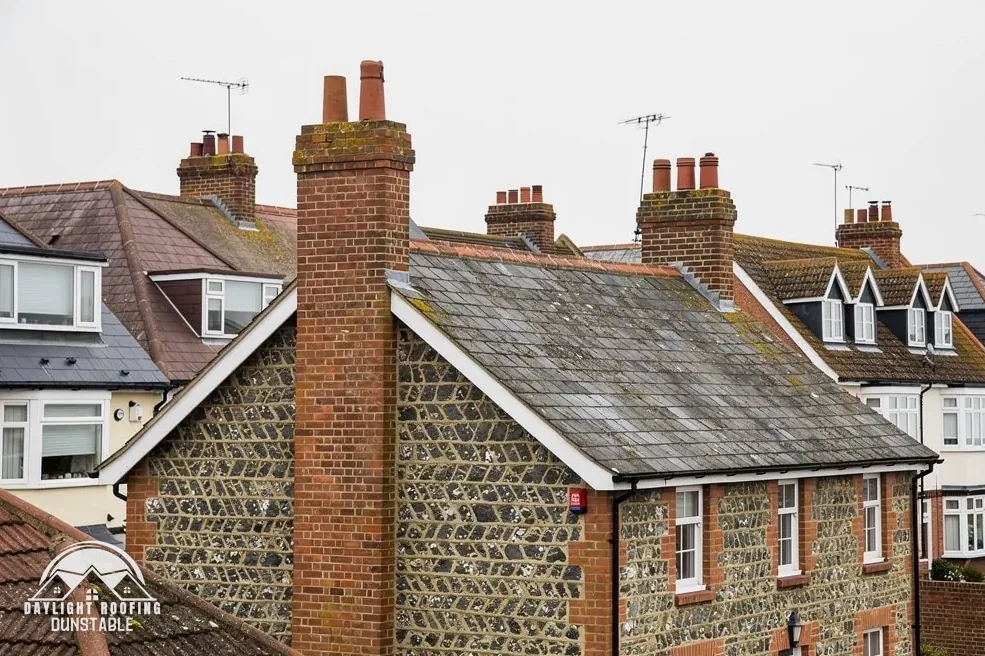
A flint and brick cottage with a grey slate roof

St Albans consent words, decoded

Article 4 direction
A council order withdrawing certain permitted development rights.
Care of Cathedrals
The Care of Cathedrals Measure 2011, the Church of England system for cathedral work.
Minimum pitch
The lowest slope angle at which a tile may be laid.
Like for like
Repair in the same material, put back where it was.

The plain-as-day roof check

Four things to settle on a St Albans roof first

4 checks about 3 minutes to read

  1. Matching the old covering
  2. The pitch limit of a new tile
  3. Eaves, gutters and the top of the wall
  4. Which consent route a building takes

01 Matching the old covering

On a house with a heritage listing, the council looks at whether work would affect the building's character, and the roof is part of that. Walk past and note the colour of the covering, whether the tiles are flat or curved, the size of the tiles, the shape of the ridge, the verge detail and the chimney pots. Those notes let the council see what a repair in the same material, or a change of material, would alter, and they give the survey a starting point for the same slopes.

A short list of what is there makes the conversation with the council brief. Photograph each slope square-on, with a wide shot of the whole elevation, and note anything that is already a repair. Sent by WhatsApp to 07880 284133, the pictures are looked at before the survey, which then starts from the roof as it stands today rather than from a guess about its age, and from the same set the council can see the roofline.

02 The pitch limit of a new tile

A tile type cannot be laid below its own lowest pitch, and a swap that suits a steep roof can fail on a shallow one. Marley gives minimums product by product: clay Hawkins 30°, Ashdowne 35° and Lincoln pantile 15°, and concrete Edgemere and Modern-Duo 17.5°, Mendip 15° and Ludlow Major 22.5°. Ludlow and Canterbury are Marley product names, not places.

The pitch of the existing slope is therefore measured before a replacement is chosen. A pitch that suits one product may rule out another, and a conservation-area house may need the original look and a safe pitch together. The pitched roofing page describes the options, and the survey says which of them the slope can carry. Slate has its own limits, and the slate roofing page covers them.

03 Eaves, gutters and the top of the wall

After a re-cover, the junction between roof and wall deserves a check of its own. Make sure the underlay is dressed into the gutter, the fascia is sound, and the wall top below the eaves is dry. A damp patch on the brickwork just under the gutter, or a gutter that overspills at a joint, shows where the roof is shedding water onto the wall instead of clear of it.

Brett Martin gives a gutter fall of 1 mm for every 600 mm towards the outlet. On a listed or conservation-area house, the roofline keeps its profile and its material where the council asks for that, and a plain plastic swap for a timber original puts a question to the council first. The gutters, soffits and fascias page covers renewal, board by board and run by run.

04 Which consent route a building takes

A Church of England church in use goes through the faculty system. The Cathedral and Abbey Church of St Alban, in Sumpter Yard, is a cathedral, and work to it goes through the Care of Cathedrals Measure instead. A listed house needs listed building consent before works that touch its character, and a scheduled monument needs authorisation, granted by the Secretary of State on an application through Historic England.

A house in a conservation area, or under an Article 4 direction, may need planning permission for work that is permitted elsewhere. For anything outside the four named Article 4 areas, check with St Albans City and District Council whether an Article 4 direction applies. Each route stands alone, so one building can sit under more than one at once, and the council can say which of them applies to a given address.

The dashed ring takes in the nearest towns and villages we cover around St Albans. Map tiles © Esri; map data © OpenStreetMap contributors.

St Albans roof questions, and who answers them

01How is the lowest safe pitch for a replacement tile checked on a St Albans roof?

The survey measures the angle of each slope in degrees, since every tile has a minimum. Marley's concrete Edgemere and Modern-Duo go down to 17.5° while its clay Ashdowne needs 35°, so a covering that suits one roof can fail on another. Any other fault the roof shows is described in everyday words next to it, and one written total comes after. A photograph from the pavement, sent by WhatsApp, gives a first look, though only a visit reveals the junctions up close, and a repair history written on the back of an old invoice helps.

02Do St Albans conservation areas and Article 4 directions change a re-roof?

They can. St Albans City and District Council designated the conservation areas, and a house inside one may face closer planning control over exterior work. The council also names four Article 4 areas: Verulam and Fishpool Street, Sopwell Lane and Albert Street, Cunningham Avenue and Childwickbury. The council alone can say what each direction takes away. For anywhere else, check with St Albans City and District Council whether an Article 4 direction applies before a covering is chosen, because the answer can change the plan.

03How does roof work at St Albans Cathedral differ from work at a parish church?

St Albans Cathedral, the Cathedral and Abbey Church of St Alban in Sumpter Yard, is a Church of England cathedral. Work to it goes through the Care of Cathedrals Measure, not the parish faculty system. It is the same building that is listed Grade I as the Abbey Church of St Alban (entry 1103163). The Diocese of St Albans covers "Bedfordshire, Hertfordshire, Luton and Barnet". Exterior work in the city might also need planning permission, if the usual planning tests bite on it, so the cathedral route does not cover everything, and the council can say whether a given piece of exterior work calls for permission.

04What applies to roof work near the Clock Tower, Verulamium and The Grange?

The Clock Tower is Grade I (entry 1103127) and also a scheduled monument (entry 1003524), within the city. Anything done to a scheduled monument must be authorised first: the Secretary of State grants consent, and the application is sent to Historic England. Verulamium (entry 1103030) is Grade I and The Grange (entry 1174089) is Grade II*, so listed building consent covers works that affect their character. A neighbouring house is judged on its own listing, not on theirs, and the council can tell a homeowner which entry, if any, covers a particular address. The list entry number is the quickest way to ask.

05Who sorts the scaffold licence and building control for a St Albans roof?

Scaffold licences for St Albans streets come from Hertfordshire County Council, not the district. Hertfordshire County Council charges £134 for a 14-day scaffold licence and £59 for every week after, and "It usually takes 3 weeks to process an application." The footway has to keep a 1.2 m clear walkway. We arrange the licence with our scaffolder. Building control comes from a service that St Albans and Watford share, and putting a new covering over the entire roof exceeds the Planning Portal's "Less than 50 per cent of the roof is affected" limit, so Building Regulations approval is needed. The building control team can confirm the route for an address.

06What does a clay tile roof last for, going by published figures?

Sources give ranges, not dates. HomeBuilding's approximate lifespans are 60-80 years for clay tiles and 40-50 years for plain concrete tiles, on a page last updated 30 September 2025. BRE gives a minimum life expectancy of 60 years for clay tiles only, and that figure does not apply to concrete. These describe materials in general. A St Albans roof depends on fixings, battens, exposure and earlier repairs, and a survey looks at all of them before it says how much life a particular slope has left. A roof with patches from earlier repairs is worth a closer look at the slopes around them, whatever its material, because a patch can sit beside tiles or slates of a quite different age.

07What do storm damage repairs and emergency call-outs cost, going by published guides?

On a page dated 22 October 2026, MyJobQuote writes: "Emergency roofer call-out costs typically range from £150 to £300, while extensive storm damage repairs can cost £1,200 or more." It gives no VAT basis. Neither figure is a price from us. For an insurance claim, the Financial Ombudsman Service says it will usually look at expert reports and photos, so photograph the damage before anything is moved. Once the survey is complete, our St Albans quote is a single written figure, with the cause of any leak explained to you in plain words.

08How much does a rubber roof cost on a small flat roof near St Albans?

On a page dated 9 October 2026, MyJobQuote's line is that "typical rubber roofing prices of around £60 per square metre mean the average rubber roof costs £1,050 fully installed". A per-metre rate describes cost per square metre of rubber roofing and cannot give a total for any particular roof. For a single garage, Which? Trusted Traders give £1,950 to £4,000 for rubber or PVC EPDM with new boards, excluding VAT, from 11 traders in November 2025. A survey comes before our price and shows whether the deck under a rubber roof is sound enough to keep.

09What should happen if birds or bats use the roof of a St Albans house?

The Wildlife and Countryside Act 1981 protects a wild bird's nest from being intentionally taken, damaged or destroyed while it is "in use or being built". Bats are covered by the Habitats Regulations, which treat damage to a breeding site or resting place as an offence whatever the intent, and Natural England can license work such as "repairing or replacing a roof". Work on the affected slope waits until the position is clear, and the order of the job on a St Albans house may change. A roof inspection before work starts is the time to find a roost, not halfway through a strip.

Get a written price for your roof

10-year workmanship guarantee, in writing

Tell us about your roof

Call WhatsApp Written quote