
Call 01582 935272

Cosgrove · 22 road miles north-west

Roofers in Cosgrove

Cosgrove is north-west of Dunstable, 22.3 road miles and a 33-minute drive away, and every roof there is surveyed first so that the quote arrives as one total in writing.

Get a written quote

Call 01582 935272WhatsApp us

Council
West Northamptonshire
Road miles
22
Conservation area
Cosgrove Conservation Area
Building control
West Northamptonshire

Cosgrove roofs between the Grade I church and the canal

Cosgrove is a village in Northamptonshire, within West Northamptonshire Council's boundary. Cosgrove parish had 652 usual residents at the 2021 Census. The council handles planning here and has its own building control service, while for re-roofing the guide to follow is the Planning Portal's. Cosgrove has a conservation area, and the Grand Union Canal Conservation Area lies in the area round it; West Northamptonshire Council designated both. A roof job near the canal or the church is worth a call to the council first.

A non-immediate direction about houses in multiple occupation applies across the river within Milton Keynes City Council's area, and it removes a change-of-use right, not a roof right. For a Cosgrove address, check with West Northamptonshire Council whether an Article 4 direction applies. The planning guide explains what the national rules say about roofs. Work on slopes, ridges and stacks, whether on the house or on a garage or outbuilding, is covered under pitched roofing, chimney repairs and roof repairs, and each begins with a survey of the roof in question, so the written price rests on what was seen.

  1. 01St Peter and St PaulListed Grade I, National Heritage List entry 1040847, first listed on 17 May 1960, and a Church of England church.
  2. 02Bridge Number 65Listed Grade II*, entry 1190608, first listed on 1 December 1951, the same day as The Manor.
  3. 03The Manor and Elms FarmhouseThe Manor is Grade II, entry 1040812, first listed on 1 December 1951; Elms Farmhouse is also Grade II, entry 1040813.
  4. 04Roman villa siteThe Roman villa south-east of Cosgrove Hall is a scheduled monument, entry 1003874, near Cosgrove.
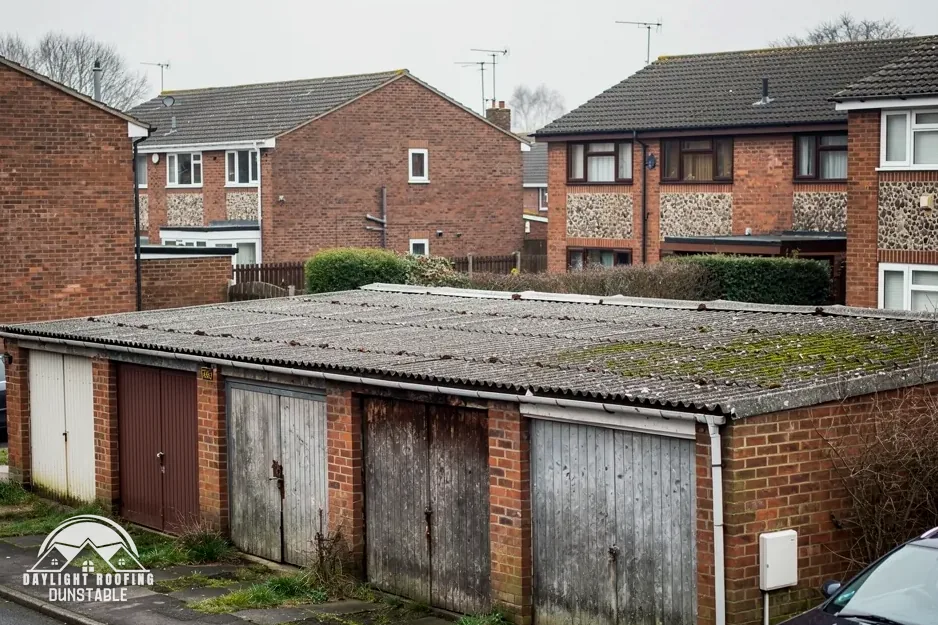
A row of brick garages with an old flat roof behind houses

Cosgrove words, in plain terms

Faculty
Church of England consent for changes to a parish church still used for worship.
Batten
A narrow timber lath nailed across the rafters; tiles hook over it.
Ridge tile
The capping piece that closes the gap along the top of two slopes.
Chimney breast
The masonry bulge inside a room that carries the flue up to the stack.

The plain-as-day roof check

Four things to look over before a Cosgrove re-tile

4 checks about 3 minutes to read

  1. How the tiles are held on
  2. Pitch against profile
  3. A chimney breast on a shared wall
  4. Ridge and hip fixings

01 How the tiles are held on

A slipped tile has come loose through its fixing and not through the tile itself, so the first question is what held it. Marley records that, since the 2015 amendments to BS 5534, "mortar could no longer be relied upon as the only means of securing the roof covering". BS 5534 is the British Standard code of practice on how slates and tiles are laid, and Marley adds that installing to it "isn't required by law", which leaves a careful job to follow it anyway.

From the garden, look for a tile that sits proud of its neighbours, a gap along a course, or a run of tiles whose bottom edges no longer line up. Any of these suggests a rotted batten or a corroded nail beneath. The survey lifts and checks the fixings around the fault, because swapping one tile on a failed batten only moves the trouble a metre along the slope, and the written price should reflect the true extent.

02 Pitch against profile

Each tile profile has a minimum pitch set by its maker. Marley lists plain concrete at 35 degrees, Double Roman at 22.5, Mendip at 15 and Anglia at 25, while for clay it gives Canterbury 40, Ashdowne 35 and the Lincoln pantile 15. Anglia and Ludlow are product names from that maker, not places on the map, so a Cosgrove roof is never judged by anything in its name.

Hold a spirit-level protractor against a gable rafter or ask the survey to measure the slope, then compare the figure with the maker's table for the tile in question. A covering that suits a steep slope can let wind-driven water back under the laps when the slope is shallow. Moving to a different profile also alters the load on the rafters, and where a new covering is 15 per cent or more heavier, the Planning Portal wants a structural engineer or surveyor consulted first, and that step should come before any tiles are ordered.

03 A chimney breast on a shared wall

Taking out a chimney breast looks like internal work, yet the Planning Portal says "Building regulations approval will always apply when removing chimney breasts". Should the breast stand against a party wall, the Party Wall etc. Act 1996 brings in the neighbour as well: a notice from the building owner "be served at least two months before the date on which the proposed work will begin".

Work may start sooner "with the consent in writing of the adjoining owners and of the adjoining occupiers". A neighbour who says nothing within 14 days is "deemed to have dissented from the notice", and the Act then hands the disagreement to a surveyor to settle, which is a different thing from a neighbour blocking the work. Party wall questions go to a party wall surveyor, not building control. The stack above the roofline needs its own look: the lead around it, the pots and the pointing all stand on the same structure.

04 Ridge and hip fixings

Ridge and hip tiles take the strongest push from wind uplift, and Marley says they should be mechanically fixed to resist the calculated force. BS 8612:2018 is the specification for verge, hip and ridge parts that are dry-fixed with clips and screws instead of resting on a mortar bed alone.

A cracked mortar bed or a ridge tile that has shifted is easy to spot against the sky. Fixing positions come from a fixing specification written for the individual site, which allows for how exposed the roof is. When the survey reaches the ridge, it checks the tiles either side as well, since a loose ridge can sit on a tired run of battens and the ridge cap is only as secure as what is underneath it. Hip ends, where two slopes meet at an angle, deserve the same attention, because their capping is cut and fixed one piece at a time and a single loose piece can let the rest shift.

The dashed ring takes in the nearest towns and villages we cover around Cosgrove. Map tiles © Esri; map data © OpenStreetMap contributors.

Cosgrove roofing questions, from tiles to the church

01Why would tiles on a Cosgrove cottage start to slide, and what is checked first?

Slipping points to a failed fixing: a rotted batten, a rusted nail or old mortar that has lost its grip. The tile is the visible part, and the cause sits under it. Look from the garden for a proud tile, an uneven course or a gap, and send a photo to WhatsApp on 07880 284133 if you want a first opinion. The survey climbs to the slope, lifts the neighbouring tiles to see what they hang from, and reports plainly on whatever else it saw before the written price is given.

02How are works to St Peter and St Paul approved if its roof needs repair?

The church is listed Grade I (entry 1040847) and is a Church of England church. While it is in use, work on it falls under "the faculty jurisdiction of the Church of England", which takes the place of listed building consent. For some roof work that renews the covering in matching material, notice in writing from the archdeacon is enough, with no full faculty. External changes may still raise a planning question of their own. A house roof in the village never goes through the church's process, and it is judged by the ordinary council tests.

03Which conservation areas are in or around Cosgrove?

Cosgrove has its own conservation area, and the Grand Union Canal Conservation Area lies in the area round it. West Northamptonshire Council designated both. Whether a particular house stands inside either is a question for the council, which can answer from an address or a postcode. Ask before a scope is agreed, because the answer changes which extra planning questions apply. A listed building is a separate control, so a house can be inside a conservation area, listed, both or neither, and each status is checked on its own.

04Does the houses in multiple occupation direction near Cosgrove matter to a house re-tile?

The nearby direction about houses in multiple occupation is Milton Keynes City Council's, for its own area, and it concerns change of use rather than roofs. An Article 4 direction can remove further permitted development rights, so we check with the council first. For your address, check with West Northamptonshire Council whether an Article 4 direction applies, and give the street, because a direction applies to a mapped area and the street name settles which side of the line a house is on. An ordinary like-for-like re-tile of a single dwelling is a conversation to have with the council, never a guess, and a copy of the answer belongs in your own folder beside the paperwork for the job. If the council needs a plan or a drawing, a short sketch of the roof can help, though the council sets what it will accept.

05Do I deal with the scaffold licence myself for a house on the Cosgrove road?

No. West Northamptonshire Council, the highway authority, does not accept scaffold licence applications from the public; the scaffolding company applies. We arrange the licence with our scaffolder when a job needs one. A licence matters only when poles or boards go over the footway or the road, under section 169 of the Highways Act 1980. Scaffold standing wholly inside the garden does not raise that question, which the survey can confirm when it looks at how the house sits against the road and any verge.

06Will a full re-tile in Cosgrove need Building Regulations approval?

The Planning Portal says: "In most situations, this work will need Building Regulations approval." Its interactive guide adds that no application is normally needed only if "Less than 25 per cent of the total 'building envelope'" and "Less than 50 per cent of the roof is affected", so a full re-tile goes past the limit. West Northamptonshire Council runs its own building control service, and we check the route with it before work starts. A covering 15 per cent or more heavier also draws in approval, and a structural engineer or surveyor is asked to look beforehand.

07What if bats or birds are nesting in a Cosgrove roof?

Bats, and the places where they breed or rest, are fully protected in law according to GOV.UK, which counts "repairing or replacing a roof" among the jobs that may need a Natural England licence. Damaging or destroying a bat roost is an offence whatever the intent. The Wildlife and Countryside Act 1981 separately protects a wild bird's nest "while that nest is in use or being built". If droppings turn up, or birds are nesting along the eaves, say so before the survey so the work can be planned around it.

08How does the scheduled Roman villa site relate to a house roof here?

The Roman villa south-east of Cosgrove Hall is a scheduled monument, entry 1003874, near Cosgrove. Works to a scheduled monument must be authorised, with consent granted by the Secretary of State and applications going to Historic England. That covers the monument. It does not extend to a house roof in the village, though the council can tell you whether a given property is near enough for anyone to ask. Digging near the site, for a scaffold footing or a skip pad, is the point at which to stop and check.

09What does Which? give for re-roofing an average three-bedroom house?

Which? Trusted Traders put "Replacing entire roof on an average three-bedroom house" at £7,000 to £21,000, excluding VAT, from a survey of 11 traders in November 2025. That is a national range from a third party, and a Cosgrove roof can fall inside it or outside it, depending on the footprint, the ease of reaching it and whatever the survey turns up. Our own price comes as a single written figure when the visit to the roof is done. Treat any total quoted before a survey as a guess, because roofs of the same size differ in their condition underneath.

Get a written price for your roof

10-year workmanship guarantee, in writing

Tell us about your roof

Call WhatsApp Written quote