
Call 01582 935272

Old Stratford · 21 road miles north-west

Roofers in Old Stratford

Old Stratford lies north-west of Dunstable, 20.8 road miles away and a 29-minute drive, and the price for a roof there arrives in writing, as one total, when the survey is complete.

Get a written quote

Call 01582 935272WhatsApp us

Council
West Northamptonshire
Road miles
21
Conservation area
Old Stratford Conservation Area
Building control
West Northamptonshire

Old Stratford roofs, from High Street listings to the canal

Old Stratford is a village in Northamptonshire, in West Northamptonshire Council's area. At the 2021 Census, Old Stratford parish had 2,427 usual residents. Planning applications go to that council, which also runs its own building control service, and for a re-roof the test to follow is the Planning Portal's. The village has its own conservation area, while the Grand Union Canal Conservation Area, also designated by West Northamptonshire Council, runs close by, while the Stony Stratford Conservation Area across the river is Milton Keynes City Council's, so an address near the edge of the village deserves a question to the council before a scope is fixed, because a conservation boundary can matter for external work even where the house itself is not listed, and nobody wants to find that out halfway through a job.

The two directions about houses in multiple occupation on the far bank are Milton Keynes City Council's, apply within its own area and remove the right to turn a house into an HMO, not any roof right. For an Old Stratford address, check with West Northamptonshire Council whether an Article 4 direction applies. The planning guide gives the national roof rules, and it repays a read before anyone is asked for a quote. The work itself is described under roof repairs, pitched roofing and leadwork.

  1. 01Tower of St Mary MagdalenListed Grade II*, National Heritage List entry 1310932, first listed on 12 June 1953; it stands near Old Stratford, over the river in Stony Stratford, Milton Keynes.
  2. 0292 and 94, High StreetA Grade II* pair, entry 1159586, first listed on 12 June 1953, on Stony Stratford's High Street, where Milton Keynes City Council answers listed building questions.
  3. 0375, High StreetListed Grade II*, entry 1125378, first listed on 12 June 1953, also over the river in Stony Stratford rather than in the village itself.
  4. 042, Towcester RoadListed Grade II, entry 1371241, first listed 1 March 1975, in Old Stratford itself; the scheduled church remains, entry 1021371, lie over the river in Stony Stratford.
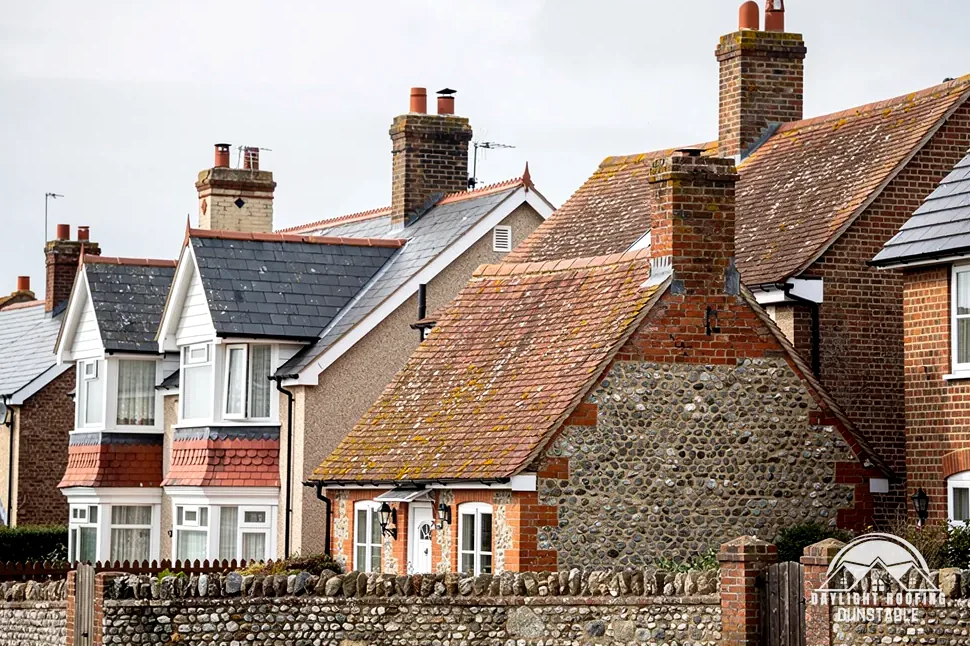
A flint and brick cottage with a weathered clay tile roof

Words from the Old Stratford listings

Grade II*
A listing grade above plain Grade II, kept for buildings of particular importance.
List entry
The number the National Heritage List gives each protected building.
Scheduled monument
A protected archaeological site where nothing happens without authorisation from above.
Flashing
Sheet metal laid over the seam where a slope abuts a wall or stack.

The plain-as-day roof check

Four checks for a roof near a listed tower

4 checks about 3 minutes to read

  1. Where a listing reaches the roof
  2. Lead at wall and chimney joints
  3. The gutter run and its fall
  4. Scaffold and the pavement

01 Where a listing reaches the roof

Three entries just over the river, on Stony Stratford's High Street and at its old church tower, are Grade II*, and a listing changes the question a roof job has to answer. Listed building consent is wanted for work done "in any manner which would affect its character as a building of special architectural or historic interest", and a different covering, a new ridge or an altered chimney can each do that.

Grade and entry number record how a building is listed, and neither says whether one repair needs consent: that is for Milton Keynes City Council on the Stony Stratford side and for West Northamptonshire Council in Old Stratford, at a listed house such as 2, Towcester Road, so ask with the address in hand and describe the work in plain terms. Slipped tiles on an unlisted cottage are a different conversation from a re-cover on a Grade II* frontage, and the council can tell the two apart in a single call. Keep a written note of what it says, with the date, because a later owner or an insurer may ask for it.

02 Lead at wall and chimney joints

Wherever a slope runs into a wall, a stack or a parapet, rolled lead carries rain over the join. MyJobQuote says lead flashing that is correctly installed can last for over 80 years, and the word that matters in that line is correctly: dressing, laps and fixings decide the outcome, and the metal alone does not.

Rolled lead sheet is made to BS EN 12588 in codes 3 to 8, and code 4 comes out at 1.80 mm. Which code suits a given joint is a matter for the specification, so the survey reads the actual lengths and folds rather than naming one thickness in advance. A lifted edge or a split at a fold can be spotted from the lawn with binoculars. A photo sent to WhatsApp on 07880 284133 makes a fair first look, ahead of the roof survey that gives the full picture.

03 The gutter run and its fall

Rainwater leaves a gutter only if the channel slopes towards the outlet. Brett Martin gives a fall of 1 mm for every 600 mm, so a six metre length drops about 10 mm along its run, a gradient so small that one sagging bracket can wipe it out and leave a pool of standing water behind the lip.

Watch the gutters in a downpour. Water spilling over the front between brackets points to a lost fall or a blocked channel, while a dark streak running down the brickwork beneath a joint points to a seam that has opened. Because gutters, fascias and eaves boards sit together along the eaves, the survey reads them as one stretch of the building, and a rotten board behind a gutter changes the repair.

04 Scaffold and the pavement

Scaffolding that overhangs a footway or the road itself falls under section 169 of the Highways Act 1980, and permission comes from the council that maintains the road. In Old Stratford that is West Northamptonshire Council, whose own page says a member of the public cannot apply and the scaffolding company applies instead. We arrange the licence with our scaffolder, so no form lands on a householder's desk.

What helps the survey is a note of where cars stand and where the front gate swings, because the position of the scaffold shapes the application. Any scaffold a job needs is part of the single written total for it. On a narrow frontage, a short conversation about parking before the survey saves a second visit, and it gives the neighbours time to plan around the poles. Ask the survey visit to look at the kerb as well as the roof.

The dashed ring takes in the nearest towns and villages we cover around Old Stratford. Map tiles © Esri; map data © OpenStreetMap contributors.

Old Stratford roof questions, High Street to canal

01A brown ring has spread on an Old Stratford ceiling after rain. What does it point to?

Where the ring sits against the roof above is the clue. Directly under a chimney stack, suspect the flashing. Close to an external wall, look at the gutter and the eaves boards. Out in the middle of the room, the covering or the underlay is the likelier cause. Snap the ring and the slope above it from the garden, then send both on WhatsApp to 07880 284133. The survey then goes up to settle the cause, and anything else noticed on the way is set out in plain words ahead of the written price. Dry the room meanwhile with a bucket and towels rather than guesswork.

02Does a listing on the High Street change a re-roof for a listed house?

It can. A listed building needs listed building consent for work that touches its character, and 92 and 94, High Street (entry 1159586) and 75, High Street (entry 1125378), both on the Stony Stratford side of the river, are Grade II*. Whether a given repair affects character is for Milton Keynes City Council to say there, and for West Northamptonshire Council at a listed Old Stratford house such as 2, Towcester Road. A small like-for-like patch and a complete change of covering are different questions, so give the council the address and the scope of the work before anything starts. Expect the answer to depend on the detail, and keep the reply in writing for the file.

03Which conservation areas lie in and around Old Stratford?

The village has the Old Stratford Conservation Area. In the area round it are the Grand Union Canal Conservation Area, which West Northamptonshire Council also designated, and the Stony Stratford Conservation Area across the river, designated by Milton Keynes City Council. Whether a given Old Stratford house falls inside one is for West Northamptonshire Council to say. The answer decides whether extra planning questions apply, and it is far quicker to settle that before a quote than afterwards, once a scope has already been agreed with a neighbour or a landlord. A postcode is enough for the council to answer.

04Do the houses in multiple occupation directions near the village touch a roof?

The two directions about houses in multiple occupation, one non-immediate and one immediate, belong to Milton Keynes City Council and apply within its area across the river; each removes the right to change a house into an HMO, not a roof right. An Article 4 direction can remove further permitted development rights, so we check with the council first. Check with West Northamptonshire Council whether an Article 4 direction applies to your address, and name the street, because a direction covers a defined area and a house on the next road may sit outside it. If the answer is yes, the council says what it removes.

05Who applies for the licence when scaffold stands on an Old Stratford street?

As highway authority, West Northamptonshire Council licenses the scaffolding company and not a householder. We arrange the licence with our scaffolder whenever a job needs one. Scaffold placed wholly on private land, clear of the pavement, does not raise the same question, and the survey looks at the front of the house to judge which case applies. The licence is a Highways Act 1980 section 169 matter, settled before any poles go up, so a neighbour is not surprised by a hoarding on the kerb.

06Which council team checks a new roof on an Old Stratford house?

West Northamptonshire Council runs its own building control service. Under the Planning Portal's guide, work that goes past either limit, such as a full re-roof, needs Building Regulations approval, and so does a covering that is 15 per cent or more heavier than the old one. For the heavier case the Planning Portal advises speaking first to a structural engineer or a surveyor. We check the route with the council before work starts, so the approval question is answered early and the date of the job is not held up later.

07Could the scheduled remains by St Mary Magdalen hold up a roof job in the village?

The remains of the church and churchyard of St Mary Magdalen are a scheduled monument, entry 1021371, near Old Stratford. Anything done to a scheduled monument needs authorisation first: the Secretary of State grants the consent, and requests go to Historic England. That concerns the monument itself, which lies over the river in Stony Stratford. An Old Stratford house roof is not part of that consent, and a question about a particular address in the village goes to West Northamptonshire Council. The listed tower nearby, entry 1310932, is a separate entry again.

08What do roof surveys cost, and when does the quote follow?

On a page dated 12 October 2026, MyJobQuote puts a roof survey at around £300 on average. That is a UK figure from a third party and not our own price. Our written quote is one total, given after the survey of the roof. Ask for the survey first and treat the price as the result of it, not as a number to compare in advance with a stranger's estimate. If the survey finds a second fault, the owner is told about it plainly at the same time.

09If a storm lifts tiles, how will my insurer weigh the damage?

The Financial Ombudsman Service says it will usually look at expert reports and photos, so photograph the damage before anything is moved. In its words, "Rain, hail or snowfall by itself can constitute a storm." Tell your insurer, and keep any tiles or pieces that came down. Flood questions run separately: GOV.UK's long-term flood risk service describes an area and cannot tell you whether one particular house will flood, so it is a different check from the roof, and a roof survey will not settle it. Keep receipts for any emergency cover, and for the clearance of debris from the gutters.

Get a written price for your roof

10-year workmanship guarantee, in writing

Tell us about your roof

Call WhatsApp Written quote