
Call 01582 935272

Hanslope · 23 road miles north-west

Roofers in Hanslope

Hanslope sits north-west of Dunstable, 23.1 road miles by road, and any Hanslope roof gets a single written total, given when the survey is finished.

Get a written quote

Call 01582 935272WhatsApp us

Council
Milton Keynes City
Road miles
23
Conservation area
Hanslope Conservation Area
Building control
Milton Keynes Council

Roofs along Gold Street and beside St James the Great

Hanslope is a Buckinghamshire village within the Milton Keynes City Council area, 23.1 road miles north-west of Dunstable, a journey of about 37 minutes by road. At the 2021 Census, Hanslope parish had 2,722 usual residents. For a roof in the village, Milton Keynes City Council is the local planning authority, and the Hanslope conservation area was first designated by that council on 31 October 1979. The council's conservation page reads "Milton Keynes has 27 conservation areas", a count taken across the whole council area. Below, each listed building appears with its grade and its National Heritage List entry.

Milton Keynes City Council has a direction on houses in multiple occupation that runs borough-wide; it applies to a change of use, not to a roof. For anything else at a Hanslope address, check with Milton Keynes City Council whether an Article 4 direction applies. The planning guide sets out the roof rules that apply nationally, and the lead roofing and leadwork page covers sheet-metal work, which suits small roofs and awkward details on older buildings.

  1. 01St James the GreatThe church is listed Grade I, National Heritage List entry 1289671, first listed on 17 November 1966, a Church of England church.
  2. 0231, Gold StreetListed Grade II, entry 1212122, first listed on 27 February 1984; 33/35, Gold Street is Grade II, entry 1115921.
  3. 03Horseshoe Cottage, Earl RowHorseshoe Cottage and Number 7 Earl Row are listed together at Grade II, entry 1212133.
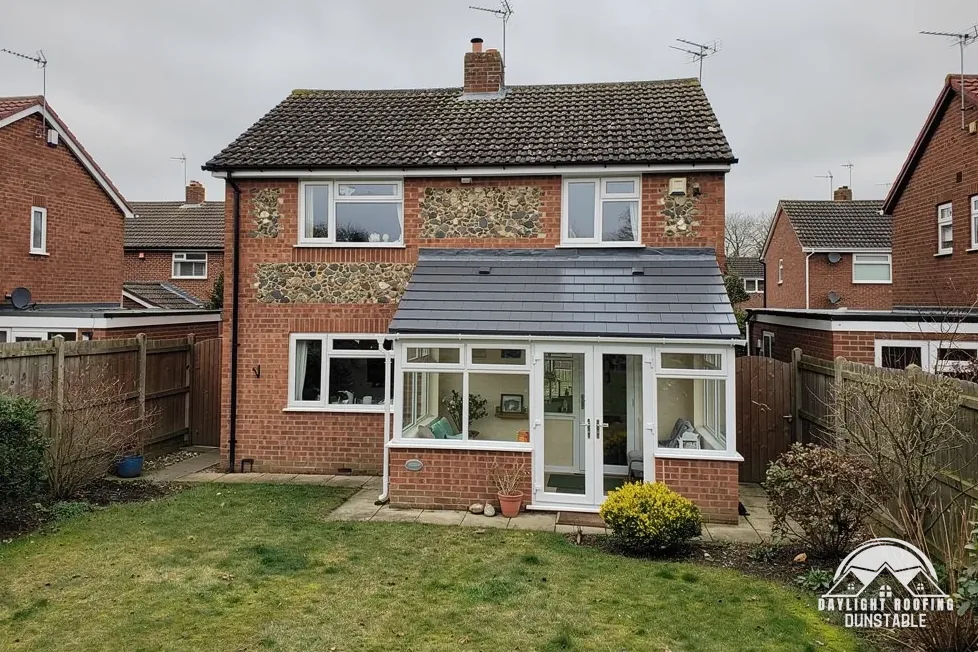
A brick house with a tiled roof and a conservatory at the back

Roofing terms, Hanslope style

Single-ply
A flat-roof membrane made as one sheet, such as EPDM or TPO.
Welt
A folded seam joining two sheets of lead or zinc.
Roost
The resting place of a bat, protected by law even when empty.
Dry verge
A gable edge finished with fixings and caps instead of mortar.

The plain-as-day roof check

Sheet metal, membranes, nests and edges: four Hanslope roof topics

4 checks about 3 minutes to read

  1. Lead and zinc on small roofs
  2. Membrane flat roofs
  3. Nests and bats under the eaves
  4. Dry verges at the gable

01 Lead and zinc on small roofs

Lead and zinc roll out in sheets and are folded into welts, so a small roof, a bay top or a dormer cheek can be covered in a single piece of metal with few joints. Look at the seams for splits, at the edges for lifting, and at any run where the sheet has crept down the slope and left a ripple. Zinc and lead both move as they warm and cool, which is why long runs are broken by joints that allow for it. A patch of white powder on lead is its oxide, and a close look at the metal beneath tells you whether it has thinned.

VMZinc says a zinc roof "can last in excess of 100 years" when correctly designed and installed. BS EN 12588 sets lead sheet in codes 3 to 8, with code 4 at 1.80 mm, and each detail's code comes from the specification. HomeBuilding gives lead roofs 60-100 years and Less says 50 to 100, and the two sources are not combined into one. Work like this is described on the lead roofing and leadwork page.

02 Membrane flat roofs

Single-ply means a membrane such as EPDM or TPO. Single-ply membranes do not include GRP or built-up felt, which are other flat-roof coverings. Look from an upstairs window at a Hanslope extension roof for pooled water that stays a day after rain, wrinkles at the edges, and patches where the surface has blistered or gone brittle. The low edge needs a working outlet or gutter, and a blocked one shows as a pond beside it. A flat roof that rises to meet a wall also needs its upstand and flashing checked, since the wall edge is where movement shows.

BS 6229:2025 is current for flat roofs with continuously supported flexible waterproof coverings, and it does not cover lead. HomeBuilding gives felt 10-15 years, EPDM 25-30 and GRP 25-30. Less says torch-on felt lasts "10 to 20 years depending on quality and installation", EPDM "typically lasts 30 to 50 years" and GRP "25 to 40 years". Where the two sources overlap they still differ, and each figure carries its source. The flat roofing page explains the options.

03 Nests and bats under the eaves

Before anyone works at the eaves, look for droppings on a wall below a gap, a tidy cup of mud under a soffit or a bird going in and out of the same spot. A bat that has used a roof for years may leave little sign. The law protects both, and the protections are different.

Wild birds come under the Wildlife and Countryside Act 1981, which bites when someone intentionally "takes, damages or destroys the nest of any wild bird while that nest is in use or being built". For bats the rule is regulation 43(1)(d) of the Habitats Regulations 2017: damage or destruction of "a breeding site or resting place of such an animal" is an offence, with no intent word attached. Leave any droppings undisturbed and note where they lie. GOV.UK's bat guidance lists "repairing or replacing a roof" as an activity that can need a Natural England licence, so a Hanslope roof with a bat roost is a pause-and-ask job. Anyone who spots either should hold off on soffit work near the spot.

04 Dry verges at the gable

The verge is where a Hanslope roof stops at a gable wall. A dry verge system fixes the edge tiles and a cap with clips and screws instead of a mortar bed. From the road, look for edge tiles that have come out of line, mortar that has dropped to the ground, and a gap between the verge and the wall plate. At a gable that carries an aerial bracket or a satellite dish, the fixings through the edge tiles deserve a look as well.

MyJobQuote says a dry verge installation "usually falls between £500 and £2,000", on a page dated 8 October 2026. BS 8612:2018 is the British Standard behind clip-and-screw edge systems of this sort. Whether a Hanslope gable suits a dry verge, or is better repaired in mortar, depends on the wall below it and on how the existing edge was built, and the survey looks at both before the written total is set.

The dashed ring takes in the nearest towns and villages we cover around Hanslope. Map tiles © Esri; map data © OpenStreetMap contributors.

Hanslope roof questions, answered without padding

01What should be checked on a Hanslope roof that has been patched more than once?

Repeated patches suggest the cause was never found, and each new patch adds a seam or a join where water can get past. On a Hanslope roof with a history of patching, the survey looks for where the water got in: a flashing, a slipped tile, a lifted edge or a split in the underlay. A run of small repairs in one area can point to a covering that is worn out as a whole, and a different area may be a one-off. Photographs of past work help, and a picture sent to WhatsApp on 07880 284133 gives us a first look. Whatever else the visit turns up comes with it, in plain terms.

02Does the Hanslope conservation area change roof work?

Milton Keynes City Council designated the Hanslope conservation area, and a house within it may sit under extra planning rules, which a house outside does not. Which houses fall within the boundary is for the council to confirm. The borough's HMO direction concerns a change of use and has no bearing on a roof, but an Article 4 direction can remove further permitted development rights, so we check with the council first, ahead of choosing a covering, and a call to the council's planning team is the way to do it.

03Whose permission does the roof of St James the Great church need?

St James the Great is listed Grade I (list entry 1289671) and is a Church of England church. As a building still used for worship, it is subject to "the faculty jurisdiction of the Church of England", and the faculty system takes the place of listed building consent. Straight replacement of the roof covering can fall within the archdeacon's written notice, short of a full faculty. Where external work is involved, planning permission may also come into it, under the ordinary tests. Listed cottages nearby, such as those on Gold Street, follow listed building consent instead.

04Are Gold Street and Earl Row buildings treated like ordinary houses for roof work?

No. 31, Gold Street (entry 1212122), 33/35, Gold Street (entry 1115921) and Horseshoe Cottage with Number 7 Earl Row (entry 1212133) are each listed Grade II. Where work is done "in any manner which would affect its character as a building of special architectural or historic interest", listed building consent is the route. A change of covering can do that, so the council is the first call, ahead of any pricing, and a note of what the covering is made of helps when asking. Houses next door that are not listed are judged on the ordinary planning and Building Regulations rules.

05When does re-covering a Hanslope roof come under Building Regulations?

Under the Planning Portal's wording, no application is "normally" needed where "Less than 25 per cent of the total 'building envelope'" and "Less than 50 per cent of the roof" are affected. Taking off and renewing the covering of an entire Hanslope roof exceeds the second figure, so approval is needed. Milton Keynes City Council's own building control team answers on 01908 252721 in office hours and on 01908 226699 out of hours, and 01908 691691 is the council's main line.

06Who licenses scaffolding on a Hanslope street, and at what charge?

A Highways Act 1980 section 169 licence covers scaffolding that obstructs the highway, and the highway authority for Hanslope is Milton Keynes City Council. Milton Keynes City Council lists scaffolding up to 1 month at £189, excluding VAT, with complex scaffolding at £694. We arrange the licence with our scaffolder, and the scaffold for a Hanslope job comes inside the written quote. Where a house stands back from the road behind a front garden, the access the survey looks at may allow scaffolding wholly on private land.

07What do the guides say about taking out a Hanslope chimney breast?

MyJobQuote's page of 3 November 2026 puts the average cost of taking a chimney breast out at around £2,500, and around £3,000 to £3,500 for the whole stack with its breast. Those come from a third-party guide and are not a price for a Hanslope house. The Planning Portal says Building Regulations approval "will always apply when removing chimney breasts as they are part of the building's structure", and a breast on a party wall adds a party wall notice, which the building owner serves.

08What call-out cost does a published guide give for an emergency roof leak?

MyJobQuote's emergency page, dated 22 October 2026, says "Emergency roofer call-out costs typically range from £150 to £300, while extensive storm damage repairs can cost £1,200 or more." Those are the guide's figures for the UK, not ours, and any repair that follows is a separate matter for the survey to scope. For a Hanslope leak, the written total for the repair arrives after the roof is surveyed, and an insurer is better served by photographs shot before anything gets moved, indoors and out, so take them as soon as it is safe to do so.

09Can spray foam under a Hanslope roof cause problems when the house is sold or re-mortgaged?

Possibly, and the position is easy to misstate. RICS reported "concern within specific sectors of the lending market, such as equity release mortgages", in March 2023. Government guidance published on 22 October 2026 says "Many mortgage providers are open to lending on properties with spray foam, subject to their own requirements." The Energy Saving Trust says foam "doesn't automatically prevent you from getting a mortgage, but some lenders may ask for extra checks". A specialist surveyor and the lender are the people to ask before removal.

Get a written price for your roof

10-year workmanship guarantee, in writing

Tell us about your roof

Call WhatsApp Written quote