
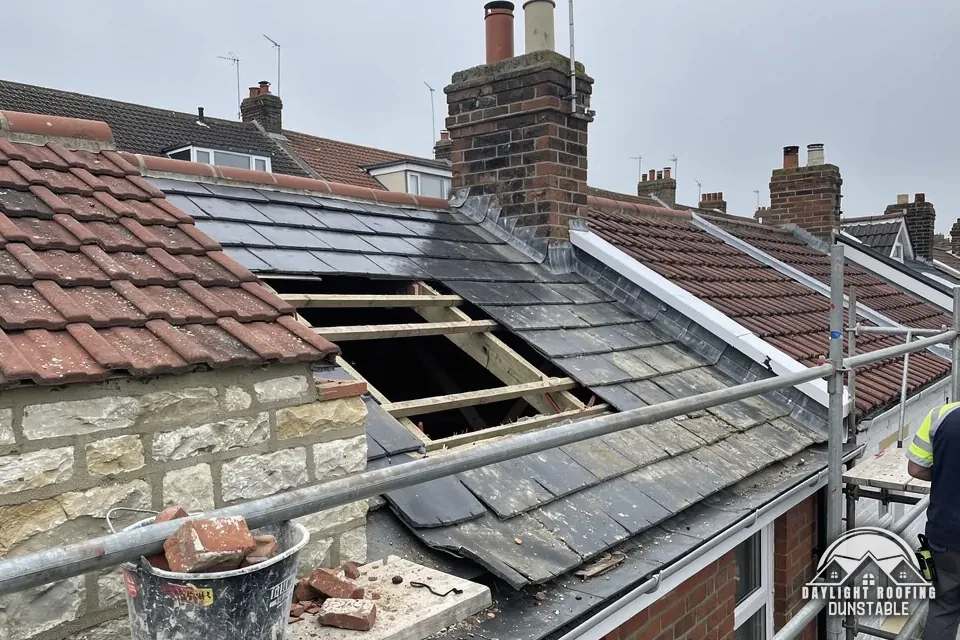
The law behind a scaffold licence
The rule sits in section 169 of the Highways Act 1980. No person may "erect or retain on or over a highway any scaffolding or other structure which obstructs the highway" without a licence. What is needed is a scaffold licence under that section, issued by the highway authority for the road in question. The licence is for the structure standing on or over the highway, which is a different matter from the roof work it serves.
Highway authority is a legal role, and it does not follow the line between a council's housing and planning duties. In Bedfordshire, Luton, Bedford Borough, Milton Keynes and Buckinghamshire the unitary council is the highway authority for its own roads. In Hertfordshire the county council holds that role, even though a district or borough council handles planning there. Broxbourne addresses apply to Broxbourne Borough Council. Trunk roads, which include the M1, sections of the A5 and the A1(M), belong to National Highways, not to the council.
| Authority | Fee as published | Period |
|---|---|---|
| Luton Council | £205 plus a £550 deposit | Up to 28 days |
| Bedford Borough Council | £178.25 | Per month or part |
| Milton Keynes City Council | £189 excluding VAT | Up to 1 month |
| Buckinghamshire Council | £402.78 | 28 days |
| Hertfordshire County Council | £134, then £59 a week | 14 days |
Each row above belongs to one council and to the roads that council looks after. For a house in Dunstable, the council that holds the highway role there is the first to ask.
Central Bedfordshire: the authority for Dunstable's roads
For Dunstable, Houghton Regis, Leighton Buzzard, Ampthill, Flitwick and Biggleswade, among other places in its area, the highway authority is Central Bedfordshire Council. Scaffold over their pavements and carriageways is licensed by that council. The fee and period are the council's to set, so the current terms come from Central Bedfordshire Council itself.
A roofer's part in this is straightforward. If the scaffold has to stand on the public footway or in the road, we arrange the licence with our scaffolder. The homeowner need not track down the right department or complete the form. What the homeowner does need to know is that scaffold on the street may need a licence at all, because a quote that leaves the question out can leave a household waiting for a permission to arrive.
A scaffold inside the property boundary, away from the public highway, raises a separate question for the owner, since the licence rule is about structures on or over a highway. Where the line falls on a particular property depends on where the boundary and the footway sit, and the council's highways team can confirm it. For a Dunstable roof, the survey establishes how the roof is reached, which tells you whether the street comes into it.
Luton: fee, deposit and notice
Luton Council's page says each licence costs £205 (VAT exempt) and is valid for up to 28 days. A deposit of £550 is also payable, refundable "upon written application and when work is completed and there has been a satisfactory inspection". The council asks for a minimum of 10 working days to process an application, so a Luton job needs the licence applied for well ahead of the date the scaffold goes up, with the date of the survey and the likely start of the roof work kept in mind.
On who applies, Luton Council is direct: "for scaffolding the licence is issued to the scaffolding company". The council also sets an insurance condition, "a minimum cover of £10 million", and provides an extension form for a job that runs on past the licence period. Renewals and extensions exist, so the end of a licence period is not an automatic stop for a job in progress.
Luton Council states that no licence is needed where the scaffold "is on your private property and does not encroach onto the public highway". That sentence is Luton's own, and it is Luton's rule for Luton addresses. The same question for any other authority goes to that authority. For a roof in Luton, we arrange it with our scaffolder.
Luton's published terms
- £205, VAT exempt
- Up to 28 days
- £550 refundable deposit
- 10 working days minimum
- Issued to the scaffolding company
Bedford Borough and Milton Keynes
Bedford Borough Council's licences page says the charge for 2026 is £178.25 per month or part thereof. On who holds the licence, Bedford Borough Council's application form says it "will normally only be issued to the Company responsible for actually erecting the scaffolding", which is Bedford Borough's rule for Bedford Borough streets. The council's application form asks for 10 working days to process the licence, sets an insurance minimum of £5 million, asks for a 1.2 m unobstructed footway, and calls for a site meeting if the scaffold stands closer than 450 mm to the carriageway edge.
Milton Keynes City Council lists a standard scaffolding licence of up to one month at £189, and notes that every fee is quoted excluding VAT, and a complex scaffolding licence at £694. Its licences page puts the responsibility plainly: "It is your responsibility to apply for the correct licence." A penalty fee is listed too for work carried out without one.
Those are two separate councils with two separate sets of published terms, and each belongs only to its own roads. For a roof in either area, we arrange the licence with our scaffolder. Nobody should read one council's period or deposit into the other's, because nothing in either council's wording links the two.
Buckinghamshire: registered scaffolding companies
Buckinghamshire Council says: "You can apply online to purchase a scaffolding licence, it costs £402.78", and that licences are valid for 28 days. Buckinghamshire Council's renewal fee is £69.09, and its retrospective licence, which is one applied for after the scaffold has gone up, costs £777.63. Those three figures are the council's own, and they belong to Buckinghamshire roads only.
On who may apply, Buckinghamshire Council says "You must be a registered scaffolding company to apply for a licence." Its conditions for the scaffolding company include an insurance requirement, a scaffolding industry training card or equivalent, and street works accreditation. Those are the council's conditions for the scaffolding company.
For Buckinghamshire addresses the licence is therefore a matter between Buckinghamshire Council and the registered scaffolding firm. We arrange the licence with our scaffolder, and a homeowner's job is to agree the quote. The retrospective figure is worth noting as a warning: a scaffold put up without a licence is the costly way to do it, and the council's published figure shows by how much.
Buckinghamshire's building control and planning services are separate from its highways service, so a roof job there can involve three different departments. The scaffold licence is the one that depends on the road outside the house, and it sits with the highways side of the council.
Hertfordshire: the county council issues the licence
Hertfordshire's roads are the county council's responsibility as highway authority, and district and borough councils do not issue scaffold licences. Hertfordshire County Council says: "It costs £134 for a 14 day licence. It's £59 for every week after." On timing, it states "It usually takes 3 weeks to process an application." Renewals have a deadline of their own, set out below.
Hertfordshire County Council sets further conditions. A fine of up to £5,000 is possible for anyone who does not get a licence. Its licence conditions set public liability insurance of "at least ten million pounds". "A 1.2m clear walkway must be maintained at all times on the footway." A renewal application goes in "no later than five working days before the expiry". For Broxbourne, the council says to go to Broxbourne Borough Council.
For Hertfordshire jobs, we arrange the licence with our scaffolder. Given the stated timing, the licence is a step to start before the roof work is booked into a diary, because the usual three weeks is a long time to wait with a scaffold already ordered.
Anyone with a Hertfordshire address should check the current fee and timing with the county council, since both can change.
You might hear
A Hertfordshire district council issues the scaffold licence.
Plain as day
The county council is the highway authority and issues it; Broxbourne is the exception.
What a licence means on a roofing job
Pulling this together for a homeowner, the point is simple. When a roof job puts scaffold on the footway or over the carriageway, the authority responsible for that road issues the licence, and each authority's fee, period and notice are its own. Scaffold forms part of the written quote for a job that calls for it. We arrange the licence with our scaffolder. The fees and rules above are each authority's own, and the survey comes first, with the price for the job set out in the written quote after it.
Insurance figures on these authorities' pages are the councils' own conditions for the scaffolding company. The same goes for the fees: each is published by its authority and set out here with the authority named, so the current amount can be checked before anyone relies on it.
For more on how a roofer is chosen, see choosing a roofer. The planning side of roof work is on planning permission for roof work, and the Building Regulations side is on building regulations for roof work. The homepage lists the roofing we do across Dunstable and the counties around it, and a photo sent to WhatsApp on 07880 284133 gets looked at.
One written total
What sets the price
The scaffold's size and height, the route it takes and how the roof is accessed decide what the job needs. One written total follows the survey.