
The short answer
Possibly, but only with care. GOV.UK describes every bat species, with its roosts, as fully protected, and harming a roost is an offence whatever the intent. Because "repairing or replacing a roof" can need a Natural England licence, stop and take advice before work that could reach a roost.
What protects a bat roost
GOV.UK's bat guidance opens with the sentence "All bat species, their breeding sites and resting places are fully protected by law". Protection does not depend on how rare a species is, so a roost in an ordinary house roof stands on the same footing as one in a church tower.
Two pieces of law sit behind that sentence, and they differ in the state of mind they ask for. Regulation 43(1)(d) of the 2017 habitats regulations makes it an offence where a person "damages or destroys a breeding site or resting place of such an animal". The rule has no word about intent, so a person who harms a roost by accident is still inside it.
Section 9(4) of the Wildlife and Countryside Act 1981 adds a second offence, where a person "intentionally or recklessly" disturbs a bat in its place of shelter or obstructs access to it. Blocking the gap a bat uses to come and go can therefore be a problem even if no bat is hurt.
Put the two together and intent does not rescue anyone from the roost rule, while carelessness can be enough for the obstruction rule. Roofers and owners alike should treat any sign of bats as a reason to pause, and should do so before work begins and not partway through the job.
Where roof work meets a roost
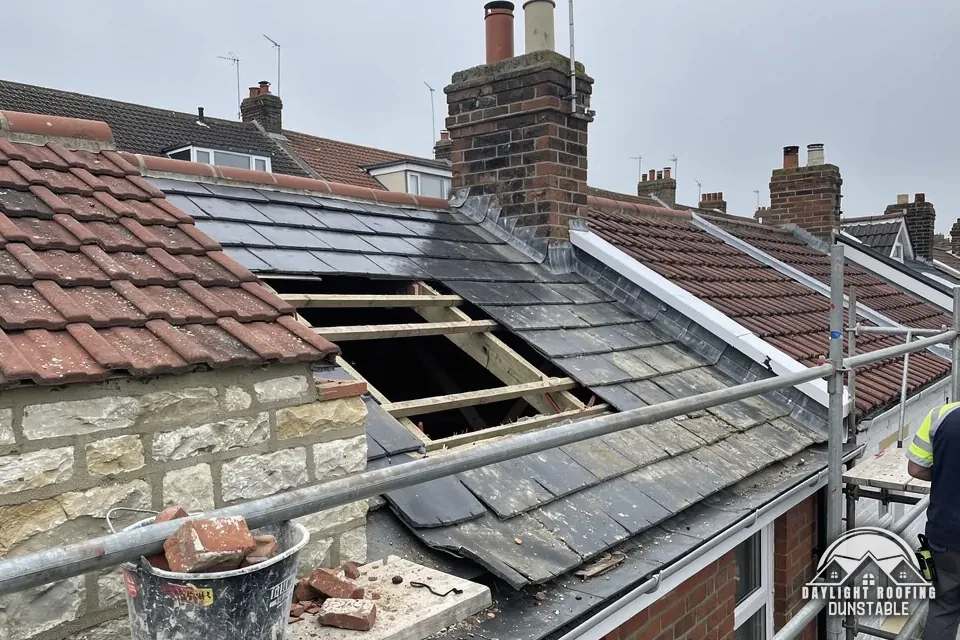
GOV.UK's bat guidance lists "repairing or replacing a roof" among the jobs that may call for a Natural England licence. The wording reaches everyday jobs on a house, from a full re-cover to a few days refixing tiles on one slope. A licence is the permission that lets work go ahead where a roost could be affected.
Work that touches the places bats can use needs the closest thought, and the table sets out a few of them.
| Roof part | Why it matters |
|---|---|
| Tiles, slates | Gaps beneath can shelter a roost |
| Ridge, hip | Lifting them opens the space under |
| Fascia, soffit | Closing the gap can block access |
GOV.UK covers protection, surveys and licences on the same pages, so the question for an owner is not only whether bats are present but what the planned work would do to the place they use. A roofer can describe the job in detail, and the licence route follows from that description, not from a guess made on the doorstep. Where the plan changes, the answer can change with it, so a revised scope of work is worth running past the guidance again before the start date is fixed.
If you suspect bats in the roof
Droppings under the ridge, a bat seen entering at dusk or rustling in the roof space at night are reasons to stop and ask. Do not seal any gap, and keep work away from that part of the roof until advice has been taken. If work has already started, tell the roofer at once and leave the area alone, and keep a note of what you saw and where, since that helps whoever gives advice next.
Begin with the GOV.UK pages on bats, protection, surveys and licences, which set out what the law asks and where a licence comes in. Natural England issues the licences, so its guidance carries more weight than a neighbour's account of what happened to them. A step taken without a licence, where one was needed, cannot be taken back afterwards.
A pause has a price, and a leak does not wait politely. Ask whoever is quoting what temporary protection is possible and what a delay means for the rest of the roof. Our roof maintenance checklist helps you inspect the roof from the ground, the guide to choosing a roofer covers the questions to put, and the Daylight Roofing home page lists the work we do.