
The short answer
It depends on your policy and the cause of the leak. Storm damage can be covered, an insurer that relies on a wear and tear exclusion has to prove it, and the Financial Ombudsman Service says it will "usually look at expert reports and photos". Photograph the damage before anything is touched, then tell the insurer.
Your policy wording decides it
Two homes with the same stain on the ceiling can get different answers, because each policy lists its own covered causes and its own exclusions. Storm damage is one heading in a policy. A slow leak from a tired covering can fall under another, where wear and tear is left out. Read the sections on storms, on water damage and on exclusions, in that order.
For storms, the Financial Ombudsman Service applies this test: "a storm usually involves violent winds, usually with rain, hail or snow". It adds that "Rain, hail or snowfall by itself can constitute a storm." A storm in the claims sense can therefore be a heavy fall of rain without a gale, though the Ombudsman weighs each complaint on its facts.
Exclusions sit differently. If your insurer turns down a claim on the grounds of wear and tear, the Ombudsman says: "The insurer has to prove that the exclusion applies - for example, with an inspection report." Calling a roof old is not proof. The insurer needs evidence, and you can ask to see it.
No one can predict what a given insurer will do. Cover is settled between you and the policy, and a roofer's view carries no weight on it. The guide to roof damage and home insurance goes into the topic at more length.
What to do at the first leak
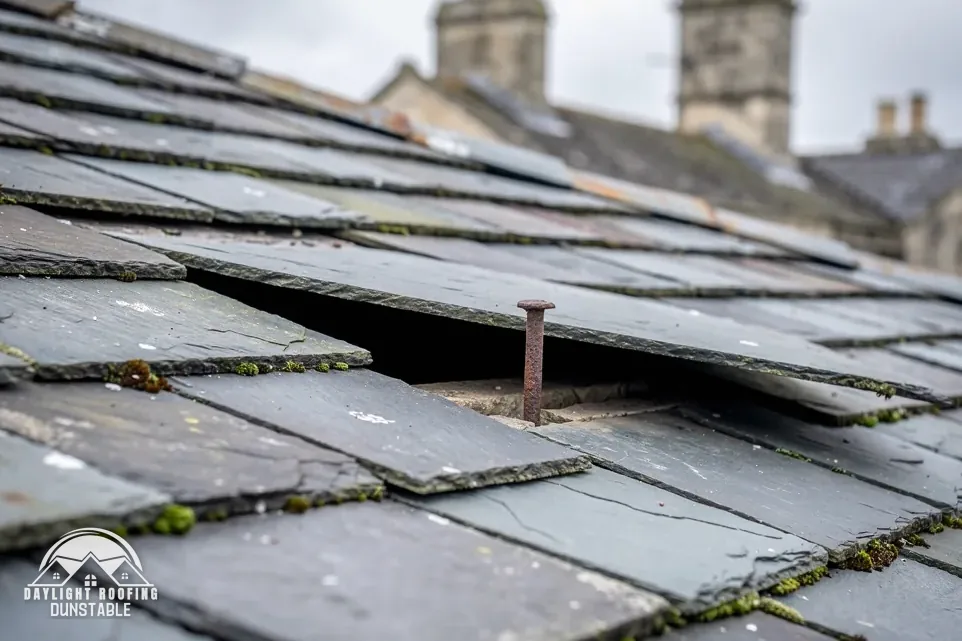
Record the damage while it is still as it was. The Ombudsman says it will "usually look at expert reports and photos", which is a reminder that pictures count, so dated pictures of the stain, the drips, the buckets and the roof seen from the ground belong in your file. Take them before a bucket is emptied or a ceiling cleared, with one wide shot and one close shot of each spot.
Tell your insurer soon after, and write down the day and the name of whoever took the call. Then stop the harm spreading: move furniture, cover floors and keep water away from sockets. A temporary measure to keep rain out is a separate thing from a full repair, so ask the insurer which of the two it wants to see first.
| Step | Why |
|---|---|
| Photograph the damage | Evidence before anything moves |
| Tell the insurer | Starts the claim record |
| Limit further harm | Stops the damage spreading |
Make your own note of what any roofer who attends found and where. That note supports your case, but the insurer decides what it accepts, and the decision rests with it.
If a refusal comes back
Take the complaint to the insurer first, in writing, quoting the policy section and the evidence you hold. The Ombudsman's guidance reads: "For most complaints, a business has up to 8 weeks to consider a complaint". Beyond that, or after a final response you disagree with, you can refer the matter to the Financial Ombudsman Service on 0800 023 4567.
The Ombudsman's own deadline is a separate clock. It allows 6 months from the date on the final response, so file that letter safely and note its date when it lands. The 8 weeks and the 6 months are not one period split in two, and the second begins at the final response, which may be long after water first came in.
A roof that has leaked is also a roof that needs a price, and that can be sorted alongside the claim. Ask a roofer for a single written figure when the survey is complete, and set it beside any offer the insurer makes. The roofing costs explainer shows what moves a price, the roof maintenance checklist helps you catch problems sooner, and the Daylight Roofing home page lists our services.