
Call 01582 935272

Cotton End · 20 road miles north

Roofers in Cotton End

Chimney, leadwork and re-roofing jobs in Cotton End, with the roof surveyed first and a written price after it; the village is 19.8 road miles from Dunstable.

Get a written quote

Call 01582 935272WhatsApp us

Council
Bedford Borough
Road miles
20
Building control
Bedford Borough Council

Chimneys, listed farmhouses and a village pub

From Dunstable the road to Cotton End is 19.8 miles and takes about 34 minutes heading north, and at the 2021 Census the Cotton End parish had 829 usual residents. Whatever the building, from a house to the listed Manor Farmhouse or the Bell Public House, we survey its roof before a price is written. Chimney work is the thread through much of what follows, and the chimney repairs page sets out the jobs in detail.

Cotton End falls under Bedford Borough Council for planning, building control and scaffold licences, and we arrange the licence with our scaffolder. The Cardington conservation area is close to Cotton End, and for a given address the council is the place to check. An Article 4 direction can remove further permitted development rights, so we check with the council first. Larger buildings such as the pub are covered on the commercial roofing page, and the planning guide explains the permission tests for a house.

  1. 01Chimney stacksBrickwork, pointing, pots, the mortar collar and the leadwork at the base are surveyed together as one structure, not as four separate fixes.
  2. 02Listed housesManor Farmhouse is Grade II*, and the Bell Public House and 8 and 10 Bell Lane are Grade II; listed building consent covers work affecting their character.
  3. 03Pub and farm roofsA larger building needs its covering, rainwater goods and any sheeting looked at on their own terms, and its price comes after the survey.
  4. 04Shared stacksA chimney breast on a party wall brings the neighbour into the work, and the notice has to be served in good time.
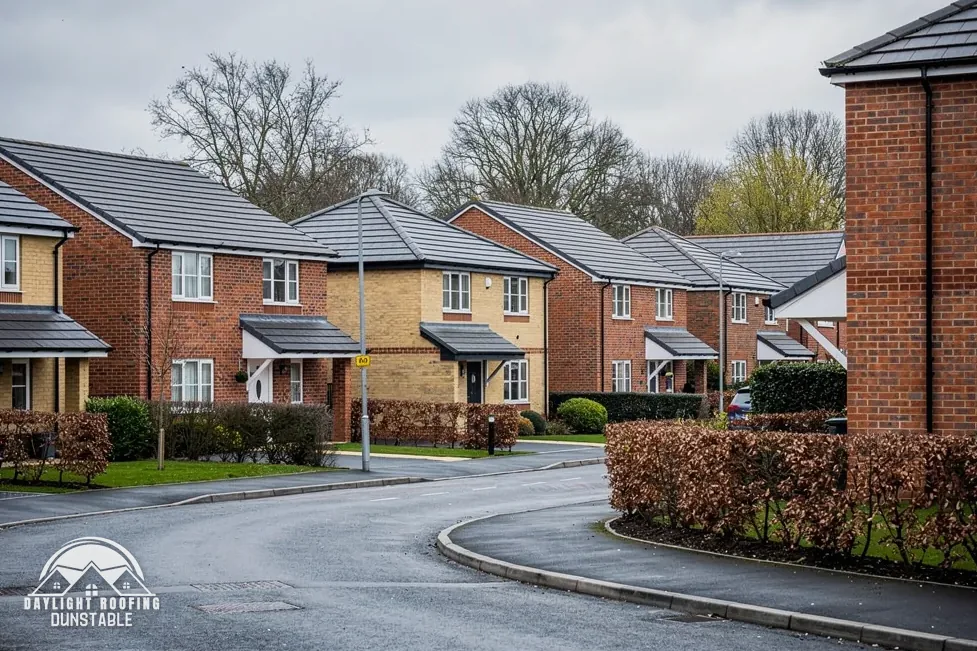
Modern brick houses with grey tiled roofs on a curving estate road

The roof, in plain words

Chimney breast
The section of chimney that juts out into a room.
Flaunching
Sloping mortar round the base of a pot that sheds rain off the stack top.
Party wall
A wall owned by two neighbours together, or standing on their shared boundary.
Cowl
A cover set over a pot, stopping rain and birds getting into the flue.

The plain-as-day roof check

Chimneys first: four checks for a Cotton End roof

4 checks about 3 minutes to read

  1. Stack brickwork and pointing
  2. Pots, flaunching and cowls
  3. Lead round the stack
  4. Pub, farm and outbuilding roofs

01 Stack brickwork and pointing

Look at the brickwork of the stack from the garden with binoculars if you have them. Mortar joints that are recessed, crumbling or missing let rain into the brick, and brick that stays wet can flake at its face. A stack that leans, or that shows a stair-step crack running through the bricks, is a different matter from tired pointing and needs looking at promptly. Do not climb up to check. Moss or a green skin on the north-facing brick shows where the stack stays damp longest, and a white crust on the brick face is salt carried out of wet masonry.

Repointing is sometimes the whole job and sometimes the start of a larger one. What repointing costs depends on how much of the stack needs it, how high it stands and how it is reached, so its price follows the survey, which takes in the stack and the slope round it. The survey also checks whether the stack is still in use, because a disused flue that has been capped without ventilation can hold damp air in the breast. A stack that has been rebuilt in a different brick, or has had its top courses taken down and relaid, tells you work has been done before; mention it with your survey request.

02 Pots, flaunching and cowls

Pots stand on the top of the stack on a mortar bed known as flaunching, which slopes outwards to throw rain away from the flue. When that bed cracks or breaks away, rain runs down alongside the pot and into the brickwork. From the ground a pot that sits at an angle, a dark ring of staining below it, or a gap at its base are the things to look for. A cowl or cap over the pot stops rain and birds entering the flue. Two pots that sit at different heights, or a pot with a missing piece, are worth noting down for the survey.

Where a flue is in use, sweeping and a sound stack go together, whatever the roof covering beside it is. A flue that is still in use for a fire or stove needs its own checks that a roofer cannot replace.

03 Lead round the stack

Where the stack comes through the slope, lead flashings and a back gutter turn the water around it. Signs of trouble are lead peeling away from the brickwork, a gap along the mortar joint it should sit in, or a trail of white or dark staining beneath. Damp on a chimney breast indoors, where the plaster darkens or the paint bubbles, can point back to this junction, and to the flaunching above it. A scatter of dropped mortar on the slope below the stack tells the same story from above.

"A chimney lead flashing patch repair typically costs around £200, while a full replacement averages around £570." That is MyJobQuote, last updated 22 September 2026. It also says correctly installed lead flashing "can last for over 80 years". Neither is a quote for your stack, and a patch that has failed twice is a sign the junction may need rebuilding rather than topping up with more sealant. Lead that has been smeared with bitumen or cement may hide a gap rather than seal it, and it needs lifting to see.

04 Pub, farm and outbuilding roofs

Larger buildings behave differently from houses. A long run of gutter carries a great deal of water, a wide span can hide a sag until the ceiling shows it, and an old outbuilding may carry sheeting rather than tiles. Look for gutters that overflow at the same bracket each time, valleys where two roofs of different heights meet, and any sheet that has slipped or lifted at a fixing. A sagging ridge line on a long outbuilding, or a door that no longer closes square beneath it, can mean the roof timbers have moved.

The Bell Public House is listed Grade II (National Heritage List entry 1114167, first listed 17 May 1984), so work to it needs listed building consent for anything that affects its character. A pub or barn roof gets its price only once the survey is done, because the span, the access and the covering all change the work. If sheets might be asbestos cement, HSE's advice is "If the building was built or refurbished before 2000, assume that there is asbestos in it." Rainwater goods on a large building are worth looking at in rain, from a safe place on the ground.

The dashed ring takes in the nearest towns and villages we cover around Cotton End. Map tiles © Esri; map data © OpenStreetMap contributors.

Cotton End roofs: your questions

01Why does a chimney breast in a Cotton End house show damp after rain?

Damp on a breast can come from the stack top, the flaunching round the pot, the leadwork where the stack leaves the roof, or the pointing of the brickwork. A survey looks at the whole chimney from top to base rather than treating the stain alone, and reports back with the other faults it saw on the roof. A disused flue with no ventilation can also hold damp. See the chimney repairs page for how these jobs are approached. A bucket under the stain does not answer the question, and a photo of the breast from inside plus the stack from outside helps us see the whole picture before the survey.

02Does removing a chimney breast in Cotton End need Building Regulations approval?

Yes. The Planning Portal says "Building regulations approval will always apply when removing chimney breasts as they are part of the building's structure." Bedford Borough Council runs its own building control service, so ask its team before the work is agreed. MyJobQuote (3 November 2026) says "The average cost of removing a chimney breast is around £2,500." and "the average price for removing the entire chimney stack with the breast is around £3,000 to £3,500". Your price follows a survey. The structure above the removed breast also has to be supported, which is why this is a structural job and not a tidy-up.

03What notice does a neighbour need when a Cotton End chimney sits on a party wall?

Under the Party Wall etc. Act 1996, the building owner serves notice, and for party-structure work, which includes cutting away a chimney breast, it must "be served at least two months before the date on which the proposed work will begin". A surveyor is needed only if the neighbour dissents or does not reply within 14 days. Where the neighbour dissents, the surveyor procedure applies, and it is not a veto. Party wall questions go to a party wall surveyor, not building control.

04Which Cotton End buildings hold listings, and what follows for their roofs?

Manor Farmhouse is listed Grade II* (National Heritage List entry 1114166, first listed 17 May 1984). The Bell Public House is listed Grade II (entry 1114167, same date), and so is 8 and 10, Bell Lane (entry 1136714). Listed building consent applies to work "in any manner which would affect its character as a building of special architectural or historic interest". Check with Bedford Borough Council before choosing a covering. If one of those is your house, say so up front, because listing changes the order of events.

05How is roof work on a pub or farm building in Cotton End priced?

A Cotton End pub or farm building is priced once it has been surveyed, since the size, the access, the covering and the rainwater goods all change the work, so any number given before that would be a guess. You receive that as a total in writing, once the survey is finished. If the building is listed, as the Bell Public House is, the consent route is settled first. If the roof carries sheets, the survey establishes what they are. The commercial roofing page has the detail. A pub roof also depends on what lies beneath it, such as a kitchen extract or a flat section, and the survey looks at those.

06Does the Cardington conservation area affect roofs in Cotton End?

The Cardington conservation area is close to Cotton End, and nothing more can be read from that. It does not settle the position of a particular address in Cotton End, which is a question for Bedford Borough Council. The same call can cover Article 4: a direction can remove further permitted development rights, so we check with the council first. That call is worth making before any date is set, because a council officer can say what a map cannot, including whether the house sits inside a boundary line.

07How can I tell whether a Cotton End chimney is leaning or only stained?

Compare the stack with something you know is vertical, such as a door frame in line with the house wall or the edge of the gable below it. Stains are surface marks and follow the run of the water. A lean, or a crack that steps through the bricks, is structural and needs a survey promptly. Keep everyone away from the base of the stack until it has been looked at, and send a photo to 07880 284133 if you are unsure. Do not use a ladder to check the top yourself.

08What does a ridge tile replacement cost on a Cotton End house?

Which? gives a new ridge tile "along the top of the roof" at "£80-£300", excluding VAT, from its November 2025 survey of 11 Which? Trusted Traders. MyJobQuote (1 October 2026) says the average ridge tile replacement costs between £225 and £550. Neither guide prices hips, so hips are priced after a survey. These are published guides rather than our quote, and ours is put in writing after we have looked at the roof. Where the ridge is mortared, the bed may need renewing along a run, not only at the loose tile.

09Which other villages around Cotton End do you work in?

Roofers can run into the same questions in Shortstown, Wilstead, Wixams, Haynes and Cople, and each has a page of its own giving the council for that village and whichever listed buildings stand in it. Villages large and small get the same order of events: survey, plain findings, then a total in writing. If your road is near a boundary and you are unsure which page applies, ask on WhatsApp at 07880 284133 with the postcode, and we will tell you which notes fit.

Get a written price for your roof

10-year workmanship guarantee, in writing

Tell us about your roof

Call WhatsApp Written quote