
Call 01582 935272

Wilstead · 17 road miles north

Roofers in Wilstead

Valleys, leadwork, gutters, repairs and re-roofs for Wilstead roofs, 17.3 road miles from Dunstable; the quote is written only once the survey is done.

Get a written quote

Call 01582 935272WhatsApp us

Council
Bedford Borough
Road miles
17
Building control
Bedford Borough Council

Wilstead roofs, from listed cottages to the parish church

Wilstead lies in Wilshamstead parish, which had 2,537 usual residents at the 2021 Census, and the village is 17.3 road miles (about 28 minutes by road) north of Dunstable. Planning questions here go to Bedford Borough Council. Whether the work is a repair, a replacement roof, leadwork or guttering, a price follows the survey of the roof. Tiled and slated slopes are covered on the pitched roofing page, and weathering faults at the joins on the leadwork page.

The Haynes conservation area, at Church End, is close to Wilstead, and whether any conservation-area rule reaches a given address is a question for Bedford Borough Council. The village church, All Saints, is listed Grade II*; it belongs to the Church of England, so its repairs go through that church's faculty system rather than listed building consent, though outside changes may still need planning permission from Bedford Borough Council. The planning guide explains the ordinary permission tests for a house.

  1. 01Church and listed addressesOrchard Cottage and 16a Luton Road are Grade II, so work affecting their character needs listed building consent; the Grade II* church goes through the faculty system.
  2. 02Valley guttersA valley's lining and the tiles on both sides are checked as a unit, since a fault can show indoors well away from its cause.
  3. 03Lead flashingsLead turns up walls and round chimneys, and lifted edges, split joints or dropped seams are what the survey looks for.
  4. 04Eaves and soffitsGaps behind the fascia, softened soffits and blocked vents under the eaves are the things looked for during the survey along the edge of a Wilstead roof.
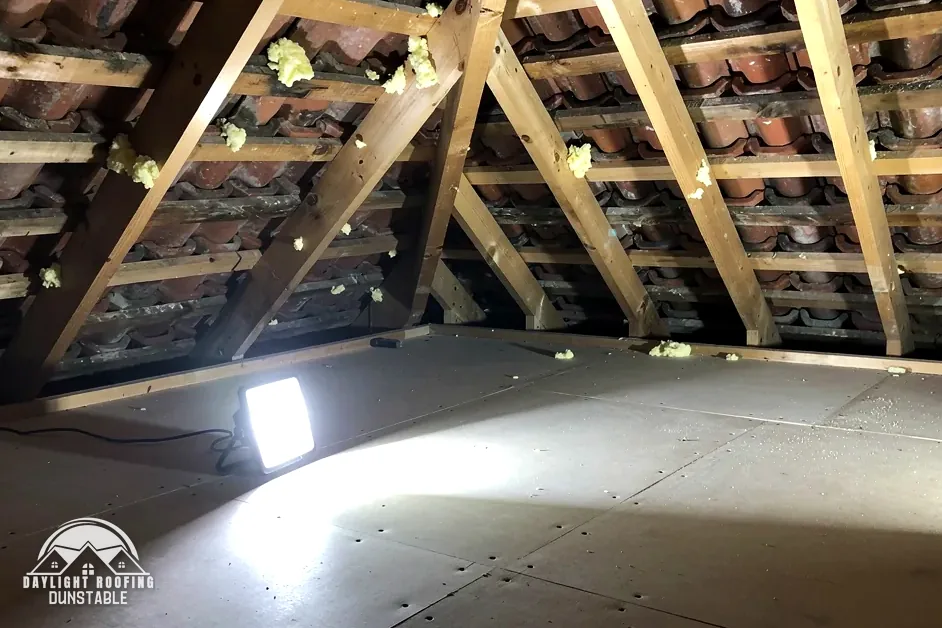
Clean loft rafters after spray foam removal, with the backs of the roof tiles showing

The roof, in plain words

Faculty
The Church of England's permission system for changes to its church buildings.
Valley
The sunken angle where two slopes of roof join and share their rainwater.
Abutment
The line along which a slope of roof stops at a wall.
Soffit
The panel that covers the underside of the eaves, below the fascia.

The plain-as-day roof check

Looking up at a Wilstead roof: valleys, lead, eaves and windows

4 checks about 4 minutes to read

  1. Valley lining and edges
  2. Lead flashings at walls
  3. Eaves, soffits and vents
  4. Roof windows and their seals

01 Valley lining and edges

A valley is the angled channel where two roof slopes meet, and it carries the water from both slopes in one stream. That makes it a harder-working part of the roof than any plain expanse of tiles. From the garden, look for a line of dark or stained tiles along the valley, tiles cut untidily where they meet it, and any moss or grass growing in the channel. Indoors, a tea-coloured mark on the ceiling beneath the valley line is worth tracing back to its source.

The lining of a valley may be lead, a GRP trough or a strip of underlay with the tiles cut to it. Lead can split along a fold, a GRP trough can crack at its edge, and underlay can tear where a loose tile has rubbed it. Which one you have is established from the roof surface, and it decides whether a repair or a new lining makes sense. MyJobQuote says correctly installed lead flashing "can last for over 80 years", which depends on the detail being right at the start. Tell us about any stain you have noticed, and where it sits.

02 Lead flashings at walls

Flashing is thin sheet metal, lead among them, that seals the line at which a slope stops against a wall, a stack or a dormer cheek. Stand where you can see the line and look for a lifted edge, a chink between metal and brickwork, or a smear of old sealant used to bridge a gap. A bead of mastic covers a joint that has moved for a short while, but it will not hold when the lead behind it is loose. Rust-coloured runs on the wall below point the same way.

Rolled lead sheet comes in codes 3 to 8 under BS EN 12588, code 4 being 1.80 mm thick, while the specification decides which code each detail takes. "A chimney lead flashing patch repair typically costs around £200, while a full replacement averages around £570.", writes MyJobQuote (last updated 22 September 2026). Those are figures for chimney leadwork only, and your own price is written as one total after the survey, not lifted from a guide. Leadwork at roof windows and dormers is a separate detail again and is surveyed in its own right.

03 Eaves, soffits and vents

At the eaves the roof meets the gutter, the fascia and the soffit, and several small jobs happen inside a few centimetres. Look along the fascia for splits, flaking paint or a sag between brackets. From a ladder, if it is safe to put one up, a soft patch or a dark stain on the soffit marks a board that has been wet. Small round vents, or a slot running the length of the soffit, bring air into the roof void, and they should be open, not painted over.

Under high-resistance underlay, Marley sets cold-roof eaves openings at "25mm along the length of the eaves for pitches of 15° or less; 10mm along the length of the eaves for pitches of more than 15°." If those openings have been stuffed with insulation or painted shut, moist air can linger in the roof void all winter. Underlay of that kind stops vapour passing through, which leaves the airflow to carry the moisture out. Mould on the rafters near the eaves, or beads of condensation on the underlay, point that way, and they are worth a photograph for the survey.

04 Roof windows and their seals

A roof window is a hole cut through the covering, so it brings its own flashing kit and its own risks. From the loft, look at the reveal around the frame for a tide-mark, flaking plaster or condensation on the lining. From outside, look at the flashing along the sides and the head, and at the slope above, where debris can collect and push water sideways under the frame. A window that was fitted some time ago may have a flashing kit that no longer matches the covering around it.

In Approved Document L the dividing line is orientation: a window "in the same orientation as, and in plane with, the surrounding roof" counts as a roof window (1.4 W/m²K or Window Energy Rating Band B for a replacement), and a glazed unit described as "out of plane with the surface of the roof on a kerb or upstand" is a rooflight, held to 2.2 W/m²K. They are different products with different values, which is why a replacement starts by identifying the existing unit. Measure the frame and note any maker's mark on it, if you can reach it safely. See skylights and roof windows for the detail.

The dashed ring takes in the nearest towns and villages we cover around Wilstead. Map tiles © Esri; map data © OpenStreetMap contributors.

Wilstead roof questions, answered plainly

01Why can a valley on a Wilstead roof leak while the tiles around it look sound?

A valley gathers the run-off of two slopes, so a small fault in its lining passes a lot of water. The tiles either side can look perfect because they are doing their job while the lining beneath is cracked, lifted or torn. The leak then shows at a ceiling some distance away. A survey of the valley from the roof surface looks for where the water is entering and how far the damage has spread; a stain you can see from your own loft hatch helps to place it. A faulty lining is repaired from the roof surface, lifting only the tiles that have to come off to reach it.

02Which consent route covers repairs at All Saints in Wilstead?

All Saints in Wilstead holds a Grade II* listing (National Heritage List entry 1321582, first listed 13 July 1964) and is a Church of England church. Roof repairs there are handled under "the faculty jurisdiction of the Church of England" in place of listed building consent, and some like-for-like repairs are List B work for which the archdeacon's written notice is sufficient. Outside alterations are tested separately for planning, so the route is settled before anything is priced. Planning is a question for Bedford Borough Council, and the faculty side is the Church of England's.

03Does a Grade II cottage such as Orchard Cottage need listed building consent for a re-roof?

Orchard Cottage is listed Grade II (National Heritage List entry 1312258, first listed 17 May 1984). Listed building consent is needed for work "in any manner which would affect its character as a building of special architectural or historic interest". The same applies to 16a Luton Road (entry 1114205, first listed 4 June 1974) and Old Church House (entry 1137451). Ask Bedford Borough Council first, before choosing a covering, and raise it at the outset if your house is listed, because that changes the order of events.

04Does the Haynes conservation area at Church End reach roofs in Wilstead?

The Haynes conservation area at Church End is close to Wilstead, but being close does not settle what applies on a particular Wilstead street, because each address has its own position. The council holds the answer. For your address, Bedford Borough Council can say whether a conservation-area rule or an Article 4 direction applies, since a direction can change what you may do without an application. The council's own officers know the local position better than a map does, so ring before a start date is fixed.

05What will Bedford Borough Council charge to licence scaffolding in Wilstead?

Bedford Borough Council, as highway authority, licenses scaffolding that stands on the road or pavement. Bedford Borough Council's licences page gives "the charge for 2026 is £178.25 per month or part thereof", and its form says a licence to erect or retain a scaffold or other structure on a street "will normally only be issued to the Company responsible for actually erecting the scaffolding or other structure." The application form asks for 10 working days. We arrange it with our scaffolder. A scaffold that sits wholly within your own boundary and does not reach the highway is outside the licence.

06Who checks building regulations when a Wilstead roof is stripped and recovered?

"Less than 25 per cent of the total 'building envelope'" and "Less than 50 per cent of the roof is affected" are the Planning Portal's two tests for a re-roof, and where both are met no application is normally needed. Taking every tile off a Wilstead roof goes beyond that 50 per cent figure. A new covering that "increases the weight of the roof covering by 15 per cent or more" needs approval, and a structural engineer or surveyor should be asked first. Building control at Bedford Borough Council is its own service, so raise it with that team before agreeing any work. A heavier covering is one reason to do so, and a full strip-and-recover is another.

07How does a storm-damaged Wilstead roof stand with an insurer?

The Financial Ombudsman Service says "Rain, hail or snowfall by itself can constitute a storm", and gives its view that "a storm usually involves violent winds, usually with rain, hail or snow". It adds that it will "usually look at expert reports and photos". Take pictures of the damage before anything gets moved, then contact your insurer. MyJobQuote says extensive storm damage repairs can cost £1,200 or more, so it helps to know the insurer's position early, before any temporary cover goes on.

08What does replacing a few broken tiles cost on a Wilstead house?

Which? Trusted Traders list "Replace one to six broken or missing standard roof tiles" at "£75-£400", excluding VAT, from a survey of 11 traders gathered in November 2025. That range is a published guide, not a price from us. Our own figure is set out as a single sum once the survey is finished, varying with how the roof is reached, the tile count and the condition of what lies underneath. A photo sent to 07880 284133 lets us look at the damaged tiles before anyone visits, and shows whether the problem is one tile or a wider pattern across the slope.

09Which villages near Wilstead can you also visit for roof work?

We also work in Wixams, Houghton Conquest, Cotton End, Shortstown and Haynes. Each of those pages has its own planning and building control notes for the council involved, and Haynes has the conservation area that sits close to Wilstead. If your road sits between two of them and you are unsure which page applies, ask on WhatsApp at 07880 284133 and we will tell you where it falls. A postcode is more useful than a street name when you ask.

Get a written price for your roof

10-year workmanship guarantee, in writing

Tell us about your roof

Call WhatsApp Written quote