
Call 01582 935272

Haynes · 18 road miles north

Roofers in Haynes

Cottage, mill house and village roofs in Haynes, 17.9 road miles north of Dunstable, looked at by a survey before any figure is put in writing as one total.

Get a written quote

Call 01582 935272WhatsApp us

Council
Central Bedfordshire
Road miles
18
Building control
Central Bedfordshire

The Old Mill House, cottages and roofs in Haynes

Haynes is a village in Bedfordshire. The road from Dunstable runs 17.9 road miles north and takes about 30 minutes. Haynes parish had 1,173 usual residents at the 2021 Census. With The Old Mill House and Pilgrim's Cottage among its listed buildings, this page looks at chimney stacks, covering pitch and quiet leaks on Haynes roofs. The survey comes before the price on every job, and the findings come back in everyday words, together with anything else seen. The chimney repairs page covers stacks, and the roof repairs page smaller faults.

Planning applications from Haynes go to Central Bedfordshire Council. The Haynes (Church End) conservation area is close to Haynes, which does not tell you if a particular house is within it, so the council is the place to ask about an address. Listed buildings include 3 Northwood End Road, The Old Mill House and Pilgrim's Cottage, all Grade II. The planning guide explains which planning tests a house faces. Photographs of the roof and of any listed neighbour help the council see the context.

  1. 01The Old Mill HouseThe Old Mill House is Grade II, first listed on 10 January 1985, so listed building consent comes first for anything that touches its character.
  2. 02Cottage chimneysA cottage stack carries pots, flaunching, brickwork and lead, and all four are looked at together, with the breast inside.
  3. 03Pitch and coveringThe pitch of a roof limits which tiles can be laid, and each product has its own published minimum.
  4. 04Slow leaksA brown patch that returns after painting is a sign that something above is still letting water in.
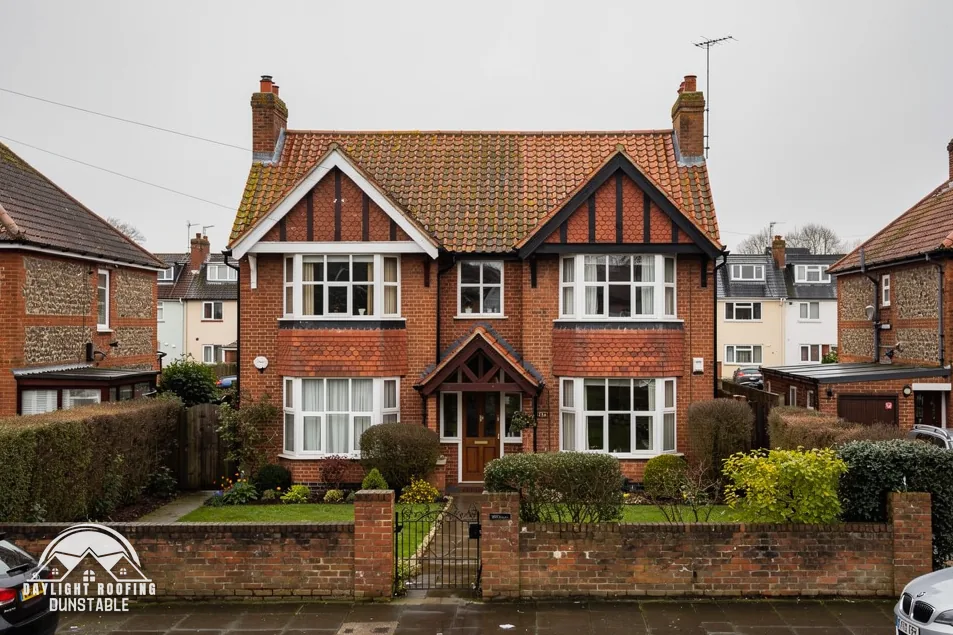
A detached Edwardian brick house with a clay tiled roof and gables

The roof, in plain words

Pitch
How steeply a roof slopes, given in degrees.
Chimney breast
The chimney's projection into a room.
Downpipe
A vertical pipe taking gutter water to a drain.
Hopper head
The collecting box at the head of a downpipe.

The plain-as-day roof check

Stacks, pitch, stains and gutters: four checks in Haynes

4 checks about 3 minutes to read

  1. Chimney breast and stack
  2. Pitch and the choice of tile
  3. Stains that come back
  4. Downpipes, hopper heads and falls

01 Chimney breast and stack

A chimney is one structure from hearth to pot. Inside, look for a breast that is damp, with patches of discoloured plaster or flaking paint. Outside, look at the pots and the bed they sit in, the brickwork and the lead where the stack leaves the slope. The Planning Portal says "Building regulations approval will always apply when removing chimney breasts as they are part of the building's structure." If the breast is built into a party wall, the neighbour is brought into the work too. A neighbour's roof that shares the stack should be noted in the message.

MyJobQuote (3 November 2026) gives "The average cost of removing a chimney breast is around £2,500." and, when the whole stack comes out with the breast, "around £3,000 to £3,500". Those are guide averages for a typical job, not a price for a Haynes cottage. A survey looks at the stack and the roof round it, and only then does a total go on paper.

02 Pitch and the choice of tile

Each tile has a lowest pitch at which it should be laid. Marley lists 17.5° for its concrete Edgemere and Modern-Duo, 25° for the Anglia, 22.5° for the Ashmore and for the Ludlow Major and Ludlow Plus, and 15° for the Wessex and the Mendip, with a Mendip 12.5 at 12.5°. For clay it lists 30° for the Acme Single Camber. Anglia and Ludlow name Marley products, not places. A photograph of any tile that has come down, with the underside showing, helps identify the product.

Marley says installing to BS 5534 "isn't required by law". The standard BS 5534:2014+A2:2018 is current at BSI. A roof's pitch can be read from original drawings, or measured at the survey, and changing the covering means the new tile must suit the pitch that is there. Which tile suits a Haynes roof is a finding for the survey. Where a roof has been patched with tiles of a different kind, the pitch limit of the lowest-rated one is what counts, and a survey can say which is which.

03 Stains that come back

A stain that returns after being painted over is telling you that something above is still wet. Mark its edge in pencil with the date, and note whether it grows after wind and rain or only after a long wet spell. A stain near the chimney breast, along a ceiling edge at an outside wall or beneath a roof window points to different causes. A drip you can hear in the loft is worth a recording on a phone. Staining that follows the line of a rafter or a wall plate suggests water running along timber to a point away from the entry.

A bucket under a drip fixes nothing. Pictures of the stain, of the matching outside wall and of the roof above it, sent to 07880 284133, help the survey decide where to start. A leak that has gone on for months may have wet the timber behind the plaster, which is why a survey also looks at what the water has touched, along with the covering above it. Moving furniture away from the stained wall lets the survey see how far it runs.

04 Downpipes, hopper heads and falls

Water leaves a roof by the gutter and the downpipe, and a fault in either lands on the wall. For guttering, Brett Martin's figure is a fall of 1 mm in every 600 mm, running towards the outlet. Look for green staining on a wall beneath a hopper head, a downpipe fixed away from the wall and pooling at the foot of a pipe.

Which? lists clearing every gutter at £75 to £350, excluding VAT (November 2025). For capping fascias and soffits, MyJobQuote's average is around £800 (17 September 2026). A gutter that is clear but still overflows may have lost its fall or a bracket, and a survey finds which. The guttering, soffits and fascias page covers rainwater work.

The dashed ring takes in the nearest towns and villages we cover around Haynes. Map tiles © Esri; map data © OpenStreetMap contributors.

Haynes roof, stack and cottage questions

01What does a brown patch that keeps coming back on a Haynes cottage ceiling mean?

Something above is still letting water in, or condensation is forming on a cold surface. A patch that grows after rain points to a leak. A patch that appears on cold, still days points to moisture inside. Mark the edge with a pencil and a date to see how it changes. A survey follows the line above the stain. Pictures of the patch and the wall outside, sent to 07880 284133, help work out where to look first. Where a stain sits directly below a chimney breast or a roof window, say so in the message. The survey separates a leak from condensation, because the fix differs.

02Does removing a chimney breast in Haynes need approval?

Removing a breast always needs Building Regulations approval, because it forms part of what holds the building up. Central Bedfordshire Council's building control team is on 0300 300 8635, a line for building control and not planning enquiries. A breast standing on a party wall also brings in the Party Wall etc. Act 1996, where the building owner's notice must "be served at least two months before the date on which the proposed work will begin". The notice goes to the neighbour, and party wall questions go to a party wall surveyor, not building control. Photographs of the breast from inside and the stack from outside help to start the conversation.

03How do the listings of The Old Mill House and Pilgrim's Cottage touch roof work?

The Old Mill House is listed Grade II (National Heritage List entry 1113753, first listed 10 January 1985), as are Pilgrim's Cottage (entry 1113754) and 3, Northwood End Road (entry 1113815, first listed 16 June 1992). A listed house retains permitted development rights on roofs; consent is a separate hurdle where character is touched. A different covering, ridge detail or rooflight therefore goes to Central Bedfordshire Council first, with a picture of the existing roof. Moving a roof window or adding one counts as a change of that kind. Any such question can be put to the council by email.

04Does the Haynes (Church End) conservation area cover my house?

The Haynes (Church End) conservation area is close to Haynes, which says the village lies near it and no more. Central Bedfordshire Council draws the line, and says on which side of it a Haynes address falls. An Article 4 direction can remove further permitted development rights, so we check with the council first. The planning guide goes through the usual tests, and a call or an email with the postcode gets the council's answer for a house. A conservation area does not prevent a roof from being repaired. A map from the council can be requested.

05Can any tile be laid on a Haynes roof whatever its pitch?

No. Each product has a published minimum pitch, and a tile laid below it is outside the maker's guidance. Marley lists 30° for the clay Acme Single Camber, 22.5° for the concrete Ashmore and 15° for the Wessex. Pitch is read from a drawing or measured at the survey. Changing the covering changes the loads on the roof, so the Planning Portal's "15 per cent or more" weight test also comes into it. A roof that was re-covered at some point may carry a different tile from the original, so check what is there before assuming. A tile of the wrong type can fail early at a low pitch. Tiles also differ in weight and fixing, so a change of type can alter the loads on the timbers.

06Can a Haynes household get help paying for loft insulation?

Schemes in England cover insulation and heating, not roof replacement. The Energy Company Obligation "is closing on 31 December 2026", and the Warm Homes: Local Grant needs a home that can "have an Energy Performance Certificate (EPC) of D, E, F or G", with income that "must usually be £36,000 a year or less". The GOV.UK energy adviser line is 0800 098 7950. Central Bedfordshire has an allocation of £1,000,000 on GOV.UK's list, and the council can say how it is run. Check GOV.UK for the current terms before applying, since schemes change. Ask for any grant offer in writing before agreeing to work.

07Does scaffold at a Haynes cottage by the road need permission?

Highways Act 1980, section 169 is the law behind scaffold licences: poles or boards that obstruct a public footway or road need one from the highway authority, which in Haynes is Central Bedfordshire Council. The licence is dealt with as follows: we arrange the licence with our scaffolder. On private land only, none is needed. Whatever scaffold is needed goes inside the quote we write. How far the cottage sits from the road is checked at the survey, along with any parked cars or a verge in front. A note on whether the cottage has a front garden is useful.

08Can asbestos be found in a Haynes soffit?

It can be, in an older building. HSE says "If the building was built or refurbished before 2000, assume that there is asbestos in it." HSE lists "AIB white soffit panels to underside of roof eaves" among the places asbestos insulating board turns up. Because the work on that board is mostly licensed, a soffit that might be board is left undrilled, unbroken and unscrubbed until it has been identified. A picture of the soffit is a good first step. Nothing should be done to a suspect board by a householder.

09Which villages near Haynes share the same round?

Cotton End, Wilstead, Clophill, Campton and Houghton Conquest each have pages of their own: Cotton End, Wilstead, Clophill, Campton and Houghton Conquest. Haynes sits among them. Which page fits a postcode on a parish edge is a question to put on WhatsApp at 07880 284133, with a picture of the roof if you have one. Each of those pages names its own council, listed buildings and consent notes, which differ from place to place even where the councils are the same. Mention the lane or road name and the nearest village when you write.

Get a written price for your roof

10-year workmanship guarantee, in writing

Tell us about your roof

Call WhatsApp Written quote