
Call 01582 935272

Elstow · 21 road miles north

Roofers in Elstow

Elstow roof work, from lead sheet and gutters to full re-roofs, 20.5 road miles from Dunstable, with a quote in writing after our survey of the roof.

Get a written quote

Call 01582 935272WhatsApp us

Council
Bedford Borough
Road miles
21
Conservation area
Elstow
Building control
Bedford Borough Council

Lead, gutters and Grade I neighbours in Elstow

From Dunstable, Elstow is 20.5 road miles to the north, about 32 minutes by road, and the Elstow parish counted 2,986 usual residents at the 2021 Census. Roof repairs, re-roofing, leadwork and guttering are all work we take on here. Each job begins with a survey, and what it finds arrives in everyday terms, along with whatever else caught our eye. The leadwork page covers sheet, flashings and gutters in depth. Church, mansion and cottage roofs each ask a different question, so each Elstow survey starts from the roof in front of it.

Elstow has a conservation area designated by Bedford Borough Council, and the village also has listed buildings of high grade, including a Grade I church and a Grade I mansion. That shapes which consent comes first on a given street. An Article 4 direction can remove further permitted development rights, so we check with the council first. For a house re-cover the roof replacement page describes the work, and the planning guide explains the permission tests.

  1. 01Church and mansionSt Mary and St Helena's parish church and Hillersdon Mansion are both Grade I, and each has its own consent route for roof work.
  2. 02Scheduled monumentRemains of Elstow Manor House are a scheduled monument, where works must be authorised by scheduled monument consent.
  3. 03Lead sheet roofsLead sheet needs its joints, rolls, laps and fixings inspected, since the code and detail are set by the specification for each part.
  4. 04Rainwater goodsGutters, hoppers and downpipes are checked for fall, joints and the brackets that hold them, because small leaks soak the wall below.
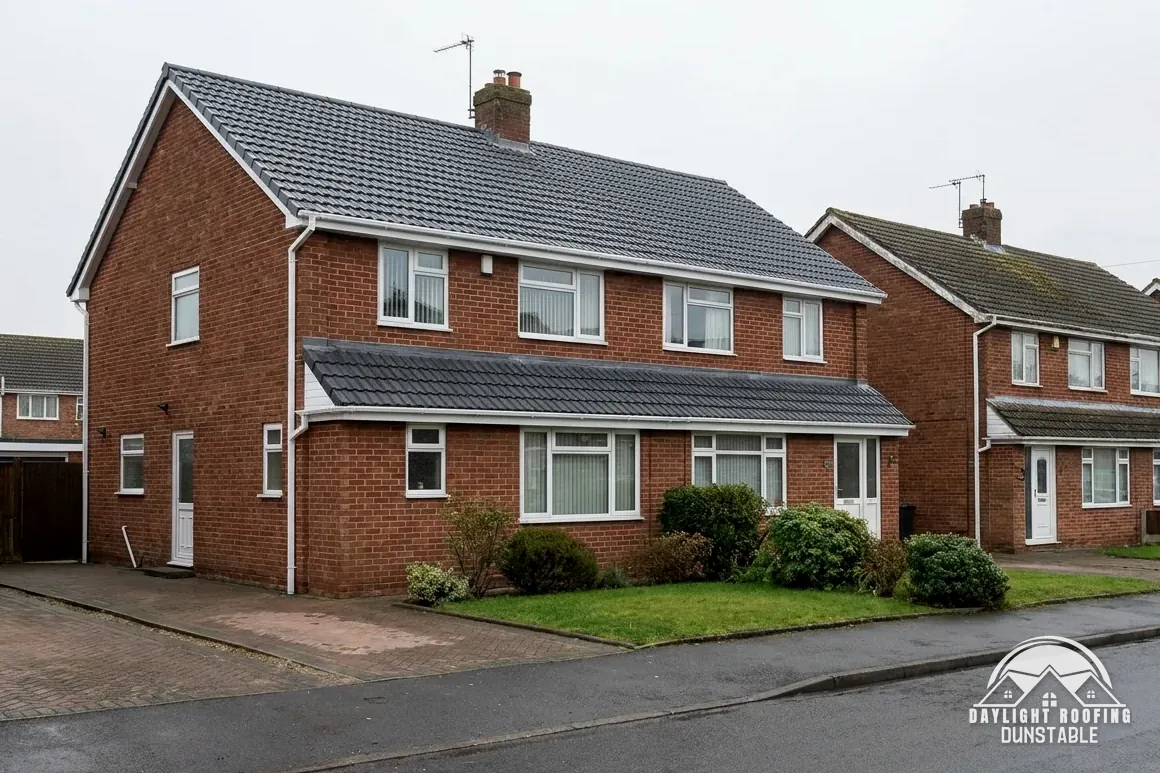
Brick semi-detached houses with new grey tiled roofs

The roof, in plain words

Scheduled monument
A site under national protection, where any works have to be authorised first.
Lead code
A number from 3 to 8 that fixes the thickness of rolled lead sheet.
Hopper head
A collecting box fitted where gutter water enters the downpipe.
Roll
A raised timber core wrapped in lead where two lead sheets join.

The plain-as-day roof check

Lead, gutters and timber: the checks that count in Elstow

4 checks about 4 minutes to read

  1. Lead sheet joints and rolls
  2. Parapet and valley gutters
  3. Rainwater heads and downpipes
  4. Timber under the covering

01 Lead sheet joints and rolls

Lead sheet is laid in panels, and the joints between panels are where the work is done: rolls over timber cores, drips at the steps, and welts at the edges. Look for a panel that has crept downhill, a crack running along a fold, or a join where the metal has lifted. A hairline crack is a small thing on the surface and a clear path for water underneath. Bright new patches among dull old lead mean someone has repaired it before. On a low-pitched or flat lead roof, a long panel that has bulged between its fixings shows as a ripple in the surface, and that ripple marks where the metal has been working loose.

Rolled lead sheet is made to BS EN 12588 in codes 3 to 8, and code 4, for example, is 1.80 mm thick. Calder and Ecobat both give code 4 as 20.41 kg/m², though their weights differ for codes 3 and 6. A specification fixes the code to use at each separate detail, so a thicker sheet is not automatically better, and a survey establishes what has been laid before a repair is described. Lead that has been dressed over a wall without a chase cut for it can lift at the top edge. If the sheet has been fixed with a sealant bead only, the bead can open. Photographs of the joint taken in raking light show cracks that the midday sun hides.

02 Parapet and valley gutters

A parapet gutter lies behind the short wall that rims a roof, and a valley gutter runs between two slopes. Both are lined with lead or some other sheet metal, and both depend on the fall of their bed and the clearing of their outlet. After rain look for a gutter that still holds water hours later, or a ceiling stain below the line of the wall. Leaves and moss collect in these channels sooner than anywhere else on the roof. On a wall-top gutter, a stain that runs down the outside of the wall below an outlet says the water has been going over rather than through.

A lined gutter that cannot clear its water spills where it should not, into a wall or over a ledge. Whether the cure is a new lining, a changed outlet or a re-laid fall is a question for the survey. Do not reach into a gutter from a ladder to clear it; send a photo instead, and we can see whether it is a clearing job or a lining job. A lining that has split along a fold can be repaired locally if the rest of the sheet is sound, while a lining that has been patched many times may be better replaced in one piece.

03 Rainwater heads and downpipes

A hopper head collects water from a gutter and passes it to a downpipe. Where they connect, joints can loosen and brackets can pull from the wall, and a leak there wets the brickwork below until stains and algae show. Look at the foot of the downpipe, the bracket spacing and any joint that is dripping or stained. Water splashing on a wall at the base can saturate the lower courses of brick. Cast-iron and plastic hoppers fail in different ways: iron by rust at the joints, plastic by splitting where it has been in sunlight for years.

Brett Martin gives a gutter fall of "1mm for every 600mm" towards the outlet, which is a gentle slope you can hardly see by eye. A section that has sagged between its brackets holds a pool in the dip. Check for brackets that have rusted through and for gutter sections that have been joined without a gasket. Replacing the whole run at once is sometimes simpler than chasing one joint after another. Rainwater goods and the fascia behind them are checked together, because a sagging gutter is sometimes a symptom of a board that has gone soft behind it.

04 Timber under the covering

Rafters, battens and boards under a covering carry the weight of the roof and are the first casualty of a long-running leak. From the loft look for dark, damp patches, soft timber you can press with a thumbnail, or white fungal growth on a rafter. Do not lean on timber that looks soft. Treat a loft stain that appears and disappears with the weather as a leak that has not finished. Droppings, chewed edges or a sour smell in the loft are separate matters from timber decay, and they are worth noting for the survey in case a protected species is involved.

Where timber has gone soft, the repair is to cut out what is damaged and splice new timber in, not to paint over it. That work sits under the covering, so the covering has to be lifted before anyone can see the extent of the damage. This is the reason a survey sometimes ends in a recommendation that is larger than the repair first asked about, and why the findings come to you plainly, with the reasons. Where roofing work could disturb a bat roost, the law does not turn on intent, so a sighting means stopping to ask before anything is lifted.

The dashed ring takes in the nearest towns and villages we cover around Elstow. Map tiles © Esri; map data © OpenStreetMap contributors.

Elstow roofs: plain answers

01Why does lead sheet on an Elstow roof split along its joints?

Lead expands and contracts with the temperature, and a long sheet fixed too rigidly can crack along a fold. Fixings that have failed let a panel creep downhill and open a joint at the top. Old patching may hold for a while and then fail where it meets sound metal. The survey looks at the whole run, not only the leak, and tells you plainly what it found. MyJobQuote says correctly installed lead flashing "can last for over 80 years".

02How is roof work at Elstow's St Mary and St Helena approved?

The parish church, St Mary and St Helena, is listed Grade I (National Heritage List entry 1114168, first listed 13 July 1964) and is a Church of England church. Work to such a church goes through the faculty system rather than listed building consent, and under the Faculty Jurisdiction Rules "The like for like replacement of roof lead or other material covering the roof of a listed building" is a List B matter, which calls for just the archdeacon's written notice. Exterior alterations may still call for planning permission.

03What consent applies to work near the remains of Elstow Manor House?

Elstow Manor House (Remains of) is a scheduled monument near Elstow, which appears on the National Heritage List under number 1005405. Any works to the monument itself need authorising: consent comes from the Secretary of State, while applications are made to Historic England. That is a separate regime from listed building consent. For a house close to the remains, Bedford Borough Council can tell you whether any other control applies, and it is worth asking before a re-roof or an extension is planned.

04Does Grade I or Grade II* listing change roof work on Elstow houses?

A listing covers only the building its entry names. Hillersdon Mansion is Grade I (National Heritage List entry 1321607, first listed 7 May 1952), Bunyan's Mead is Grade II* (entry 1136945, first listed 13 July 1964) and The Moot Hall, Elstow, is Grade II* (entry 1136906). Listed building consent is needed for work "in any manner which would affect its character as a building of special architectural or historic interest". If your own house is listed, say so at the outset and put the question to Bedford Borough Council ahead of choosing a covering.

05What does the Elstow Conservation Area mean for my roof?

Elstow has a conservation area designated by Bedford Borough Council. The council's own mapping settles whether a given house is inside it, and the council decides what applies to the work. Bedford Borough Council can tell you if an Article 4 direction covers your address, and we put that question to it before work is agreed. The planning guide covers the general tests, and a call to the council before work is priced prevents surprises later. Elstow's conservation area is a reason to ask early, not a reason to assume the answer is no.

06What lifespan can lead sheet expect, set against zinc?

HomeBuilding puts a lead flat roof at 60-100 years, while Less says "Lead is the longest-lasting option at 50 to 100 years". VMZinc says a zinc roof "can last in excess of 100 years" when correctly designed and installed. These are published guides and not promises for your roof. Condition depends on the detail, the fixings and the care taken at the start, which a survey assesses on the roof itself. Where figures differ between sources we show both, with their names, and never choose between them for you.

07What must a scaffold on an Elstow road keep clear, and who applies?

Bedford Borough Council's application form for 2026 sets a minimum insurance of £5m, asks for 1.2 m of unobstructed footway, and requires a site meeting if the scaffold is closer than 450 mm to the carriageway edge. It asks you to allow 10 working days, and the 2026 charge is £178.25 per month or part thereof. Bedford Borough Council's form says the licence is normally only issued to the company that actually erects the scaffolding. We arrange the licence with our scaffolder. Insurance of that size is a requirement of the council for scaffolding licence applicants, not a statement about us.

08Can a damp patch in the loft below Elstow slates or tiles be left until spring?

A damp patch that varies with the weather is a leak that has not finished. Timber that stays wet can soften, and the longer a leak runs the more of the structure it reaches. Take a photo of the patch and of the roof above it, and send both to 07880 284133. Where a ceiling is letting water through, mention that first, and switch off the circuit to any light fitting that is wet. Timber that has stayed damp for a season or more is worth asking about even when the ceiling looks dry.

09Where else near Elstow does the same survey-first approach apply?

Kempston, Wixams, Bedford, Shortstown and Great Denham are written up on separate pages, each carrying the council details for its own village or town. The same survey-first order applies in each. If you are unsure whether your road sits in the Elstow area or one of the neighbouring pages, send the postcode on WhatsApp to 07880 284133 and we will point you to the right one. A neighbour's page may mention a church or a conservation area that applies to your address and not to Elstow itself, so it is worth reading the one that fits your road.

Get a written price for your roof

10-year workmanship guarantee, in writing

Tell us about your roof

Call WhatsApp Written quote