
Call 01582 935272

Flitwick · 11 road miles north

Roofers in Flitwick

Flitwick is a town 10.6 road miles north of Dunstable, about 19 minutes by road. A Flitwick roof gets its survey first, and the figure that follows comes as one written total.

Get a written quote

Call 01582 935272WhatsApp us

Council
Central Bedfordshire
Road miles
11
Building control
Central Bedfordshire

Flitwick roofs around the Manor and the Grade I church

Flitwick is a town in Central Bedfordshire. The route from Dunstable is 10.6 road miles to the north and takes about 19 minutes, and Flitwick parish had 13,661 usual residents at the 2021 Census. The Church of St Peter and St Paul is Grade I, and Flitwick Manor is Grade II*. Among the Grade II entries are 2 Gravel Pit Road and 117 Station Road. Ampthill, Flitton and Steppingley each have a conservation area close to Flitwick, and Central Bedfordshire Council is the one to say whether a given Flitwick address lies inside any of them.

A larger town carries a wider spread of buildings, from houses and extensions to shops and units, and the right page depends on the roof. The flat roofing page covers membranes and falls, the commercial roofing page covers larger buildings, and the chimney repairs page covers stacks. For planning questions, the planning guide sets out the national rules. Listed buildings, nearby conservation areas and the council's own records each add a layer, so a quote for an address near any of them starts with those checks.

  1. 01St Peter and St PaulGrade I, list entry 1137705, first listed 23 January 1961, Church of England. The faculty system, not listed building consent, governs its roof.
  2. 02Flitwick ManorGrade II*, list entry 1137690, first listed 22 October 1952. Roof questions go to the council before work is priced.
  3. 032 Gravel Pit RoadGrade II, list entry 1113913, first listed 27 April 1983. The listing covers the whole building, roof included.
  4. 04Conservation areas close byAmpthill, Flitton and Steppingley each have one close to Flitwick, and the council confirms whether an address falls inside.
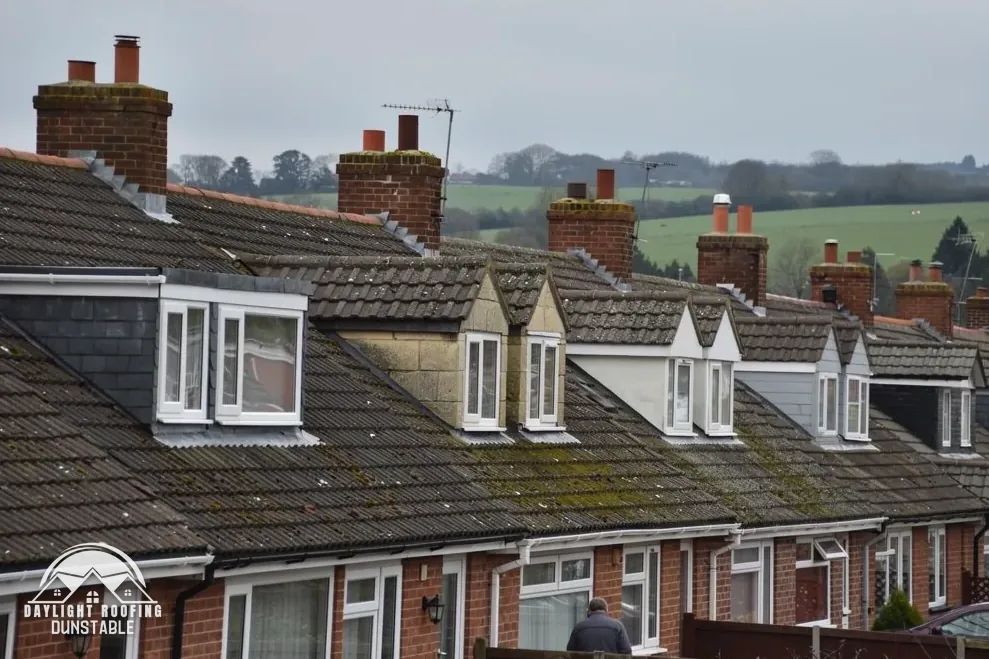
Concrete tiled estate rooftops towards green hills

Flitwick roofing words

Chimney breast
The wall of brick that projects into a room and carries the flue.
Party structure
A wall or floor shared by two properties, which can trigger a notice.
Membrane
A waterproof layer stretched across the whole of a flat roof.
Eaves
The lowest edge of a slope, where the roof ends at or beyond the wall.

The plain-as-day roof check

Four things to check on a Flitwick roof, from chimney to unit

4 checks about 3 minutes to read

  1. Chimney breasts and party walls
  2. Flat roofs on shops and units
  3. Underlay and eaves ventilation
  4. Slipped and broken tiles

01 Chimney breasts and party walls

Removing a chimney breast is a structural matter, and the Planning Portal puts it plainly: "Building regulations approval will always apply when removing chimney breasts as they are part of the building's structure." Where that breast is on a party wall, the Party Wall etc. Act 1996 adds a notice. Section 2(2)(g) covers the right "to cut away from a party wall, party fence wall, external wall or boundary wall any footing or any projecting chimney breast, jamb or flue".

A party structure notice has to "be served at least two months before the date on which the proposed work will begin". GOV.UK adds that "You cannot assume that no response means they agree to the works." MyJobQuote's average for taking out a chimney breast is around £2,500, while taking away the entire stack along with its breast runs at around £3,000 to £3,500 (page dated 3 November 2026). A party wall surveyor, not building control, answers the notice questions. A roofer cannot settle them, so a homeowner with a shared chimney wall asks the right person before any date is fixed.

02 Flat roofs on shops and units

Shop, office and unit roofs belong to commercial roofing, which is priced after a survey because no outside figure fits the size, access and covering of a particular building. What can be set out is how flat roofs are judged. BS 6229:2025 came out on 16 December 2025 and governs flat roofs that use continuously supported flexible waterproof coverings. The 2018 edition is withdrawn, and lead falls outside its scope.

NFRC reports a "minimum 1:80 finished fall for general roof areas and internal gutters", while IKO says that, to reach it, the code asks for a design fall of 1:40. HomeBuilding gives EPDM 25-30 years and Less gives 30 to 50; for felt, HomeBuilding says 10-15 years and Less says 10 to 20 years "depending on quality and installation". Standing water and lifted seams are the signs to photograph. A shop front canopy or a lean-to over a loading bay is a flat roof in its own right and is read separately from the main roof.

03 Underlay and eaves ventilation

Marley's figures for eaves ventilation, where a cold roof is laid with a high-resistance underlay, are "25mm along the length of the eaves for pitches of 15° or less; 10mm along the length of the eaves for pitches of more than 15°". A different build-up changes the answer. Marley gives a separate rule for the build-up with a low-resistance underlay, and the specification names whichever rule applies, so one roof's eaves figure is never borrowed for another. A mismatch between the underlay named and the vents fitted is worth raising with whoever prepared the quote.

The underlay is therefore named in a specification, not guessed. From the loft, signs of poor air movement are dark spotting under the covering, damp insulation or a musty smell near the eaves. BSI lists BS 5250:2021, the moisture code of practice for buildings, as current and under review. A photograph of any of these marks, with a note of where it sits, is a useful starting point, and the date on the file shows when it was taken.

04 Slipped and broken tiles

A slipped tile is easy to pick out from the ground, and a broken one is a hole. In November 2025, 11 Which? Trusted Traders gave £75-£400, excluding VAT, to replace one to six broken or missing standard roof tiles. Replacing roof tiles averages around £215 on MyJobQuote, and an average roof repair around £650 (page dated 6 October 2026).

A tile that has moved once is worth watching, because it can be a sign of failing fixings along a whole row. Marley says installing to BS 5534 "isn't required by law", while the 2015 amendments "made it clear that mortar could no longer be relied upon as the only means of securing the roof covering". Photograph the row from the ground in good light and note the date, then compare it with a second picture a few weeks later. If the row has moved between the two, send both on WhatsApp.

The dashed ring takes in the nearest towns and villages we cover around Flitwick. Map tiles © Esri; map data © OpenStreetMap contributors.

Flitwick roof questions, from stack to church

01Which Flitwick roof faults need a surveyor rather than a quick patch?

A ridge that sags, a slope that bows, a flat roof still holding water once the rain has stopped and a stack that leans each suggest a problem beneath the covering and not only on it. A single slipped tile is a lesser fault, but a row of them is not. Take pictures from the ground in even light, noting the date, and send them on WhatsApp for us to look at. The survey that follows looks at the whole roof, and what else we saw is reported plainly.

02What route does work on the Church of St Peter and St Paul roof take?

The Church of St Peter and St Paul is Grade I, list entry 1137705, first listed 23 January 1961, and is a Church of England church. The faculty jurisdiction of the Church of England covers a church like this while it is in use; that route stands in for listed building consent. Where roof lead or other covering is replaced like for like, the Faculty Jurisdiction Rules' List B route can mean only an archdeacon's written notice. Exterior work may still raise planning questions.

03What does a Grade II* listing at Flitwick Manor mean for roof work?

Flitwick Manor is Grade II*, list entry 1137690, first listed 22 October 1952. 117 Station Road (entry 1137734) and 2 Gravel Pit Road (entry 1113913, first listed 27 April 1983) are Grade II. A listed building's character is what consent protects, and a roof is part of that character. A repair can meet the test as readily as a new covering, so the question goes to Central Bedfordshire Council first, and its reply is worth keeping beside the quote. Ask for the reply to name the address and the work discussed.

04Do the conservation areas near Flitwick reach its streets?

Conservation areas lie close to Flitwick, at Ampthill, Flitton and Steppingley, each a separate area with its own boundary. Whether a Flitwick address is within any area is for Central Bedfordshire Council to confirm. An Article 4 direction can remove further permitted development rights, so we check with the council first. If an address is on a boundary or near one, the council's written reply decides the matter and should be kept with the quote. A house that looks as if it belongs to an area may not, and the reverse is true as well.

05How is scaffolding on a Flitwick street licensed?

Under section 169 of the Highways Act 1980, scaffolding that blocks the highway cannot stand without a licence. The licensing body for Flitwick's streets is Central Bedfordshire Council, and we arrange the licence with our scaffolder. Shopping streets and car parks make a scaffold layout harder to plan, so where it stands is settled early, and the written quote carries it inside one total. Fee and timing are the council's own to state, so current figures are taken from the council and not from memory or from a neighbour.

06What can a Flitwick owner ask building control about a re-roof?

Central Bedfordshire Council's own building control team answers on 0300 300 8635, a line for building control and not for planning enquiries. Approval is required for a complete re-roof, because on its own it crosses the Portal's 50 per cent roof limit. Either the council or a registered building control approver can carry out building control. The council's route ends in a completion certificate, and an approver's in a final certificate. A question about weight, structure or ventilation is one for building control, and it is asked before any order is placed.

07What happens to a Flitwick roof claim if the insurer is slow?

For most complaints, a business has up to 8 weeks to consider a complaint. After a final response, the window for going to the Financial Ombudsman Service is 6 months from the date on that response, and the Ombudsman's number is 0800 023 4567. The Ombudsman will usually look at expert reports and photos. Photographs taken before anything was moved or covered are therefore the evidence to hold on to, with receipts for any emergency work and a note of when each message to the insurer was sent.

08Can a Flitwick homeowner change their mind after signing a roofing contract?

A contract signed at home carries a cooling-off right: "the cancellation period ends at the end of 14 days after the day on which the contract is entered into". Starting work sooner takes a written request, which leaves the right standing. The right does not cover a visit that the customer "has specifically requested" for urgent repairs, and a customer who asks for work to start inside the period may owe for what is done. Citizens Advice, on 0808 223 1133, is the consumer helpline for individuals, and Trading Standards does not advise them.

09Is a roof grant available to a Flitwick household?

None of the schemes on GOV.UK's pages funds a roof replacement or repair. The schemes open in England cover insulation, loft insulation included, and heating upgrades. For the Warm Homes: Local Grant, GOV.UK limits the grant to homes banded D to G on their EPC, and says "Your household income must usually be £36,000 a year or less." The Energy Company Obligation is closing on 31 December 2026. How a council runs its allocation is for that council to say, so check with Central Bedfordshire Council.

Get a written price for your roof

10-year workmanship guarantee, in writing

Tell us about your roof

Call WhatsApp Written quote