
Call 01582 935272

Pulloxhill · 12 road miles north

Roofers in Pulloxhill

The village of Pulloxhill is a drive of about 25 minutes from Dunstable, 11.7 road miles north. Pulloxhill roofs get a survey before anything else, and the figure after it is one written total.

Get a written quote

Call 01582 935272WhatsApp us

Council
Central Bedfordshire
Road miles
12
Conservation area
Pulloxhill
Building control
Central Bedfordshire

Pulloxhill roofs, from Pond Farmhouse to High Street

Pulloxhill is in Central Bedfordshire. Dunstable is 11.7 road miles away to the south, a journey of about 25 minutes, and 1,044 usual residents lived in Pulloxhill parish at the 2021 Census. St James's church is listed Grade II*. Anfield Cottage, 5 High Street and Pond Farmhouse are each Grade II. Central Bedfordshire Council has designated the Pulloxhill conservation area, so a roof on a village address is checked against that designation and the listings before any work is priced.

Small village roofs raise their own questions: a porch with a flat covering, a garage roof, a loft with sprayed foam under the tiles, a gable end that has begun to weep. The flat roofing page covers porch and garage coverings, the roof repairs page covers faults on a pitched slope, and the planning guide sets out the national rules that apply before any consent is sought.

  1. 01Church of St JamesGrade II*, list entry 1138002, first listed 23 January 1961, Church of England. The faculty system governs its roof.
  2. 02Anfield CottageGrade II, list entry 1113938, first listed 3 May 1985. Roof work is raised with the council before it is priced.
  3. 035 High StreetGrade II, list entry 1321707, first listed 3 May 1985. The listing reaches the house as a whole, slates or tiles included.
  4. 04Pond FarmhouseGrade II, list entry 1113939. A repair that matches the old work still goes to the council first.
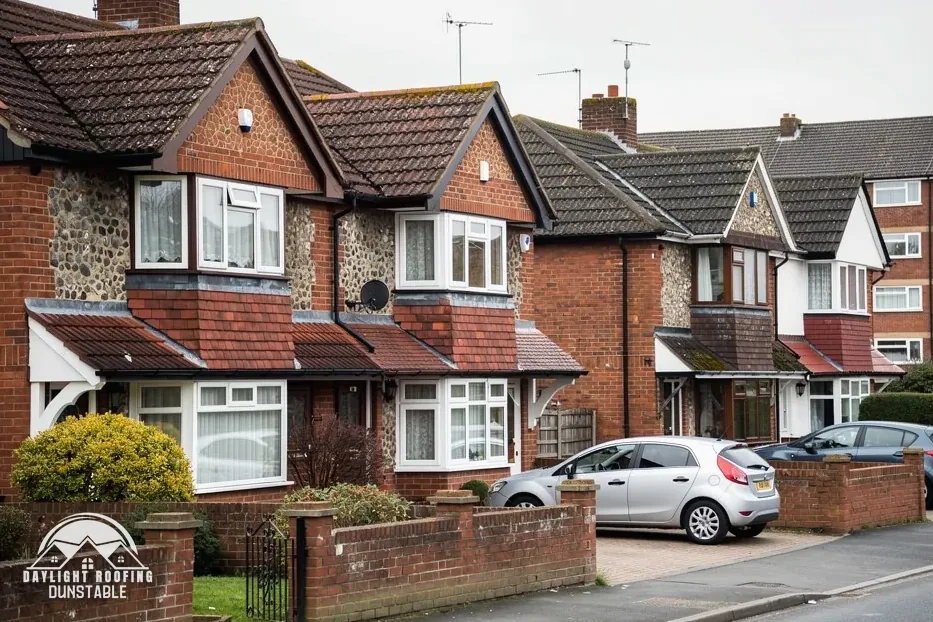
Edwardian brick and flint semi-detached houses with tiled gables

Pulloxhill roof words

Closed-cell foam
Spray foam made of sealed cells, which is hard and dense when cured.
Bargeboard
The timber that finishes the sloping end of a gabled roof.
Roost
Where bats rest or breed; damaging one is an offence whatever the intent.
Reverse charge
A VAT rule that shifts who accounts for the tax between businesses.

The plain-as-day roof check

Four Pulloxhill checks, from foam under the tiles to the porch roof

4 checks about 3 minutes to read

  1. Foam sprayed under the tiles
  2. Rubber on a porch or garage
  3. Gable ends and bargeboards
  4. What the underlay shows

01 Foam sprayed under the tiles

A roof with foam on the underside of its covering is harder to read from the loft. Open-cell foam is the soft, porous kind. The Energy Saving Trust says the rot risk "should be much lower with open-cell foam", a remark about the material that does not describe any particular roof. Checkatrade says removal "typically runs between £50 and £75 per m² for open-cell foam" (guide last updated July 2026), with no VAT basis given.

For a three-bedroom detached house, Checkatrade says "you can expect the total roof foam insulation removal cost to come to around £3,200". That total belongs to one type of house, and no other house is priced from it. Deciding whether foam stays or goes involves a specialist surveyor and the lender. A shot of the underside taken from the hatch, with a torch held low and to one side, gives a first record of what is up there.

02 Rubber on a porch or garage

Some small flat roofs are covered in a single rubber membrane. MyJobQuote says "typical rubber roofing prices of around £60 per square metre mean the average rubber roof costs £1,050 fully installed" (page dated 9 October 2026). A rate per square metre is only a rate, and the area and the access of a particular roof decide its total.

On a typical single garage, 6m x 3m, the Which? Trusted Traders survey of November 2025 gave £1,950-£4,000 for rubber EPDM or PVC laid on new boards and £1,400-£3,500 for felt, prices that exclude VAT. Whichever covering is chosen, the finished fall matters: NFRC reports "a minimum 1:80 finished fall for general roof areas and internal gutters". Water still lying on a porch roof a day after rain is the thing to photograph, together with any seam that has lifted at the upstand.

03 Gable ends and bargeboards

The gable is the end wall that climbs to the peak, and along its sloping edge sit the verge tiles and, sometimes, a timber board. Rain runs down the verge and onto the wall below, so staining or green growth under the edge says that water is not clearing it. The same applies to the eaves on the long sides, where a gutter that overflows puts water on the same wall. Timber that has gone soft, split or dark at its lower end has been wet for a while, and paint peeling off in strips tells the same story.

From the lane, look at the line where the verge meets the wall. A gap, a crumbling mortar bed or a tile that has dropped at the edge are signs to photograph, and a few steps along the lane in each direction give two angles. A photograph taken square on to the gable shows the line of the verge clearly. A verge fixed dry follows BS 8612:2018, and a mortar verge follows the specification the roofer names. The photograph should show the whole gable and a closer shot of the bottom of the board, with the date noted on the file. If the board is out of reach, a long lens from the lane is better than a ladder.

04 What the underlay shows

The underlay is the membrane under the tiles, and when a roof is stripped it is the first layer that can be seen and judged. Tears, a sag between the rafters or staining along the laps all say something about what has been happening above. Underlays differ in how they behave, and ventilation follows the type. For a low-resistance underlay in the right build-up, Marley's line is "fortuitous ventilation at the eaves via normal eaves construction (3mm) is all that is required, provided the requirements of UKAS Third Party certification are fully met."

The right choice depends on the whole build-up, so the underlay is named in the specification and not decided on the day. From inside the loft, a photograph of the underside of the covering, showing the underlay where it can be seen, is worth taking before any work is planned. A torch held to one side shows tears and staining more clearly than one pointed straight at the surface.

The dashed ring takes in the nearest towns and villages we cover around Pulloxhill. Map tiles © Esri; map data © OpenStreetMap contributors.

Pulloxhill roof questions, from gable to call-out

01What can a Pulloxhill owner learn from a photograph of a gable end?

A whole-gable photograph taken from the lane shows whether the verge is straight, whether tiles at the edge have dropped and whether the wall below is stained. A second shot of the bottom of the bargeboard shows whether it is soft or split. Note the date on both, then pass them through WhatsApp for a first look. If a visit is wanted, the survey looks at the entire roof, not just the gable. Anything else we saw is reported to you in plain words.

02What approval does a Pulloxhill church roof repair need?

St James's church is Grade II*, list entry 1138002, first listed 23 January 1961, and is a Church of England church. Churches in use come within the faculty jurisdiction of the Church of England, as this one does, and that jurisdiction substitutes for listed building consent. List B of the Faculty Jurisdiction Rules includes "The like for like replacement of roof lead or other material covering the roof of a listed building", which the archdeacon's written notice deals with in place of a full faculty. Planning permission for a change to the exterior is a separate test.

03What do the Grade II entries at Anfield Cottage and 5 High Street mean for a roof?

Anfield Cottage (list entry 1113938) and 5 High Street (entry 1321707) were each first listed on 3 May 1985, and Pond Farmhouse has entry 1113939. For a listed building, such as the three named above, works "in any manner which would affect its character as a building of special architectural or historic interest" need consent. A roof is part of what a listing protects. Ask the council ahead of any order, quoting the entry number so the reply is specific, and file the reply with the quote.

04Which questions about the Pulloxhill conservation area go to the council?

Central Bedfordshire Council designated the Pulloxhill conservation area, and the council keeps the records that say which addresses are inside it. Its online map, My Central Bedfordshire, finds conservation areas from a postcode. The questions for the council are simple: does the address lie within the area, does an Article 4 direction apply, and does the council have anything to say about a roof alteration at that address. Its guidance says permitted development rights are stricter in conservation areas. An Article 4 direction can remove further permitted development rights, so we check with the council first.

05How does scaffolding get licensed on a Pulloxhill lane?

Highways Act 1980 section 169 prohibits scaffolding that obstructs the highway unless it is licensed. For Pulloxhill the licensing body is Central Bedfordshire Council, and we arrange the licence with our scaffolder. Where a lane has no footway, working out how people and vehicles pass is part of the layout, and that point is raised early. Neighbours are affected as well, so it helps to tell them where the poles will stand before a date is fixed. The scaffolding itself sits within the one written total, and the council states its own fee and timing.

06What should be done on finding bats or nesting birds in a Pulloxhill roof?

Nobody should carry on until advice has been taken, and a note of what was seen, where and when, helps whoever is asked. The Wildlife and Countryside Act 1981 lists one who, intentionally, "takes, damages or destroys the nest of any wild bird while that nest is in use or being built". For bats, regulation 43 of the Habitats Regulations includes "damages or destroys a breeding site or resting place of such an animal", with no intent word. Among the activities that GOV.UK says can need a Natural England licence is "repairing or replacing a roof". Blocking an entrance is never the answer.

07What must be true for a Pulloxhill conservatory to escape the energy rules?

Approved Document L 2021, paragraph 0.14, sets five conditions, and all of them must apply, since failing any one removes the exemption: "The extension is at ground level."; "The floor area of the extension does not exceed 30m2."; "The glazing complies with Part K of Schedule 1 to the Building Regulations."; a wall, door or window that separates the extension from the dwelling is retained or replaced; and "The heating system of the dwelling is not extended into the conservatory or porch."

08What do outside guides give for a Pulloxhill emergency call-out?

MyJobQuote says "Emergency roofer call-out costs typically range from £150 to £300, while extensive storm damage repairs can cost £1,200 or more." (page dated 22 October 2026). In November 2025, Which? Trusted Traders gave £75-£400, excluding VAT, for one to six broken or missing standard roof tiles. Those ranges come from other jobs and other roofs, so neither one prices a Pulloxhill roof. After a survey, the price for a repair comes as one written total. A call-out figure and the cost of a lasting repair are different things, and the second waits until the roof has been read.

09What does the Planning Portal say about a new roof on a conservatory?

The Planning Portal says "Many homeowners choose to replace their traditional polycarbonate conservatory roof with a solid tiled roof for better thermal efficiency." It adds "A new roof must comply with building regulations to ensure it is structurally safe, energy efficient and properly ventilated." For that reason the route is checked with building control before work starts. A change from polycarbonate or glass to a solid covering alters what the existing frame has to carry, which is a question for the people who know the structure. Central Bedfordshire Council's team is on 0300 300 8635, a line for building control and not for planning enquiries.

Get a written price for your roof

10-year workmanship guarantee, in writing

Tell us about your roof

Call WhatsApp Written quote