
Call 01582 935272

Harlington · 9 road miles north

Roofers in Harlington

Harlington lies 9.2 road miles north of Dunstable, about 16 minutes by road. A Harlington roof is looked over first, and the written price after that is a single total.

Get a written quote

Call 01582 935272WhatsApp us

Council
Central Bedfordshire
Road miles
9
Conservation area
Harlington
Building control
Central Bedfordshire

Harlington roofs near the Manor and Straw Plait

Harlington is a village in Central Bedfordshire. From Dunstable it is 9.2 road miles to the north, a drive of about 16 minutes, and Harlington parish had 2,278 usual residents at the 2021 Census. The Church of Saint Mary the Virgin is Grade I and Harlington Manor is Grade II*. Mulberry Cottage and Straw Plait are each Grade II. Central Bedfordshire Council has designated the Harlington conservation area, so a roof job starts with finding out how far those entries reach.

The questions differ by building. A cottage roof and a manor roof are questions for the council where consent is needed, while the church roof follows the Church of England's faculty system, and the planning guide sets out the national rules for ordinary houses. The roof repairs page covers small faults, the lead roofing page covers flashings and the skylights and roof windows page covers windows in a slope.

  1. 01Saint Mary the Virgin churchGrade I, list entry 1321734, first listed 23 January 1961, Church of England. Its roof is a faculty matter.
  2. 02Harlington ManorGrade II*, list entry 1137774, first listed 22 October 1952. Roof questions go to the council before anything is ordered.
  3. 03Mulberry CottageGrade II, list entry 1312167, first listed 23 January 1961. The roof sits inside the listing.
  4. 04Harlington Conservation AreaDesignated by Central Bedfordshire Council, which confirms whether an address lies within it.
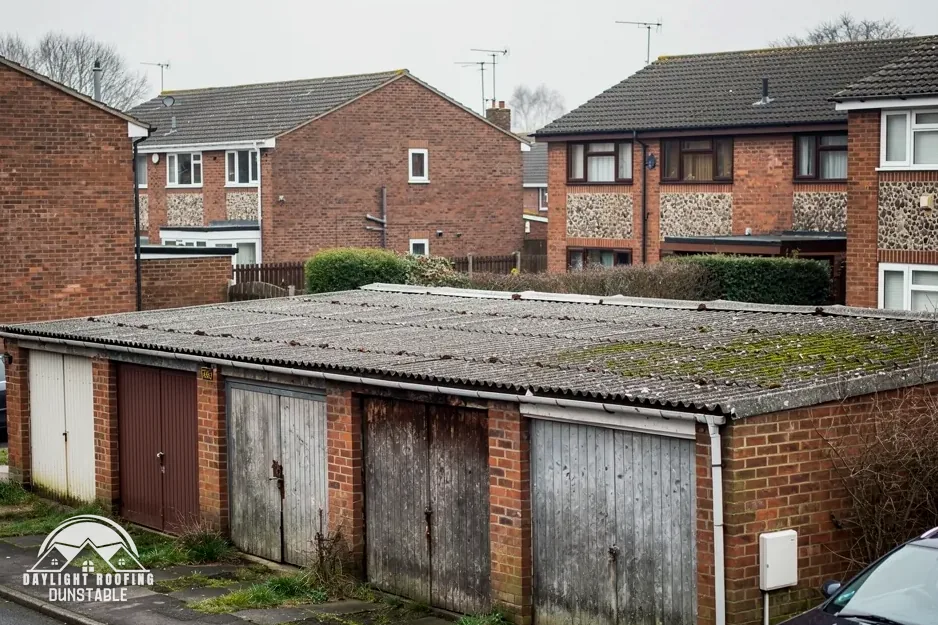
A row of brick garages with an old flat roof behind houses

Harlington roof words

Flashing
A metal strip sealing the joint between a roof and a wall or stack.
Escape window
A window that opens wide enough to get out through in an emergency.
Gable
The upper part of an end wall that rises to the peak of a pitched roof.
Bracket
The fixing that holds a gutter to the fascia or the wall.

The plain-as-day roof check

Four Harlington checks, from the ceiling to the loft window

4 checks about 3 minutes to read

  1. Reading a ceiling stain
  2. Lead flashing and higher codes
  3. Escape openings for a loft room
  4. Gutter edges and brackets

01 Reading a ceiling stain

A brown ring on a ceiling is a record of where water has been, and its shape says something about where it came from. A stain that spreads along the line of a joist suggests water running down a rafter before it drops. A drip that appears only during heavy rain points to a path that is open only when the volume is high.

Mark the edge of a stain in pencil and write the date beside it, then look again after the next rain. If the ring has grown, water is still arriving. If the ring sits right under a bathroom, a tank or a pipe run, the pipework needs ruling out before the roof takes the blame. Put a photograph of the ring and a photograph of the slope above it through WhatsApp for a first look, before anyone climbs anywhere. A bucket under a drip and a towel on the floor buy time without hiding the evidence.

02 Lead flashing and higher codes

Flashings are the strips that seal a roof against a wall or a stack, and lead is the traditional sheet for them. MyJobQuote says "When correctly installed, lead flashing can last for over 80 years (over 100 years for higher codes) with minimal maintenance." Rolled lead sheet is made to BS EN 12588 in codes 3 to 8, from code 3 at 1.32 mm to code 8 at 3.55 mm, so the code on a quote tells a reader how thick the sheet is, and a thicker code is a heavier sheet.

Weights are given by the maker: for code 5 both Calder and Ecobat list 25.40 kg/m², and for code 7 both list 35.72 kg/m². Which code suits which detail is set by the specification, so a quote should say which code is meant at each joint, and a reader can ask for it. From the ground, a flashing that has lifted at an edge, split along a fold or left a gap against brickwork is worth a picture. MyJobQuote's chimney leadwork figures cover chimney leadwork only.

03 Escape openings for a loft room

A loft conversion changes the way people escape from a house. Escape windows serve storeys up to 4.5 m above ground. Approved Document B gives the size of a window that counts: "A minimum area of 0.33m2.", "A minimum height of 450mm and a minimum width of 450mm", and "The bottom of the openable area is a maximum of 1100mm above the floor." A roof window that is too small, or set too high above the floor, does not meet that description.

When a conversion makes a new storey above 4.5 m, paragraph 2.5 offers two answers, a protected stairway or an alternative escape route, and paragraph 2.23 adds sprinkler protection as a choice for open-plan areas. The Approved Document is the 2019 edition incorporating 2020, 2022, 2025 and 2026 amendments. Building control, from the council's team or a registered approver, is where these points are agreed before work starts.

04 Gutter edges and brackets

Water that misses a gutter runs down a wall, and a gutter that overflows at one point is telling a reader where the trouble is. Check whether it is a joint, a sagging length, a bracket that has pulled away from the fascia or a blocked outlet. Brett Martin gives the fall as "1mm for every 600mm" towards the outlet, so a length that holds water along its run has lost that fall.

A fascia board that is soft, split or stained below the gutter has been wet for a while. The ground tells a good deal, so look for green streaks below a joint, a dark line down the wall under the eaves and brackets that no longer sit in line. Photograph each, note the date, and keep the pictures together. A dated set shows whether a fault is new or has been there a while, which is useful to a surveyor and to an insurer. Which? Trusted Traders priced clearing front and rear gutters at £75-£350, excluding VAT, in November 2025.

The dashed ring takes in the nearest towns and villages we cover around Harlington. Map tiles © Esri; map data © OpenStreetMap contributors.

Harlington roof questions, from ceiling to church

01When does a damp ceiling in Harlington mean the roof rather than the plumbing?

Pattern and timing separate the two. A stain that grows only after rain, and sits below the roof slope or a stack, points to the roof. A stain that grows on a dry day, or lies under a bathroom or a cold-water tank, belongs to the pipework. Dated photographs of the ring, taken after each spell of weather, show which. Send them through WhatsApp with a picture of the roof above. If a visit looks sensible, the survey covers the whole roof, and anything else seen on it is reported plainly.

02What does a faculty cover for the roof of Saint Mary the Virgin?

The Church of Saint Mary the Virgin is Grade I, list entry 1321734, first listed 23 January 1961, and belongs to the Church of England. Such a church in use is subject to the faculty jurisdiction of the Church of England, and that system takes the place of listed building consent. Swapping roof lead or other covering for the same material falls under List B, which calls for the archdeacon's written notice. A church's own contacts know which route a given repair takes. Planning permission is judged separately, so a change to the outside of the building goes through the council's own tests as well.

03Harlington Manor is Grade II*: how does that shape a roof repair?

Harlington Manor is Grade II*, list entry 1137774, first listed 22 October 1952. Mulberry Cottage and Straw Plait are on the same list at Grade II. Consent under the listed building rules covers works "in any manner which would affect its character as a building of special architectural or historic interest". The roof is part of the building the entry describes, and a repair that alters the look, the covering or the detail can meet that test. Ask Central Bedfordshire Council, name the entry number, and keep the reply with the quote. The entry number is the clearest way to identify the building, since two houses on one street can have different listings.

04What are the Grade II listings at Mulberry Cottage and Straw Plait?

Mulberry Cottage is Grade II, list entry 1312167, first listed 23 January 1961. Straw Plait is Grade II, list entry 1113916. Each entry names one building. A neighbouring house is not listed because it stands beside one, and the National Heritage List for England settles the point for any address. If a cottage roof is listed, a re-cover needs the same question put to the council as a repair does, because consent turns on character and not on the size of the job.

05How does the Harlington conservation area affect permitted development?

Central Bedfordshire Council designated the Harlington conservation area, and its guidance says that permitted development rights are stricter for properties within conservation areas. That tightening is why a window in a slope, a new covering or a change of shape is checked with the council before an order is placed. Whether an address sits inside the area is the council's call, and it can be asked for in writing. An Article 4 direction can remove further permitted development rights, so we check with the council first. For a roof alteration, the answer for the specific address, in writing, is the thing to hold, and the planning guide shows how it fits the national rules.

06What does Harlington's building control team look at on a re-roof?

Central Bedfordshire Council's own building control team is on 0300 300 8635, a number for building control, not for planning enquiries. Re-roofing is covered by the Planning Portal's two limits, and a complete re-roof exceeds the second, the 50 per cent roof limit. A covering that adds 15 per cent or more to the weight of the existing one needs approval too, and a heavier roof is a question about the rafters beneath it as well as the tiles above. The team checks work against the Building Regulations and, where the work complies, issues a completion certificate. A registered building control approver is the private alternative, and gives a final certificate instead of a completion certificate. Either way, the certificate is a document worth keeping in the file for the house.

07What should be done with a Harlington garage roof that may contain asbestos?

HSE says "If the building was built or refurbished before 2000, assume that there is asbestos in it." It also says "AC roofs are always fragile", so nobody should walk on one. Asbestos waste goes in a lockable skip, because "it is not good enough to throw sheeting over a standard skip". The household consignment-note exemption is "other than asbestos waste". Do not break, drill or scrub the sheets, and send a photograph for a first view. A picture taken from the ground, with the date on the file, lets the sheets be seen without being disturbed.

08What do outside guides give for conservatory roof replacement near Harlington?

MyJobQuote says "In 2026, the average conservatory roof replacement costs between £3,200 and £6,000" (page dated 20 October 2026). On lifespan, HomeBuilding's own line is that polycarbonate has "a typical lifespan of 10 years". The longer figures belong to someone else: Roofing Megastore's managing director, quoted by HomeBuilding, puts glass at likely beyond 30 years and tiled at beyond 50. None of these is a price for a particular Harlington conservatory. The figure for one is set after a survey, as a single total in writing. Whether a solid roof can replace glass or polycarbonate is a building control question first.

09Where does a Harlington homeowner turn if roof work falls short?

Write to the firm first and keep a copy. The Consumer Rights Act 2015 section 49 is headed "Service to be performed with reasonable care and skill". Under the Consumer Contracts Regulations a Harlington homeowner who signs indoors following a survey has 14 days to cancel, the first of them falling on the day after the signature. The Citizens Advice consumer helpline, 0808 223 1133, advises individuals, which Trading Standards does not. Dated photographs, the written quote and all messages are the evidence that matters.

Get a written price for your roof

10-year workmanship guarantee, in writing

Tell us about your roof

Call WhatsApp Written quote