
Call 01582 935272

Maulden · 13 road miles north

Roofers in Maulden

To reach Maulden from Dunstable is a run of 13 road miles to the north, about 25 minutes. A roof here is surveyed before any price is named, and the price comes as a single total in writing.

Get a written quote

Call 01582 935272WhatsApp us

Council
Central Bedfordshire
Road miles
13
Conservation area
Maulden
Building control
Central Bedfordshire

Maulden's roofs beside the White Hart and Moor Lane

Maulden lies in Central Bedfordshire, 13 miles by road to the north of Dunstable, with a drive of about 25 minutes. The 2021 Census recorded 3,234 usual residents in Maulden parish. Saint Mary the Virgin church, listed Grade II*, stands among them. The White Hart Inn, Chestnut Tree Farmhouse and 15 and 17 Moor Lane are each Grade II. Bolebec Farm moated enclosure, with its associated platforms and enclosures, is a scheduled monument recorded near Maulden, and Central Bedfordshire Council has designated the Maulden conservation area.

That mix of designations makes the first question about any Maulden roof one for the council, not the roofer. The planning guide sets out the general rules, and the roof repairs page covers small faults. Where a slope has been re-covered or needs to be, the pitched roofing page describes that work, and the lead roofing page covers the metalwork round valleys and bays.

  1. 01Saint Mary the Virgin churchGrade II*, list entry 1321701, first listed 23 January 1961, Church of England. Its roof falls under the faculty system.
  2. 02The White Hart InnGrade II, list entry 1113923, first listed 22 October 1952. The entry names the inn, and its roof is part of it.
  3. 03Chestnut Tree FarmhouseGrade II, list entry 1113924, first listed 23 April 1980. Roof work is raised with the council before it is priced.
  4. 04Bolebec Farm moated enclosureA scheduled monument, list entry 1010970, recorded near Maulden. Works need scheduled monument consent.
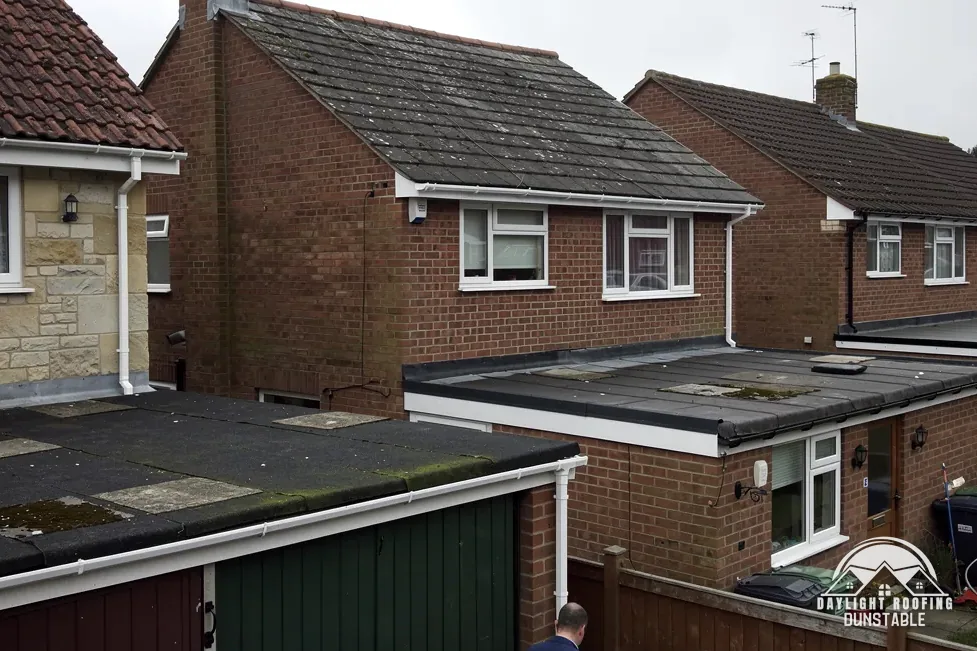
Flat-roofed garages behind brick semi-detached houses

Maulden roofing words

Valley
The V-shaped fold in a roof where two planes of tiles drain into one line.
Chimney pot
The clay or metal pipe fitted on top of a flue.
Crown
The slab of mortar or concrete that caps the top of a chimney stack.
Cheek
One of the two side panels that enclose a dormer window.

The plain-as-day roof check

Four Maulden checks, from the valley to the chimney crown

4 checks about 3 minutes to read

  1. Valley lines
  2. Chimney pots and crowns
  3. Bay and dormer roofs
  4. Tile life, as makers describe it

01 Valley lines

The V-shaped fold between two roof planes is a valley, and rain from both planes crosses it. Leaves, moss and silt settle along the fold and slow the flow, and the lining under the tiles or slates does the real work of keeping water out. From the lawn, trace the fold from ridge to gutter and note any debris, an edge tile that has lifted, or staining on the wall beneath the point where the fold meets the gutter.

A valley lined in lead is judged by the code of the sheet and the way it is dressed. Rolled lead sheet is made to BS EN 12588 in codes 3 to 8, and the specification names the code to use for each detail. A valley is a bad place for a guess: a repair that stops a stain in the ceiling may leave water moving behind the lining, so a survey follows the line from the gutter at the foot up to the ridge.

02 Chimney pots and crowns

The top of a stack has three parts that can be seen with binoculars: the pot, the flaunching that holds it, and the crown that caps the brickwork. A crown with hairline cracks lets water into the flue and the brickwork, and a pot that has loosened can move in strong wind. The shoulders of the stack and its top courses are worth a close look, since mortar that has gone soft there lets water into the masonry.

None of this needs a ladder. Photograph the stack from the garden or the road in even light, then zoom in on the crown and the shoulders. A stack that leans, or one with a gap showing between pot and flaunching, deserves a prompt look from a surveyor. Chimney lead flashing is a separate item: MyJobQuote puts a patch repair at around £200 and a full replacement at around £570 (page dated 22 September 2026).

03 Bay and dormer roofs

A small roof above a bay window, or the sides and top of a dormer, forms a separate roof with joints of its own. The sides are where wall meets roof, and they are sealed with flashings. The top can be flat or at a shallow pitch, which makes it a place where water lies. Look for a lifted flashing, a gap at the corner or damp staining on the window frame inside.

Because these roofs are small, their problems are easy to put off, and a bucket in the room below tells the story later. A bay roof that is allowed to leak can wet the lintel above the window and the plaster beneath it, so a stain at the top of a window frame is worth a note. For a bay or dormer on a listed building or in the conservation area, any change to its roof is first a question for Central Bedfordshire Council. A repair that matches the existing work is discussed with the council, with the list entry quoted, and the council's answer is kept with the quote.

04 Tile life, as makers describe it

HomeBuilding's approximate lifespans, from a page last updated on 30 September 2025, are 100+ years for Welsh slate, 60-80 years for clay tiles and 40-50 years for plain concrete tiles. The BRE determined a minimum life expectancy of 60 years for clay tiles, and Marley says "This is not a guarantee or warranty of its longevity." Those are published expectations, not predictions for a given Maulden roof. The survey reads the fixings as well as the surface.

What shortens a tile's life in practice is a matter for the survey: fixings that have failed, a surface that has been scoured, edges that have been walked on. Marley says high powered jet washes are "not recommended as it can damage the surface of the slate or tile, thus reducing its expected life considerably". Where moss needs removing, the method is worth settling before work begins, and Checkatrade says roof cleaning typically costs £8.50 to £14 per m² (April 2026).

The dashed ring takes in the nearest towns and villages we cover around Maulden. Map tiles © Esri; map data © OpenStreetMap contributors.

Maulden roof questions, from valley to monument

01Which Maulden roof faults can a householder spot from the garden?

A valley, a bay and a stack each carry water from elsewhere on the roof, so one stain can have two or three candidate sources above it. A valley with leaves piled in it, a chimney crown with cracks, a flashing that has lifted at a bay and a ridge that dips are all visible from the ground. Binoculars let a householder see more than a phone does, and a picture taken on a dull day shows edges better than one in low sun. Photographs sent by WhatsApp are looked at, and a survey covers the full roof if a visit makes sense, with anything else seen on it reported plainly. Staying on the ground is the safer course, since a zoomed picture carries enough detail for a first opinion.

02What consent does the Maulden church roof need?

Maulden's parish church, Saint Mary the Virgin, is Grade II*, list entry 1321701, first listed 23 January 1961, and belongs to the Church of England. A church in use has its own consent system under the faculty jurisdiction of the Church of England, which takes the place of listed building consent. List B of the Faculty Jurisdiction Rules takes in swapping roof lead or covering for identical material, and the archdeacon's written notice could then be sufficient. Whether planning permission is also needed is for the council to judge.

03How are works near Bolebec Farm moated enclosure treated?

Bolebec Farm moated enclosure, associated platforms and enclosures is a scheduled monument, list entry 1010970. A scheduled monument is not a listed building, and the listed building consent provisions "shall not apply to any building for the time being included in the schedule of monuments". Consent is a matter for the Secretary of State, with requests lodged at Historic England, and nothing should start before it is in place. For a Maulden house the question is different: whether the monument touches that address, which the council can answer.

04Which Maulden buildings are listed Grade II, and what follows?

The White Hart Inn (list entry 1113923, first listed 22 October 1952), Chestnut Tree Farmhouse (entry 1113924, first listed 23 April 1980) and 15 and 17 Moor Lane (entry 1321703) are Grade II. A listed building's character is the test for consent, and the roof is one of the things that make up that character. Even a repair that matches the existing work goes to the council first. What counts is the effect of the work and not its size, so the entry number is quoted when asking and the reply is filed with the quote.

05What does the Maulden conservation area change about a roof job?

Central Bedfordshire Council designated the Maulden conservation area, and its guidance says permitted development rights are stricter for properties within conservation areas. An Article 4 direction can remove further permitted development rights, so we check with the council first. Ask the council two things about an address: is it inside the area, and does any direction apply? Ask for the reply by email, so it can be forwarded to whoever is pricing the work. Keep that reply with the quote, because it is the clearest record of what was agreed and when.

06Does a Maulden extension at the boundary need a party wall notice?

Where a new wall is to stand astride or against the boundary, section 1 of the Party Wall etc. Act 1996 sends notice to the adjoining owner "at least one month before he intends the building work to start". Silence from a neighbour for 14 days makes them "deemed to have dissented". Dissent opens the surveyor procedure and does not amount to a veto, so work can still go ahead once the procedure is complete. GOV.UK says "You cannot assume that no response means they agree to the works." A party wall surveyor, not building control, answers these questions.

07What changed for private building control in April 2024?

Only the registration regime is new. Building control is carried out by the council's team or by a registered building control approver, and the regulations setting up the registration regime came into force on 6 April 2024. Private building control existed before that date, so what changed is the registration, not the existence of a private route. Where work complies, a council's building control team gives a completion certificate, and a registered approver gives a final certificate. Central Bedfordshire Council's own team is on 0300 300 8635, a line for building control, not planning.

08Who can advise a Maulden household on energy bills and insulation?

GOV.UK's energy adviser line is 0800 098 7950. GOV.UK lists loft insulation and heating upgrades among the schemes open in England, and a new roof is not on that list. Under HMRC's Notice 708/6, a supply made between 1 May 2023 and 31 March 2027 is zero-rated where it installs insulation in "roofs or lofts", and the reduced rate of 5% follows after that. A quote that mentions VAT on insulation can be checked against that notice, with the supplier asked which treatment is applied. The same check suits any energy-saving work wrapped into a roof job.

09Is a Maulden homeowner a client under the construction regulations?

Yes, a homeowner who has a roof replaced is a domestic client, someone with building work done on their own home rather than for a business. Under regulation 7 of CDM 2015, a household's client duties pass to "the contractor for a project where there is only one contractor", and, where several contractors are on the job, to the one appointed principal contractor. The regulations also call for a construction phase plan, which is the written plan for the building work. HSE confirms that the duties of a client apply to work on a home even where no business is involved. The household can ask the firm quoting which arrangement applies.

Get a written price for your roof

10-year workmanship guarantee, in writing

Tell us about your roof

Call WhatsApp Written quote