
Call 01582 935272

Great Brickhill · 11 road miles north-west

Roofers in Great Brickhill

Flashing repairs, tile and slate work and re-roofs in Great Brickhill, 11.1 road miles north-west of Dunstable; every job ends in a single written price after the survey.

Get a written quote

Call 01582 935272WhatsApp us

Council
Buckinghamshire
Road miles
11
Building control
Buckinghamshire Council

Roofs on Lower Way and Rotten Row

Great Brickhill is a village in Buckinghamshire, 11.1 road miles from Dunstable, about 22 minutes by road to the north-west. At the 2021 Census, Great Brickhill parish had 859 usual residents. The village has a conservation area, and its listed buildings take in St Mary's church at Grade II*, Robin Cottage, 28 Lower Way and 6, Rotten Row. A roof job in the village starts with learning which of those labels, if any, touches the address. The listed buildings are houses and a church, so the checks differ between a house roof and the church roof, and each gets its own look during the survey.

Planning questions for Great Brickhill houses are decided by Buckinghamshire Council, and the planning guide shows the national rules it works from. The price waits for the survey, and whatever else turns up there is mentioned alongside the single written total. If a ceiling has been marked by a drip, the roof repairs page is a good place to start, and a photograph sent to WhatsApp, 07880 284133, speeds up the first conversation. Where the roof needs scaffolding, that is part of the quote as well.

  1. 01St Mary's, Great BrickhillListed Grade II*, National Heritage List entry 1115994, first listed on 18 October 1966. The church is part of the Church of England.
  2. 0228 Lower WayListed Grade II, National Heritage List entry 1219256, first listed on 8 January 1981.
  3. 03Robin CottageListed Grade II, National Heritage List entry 1116001, first listed on 6 July 1984.
  4. 046, Rotten RowListed Grade II, National Heritage List entry 1320148, so roof work at 6, Rotten Row is put to the council first.
  5. 05Great Brickhill Conservation AreaDesignated by Buckinghamshire Council; ask the council whether your address is inside it or under an Article 4 direction.
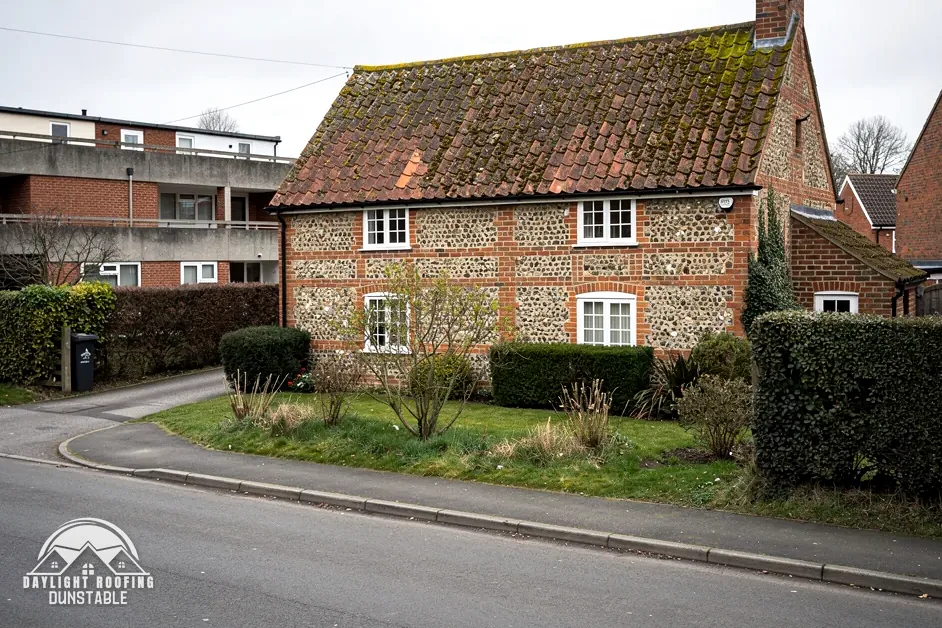
A flint and brick cottage with a clay tile roof beside a quiet road

Great Brickhill roof words, plainly put

Abutment
Where a roof slope meets a wall that rises above it.
Step flashing
Stepped metal pieces that seal a roof against a rising wall.
Article 4 direction
A council power to remove named permitted development rights from a mapped area.
Ridge sag
A dip in the line of the top of the roof, where the structure has moved.

The plain-as-day roof check

Four checks for a Brickhill roof, wall to ridge

4 checks about 3 minutes to read

  1. Abutments and step flashings
  2. Battens from the loft side
  3. Birds at the eaves and gable
  4. A dip along the ridge

01 Abutments and step flashings

Where a roof slope runs up against a wall, such as a gable, a chimney side or an extension, the join is sealed with a flashing. On a pitched roof it is cut as a series of steps that follow the brick courses. Look for metal that has peeled away from the wall, joints that have opened, and a dark streak below the line on the brickwork. A pair of binoculars or the zoom on a phone camera from the road shows the line of the flashing against the brick.

A failed abutment lets rain run behind the covering and down the inside of the wall, so the damp can show a long way from the flashing. MyJobQuote says correctly installed lead flashing can last for over 80 years, so a flashing that has failed early is worth a closer look at how it was fixed. The lead roofing and leadwork page covers the repair.

02 Battens from the loft side

Inside the loft, the battens (the thin timbers that carry tiles and slates) show on the underside of the covering. Look at them in daylight for dark patches, splits and soft spots, and at the underlay between rafters for sagging or tears. Battens left damp for years can give way under the weight of the tiles they carry. A torch held low across the underside shows up the surface better than a ceiling light. A phone torch shone along the underside of the battens picks out splits that daylight misses.

Step only on the joists or a board, and never lean on the ceiling beneath. Pinpricks of light mean gaps in the covering, and a smell of damp means water has been getting in. Photograph what you see and send it over. The survey that follows starts outside, and the written price reflects what is found. A phone video panned slowly along the rafters is a good record.

03 Birds at the eaves and gable

Gaps under the eaves and behind the verge attract birds, and a nest there can block a gutter or loosen a tile. The law is that anyone who "takes, damages or destroys the nest of any wild bird while that nest is in use or being built" intentionally commits an offence. So an active nest, in use or being built, stays put until the birds have finished.

The offence turns on whether a nest is in use or being built, so an abandoned one is a different matter from an active one. If you are unsure, photograph it from a safe distance and send the picture. Bat roosts are protected differently, and a licence can be needed for roof work where bats are present.

04 A dip along the ridge

Stand at the end of the road, shut one eye and check the ridge line for any dip or bow. A slight wave in a long old roof is not always a fault, but a new dip, or one that has deepened, means something under the covering has moved. It may be a rafter, a purlin or the wall that carries them. Check the chimney stack too, because a stack that leans along the ridge line can pull the roof with it. A tape measure laid against the ridge from each end gives a rough sense of how long the dip runs.

A level and a taped string line across a gable wall give a rough check, but structural movement is for a survey. Cracks in the plaster at the top of an upstairs wall, doors that stick and a gap between the ceiling and the wall are further signs. A sagging ridge is not a job to patch, because the cause has to be found first. Photographs taken a month apart make any change easy to see.

The dashed ring takes in the nearest towns and villages we cover around Great Brickhill. Map tiles © Esri; map data © OpenStreetMap contributors.

Great Brickhill roof questions, one at a time

01What does a flashing do where a Great Brickhill roof meets a wall?

A flashing is a metal strip, lead for example, sealing the join where a roof slope meets a wall that rises above it. It sits in a cut in the mortar and is dressed down over the covering, so water runs off it instead of behind it. Where the wall is a gable or a chimney side, the metal is cut into steps. Where a flashing has lifted or split, water gets into the wall, and the survey follows the join from end to end before the one written total is given. A photograph taken from the garden shows whether the metal has lifted from the brick. Photographing the flashing from each side of the wall gives the clearest picture.

02Could an Article 4 direction reach a roof on Lower Way or Rotten Row?

An Article 4 direction withdraws named permitted development rights from a mapped area, and only the council can say whether one reaches a Great Brickhill address. Ask Buckinghamshire Council whether an Article 4 direction covers your address before any job is planned. A direction for one site, or for a change of use, does not speak to a house roof, so a nearby entry settles nothing by itself. The village also has a conservation area, which Buckinghamshire Council designated, and the planning guide explains what permitted development allows for a roof. We make that enquiry to the council before work is booked.

03How does the Church of St Mary in Great Brickhill approve roof work?

The Church of St Mary is Grade II* with list entry 1115994, and it belongs to the Church of England. Faculty approval is the system for a church still in use, and it replaces listed building consent. For like-for-like work on the roof covering, the archdeacon's written notice can be all that is needed. Any exterior change might also meet a planning question. Who applies for the faculty is the church's decision, so a householder has no part in it. The roof of the church is looked after through its own process, which a householder never needs to start.

04Is 28 Lower Way, Robin Cottage or 6, Rotten Row a listed roof?

Yes. 28 Lower Way is Grade II (entry 1219256), Robin Cottage is Grade II (entry 1116001) and 6, Rotten Row is Grade II (entry 1320148). Consent for works "in any manner which would affect its character as a building of special architectural or historic interest" is listed building consent. Whether a roof repair touches character is a call for Buckinghamshire Council. Listed homes keep their permitted development rights for roof work, but the character test still applies, and we put the question to the council first. A clear view of the roofline from the lane lets the council see quickly what is proposed. Roof repairs on a house in Rotten Row or Lower Way start with the same question to the council.

05Who applies for the scaffold licence in Great Brickhill?

The highway authority licenses any scaffold that obstructs a pavement or road, under section 169 of the Highways Act 1980, and in Great Brickhill that is Buckinghamshire Council. Buckinghamshire Council charges £402.78 for a 28-day licence, £69.09 for renewal and £777.63 for a retrospective licence, and it says "You must be a registered scaffolding company to apply for a licence." We arrange the licence with our scaffolder. The cost of scaffolding is part of the written total. A scaffold wholly on private land raises no highway question.

06What might re-covering a Great Brickhill semi cost, by material?

HomeBuilding, last updated 30 September 2025, says re-roofing a three-bedroom semi with a 65m² roof in plain concrete tiles "may cost between £10,000 and £15,000", while Welsh slate "might reach £18,000". Those are another publisher's figures for one type of house, not our price. Our price is a single figure in writing, set after the surveyor has seen the roof, and it moves with access, the covering, the size of the roof and whatever the survey turns up. Writing the covering and the roof area into the quote lets you compare like with like.

07What U-value applies to the roof of a new extension in Great Brickhill?

Approved Document L 2021, Table 4.2, gives 0.15 W/m²K for a roof in new fabric on an existing dwelling. A roof that is renovated rather than newly built is judged on Table 4.3, with a 0.35 threshold and an improved 0.16 W/m²K, so the two tables must not be mixed. Windows set in a new roof slope are a separate row, at 1.4 W/m²K or Window Energy Rating Band B minimum. Buckinghamshire Council's own building control service decides whether a design complies, and its contact details are on the building control section of its site. A drawing of the proposed roof makes that conversation easier.

08What if work on a Great Brickhill roof goes wrong?

The law asks for a "Service to be performed with reasonable care and skill". When something has gone wrong, begin with a letter to the firm that includes photographs and dates. Individuals get advice from the Citizens Advice consumer helpline on 0808 223 1133, which Trading Standards does not give. If you signed the contract at home, the right to cancel lasts 14 days from the day after it was made, unless you asked for the repair visit to be urgent. Keep the written price, photographs of the roof before work starts and every message you send. Citizens Advice can also explain the steps to take if the firm does not reply.

09How do I look up flood risk around Great Brickhill?

A flood question is about one site. GOV.UK's long-term flood risk service describes an area and gives no verdict on one house, and a planning application takes its flood zone from the Environment Agency's flood map for planning. A new roof changes neither, but a roofer can see where the downpipes end, and a downpipe that empties against a wall base in Great Brickhill is easy to redirect. The survey checks where every outlet discharges. Rainwater that lands against a wall base keeps the brickwork wet, so redirecting a downpipe is a modest job with a visible benefit.

Get a written price for your roof

10-year workmanship guarantee, in writing

Tell us about your roof

Call WhatsApp Written quote