
Call 01582 935272

Stoke Hammond · 13 road miles north-west

Roofers in Stoke Hammond

Chimney, flat roof edge and garage roof work in Stoke Hammond, a drive of 12.9 road miles north-west from Dunstable, finished with a single written price.

Get a written quote

Call 01582 935272WhatsApp us

Council
Buckinghamshire
Road miles
13
Building control
Buckinghamshire Council

Stoke Hammond roofs, from Stoke Lodge to Tyrell's Manor

Head north-west of Dunstable for 12.9 road miles, about 20 minutes by road, and you reach Stoke Hammond in Buckinghamshire. At the 2021 Census, Stoke Hammond parish had 2,054 usual residents. Buckinghamshire Council has designated a conservation area in the village. St Luke's church (Grade II*), Little Thatch, Stoke Lodge and Tyrell's Manor Farmhouse are among its listed buildings. For roof work, the opening question is what status the address carries, because that settles who has to be consulted before anything is ordered. It is a question worth settling early.

Planning questions for Stoke Hammond are Buckinghamshire Council's to answer, and the planning guide sets out the national rules. Pricing begins only after the survey, which also looks at whatever else is up there. Then one written total is drawn up. A stack in poor condition is covered on the chimney repairs page, and a full new covering on the roof replacement page. A photograph sent to WhatsApp, 07880 284133, is a quick way to begin.

  1. 01Church of St LukeListed Grade II*, National Heritage List entry 1115981, first listed on 18 October 1966. The Church of England is its denomination.
  2. 02Little ThatchListed Grade II, National Heritage List entry 1115980, first listed on 6 July 1984.
  3. 03Stoke LodgeListed Grade II, National Heritage List entry 1115979, first listed on 6 July 1984.
  4. 04Tyrell's Manor FarmhouseListed Grade II, National Heritage List entry 1115976, so a change at Tyrell's Manor Farmhouse that touches its character needs consent.
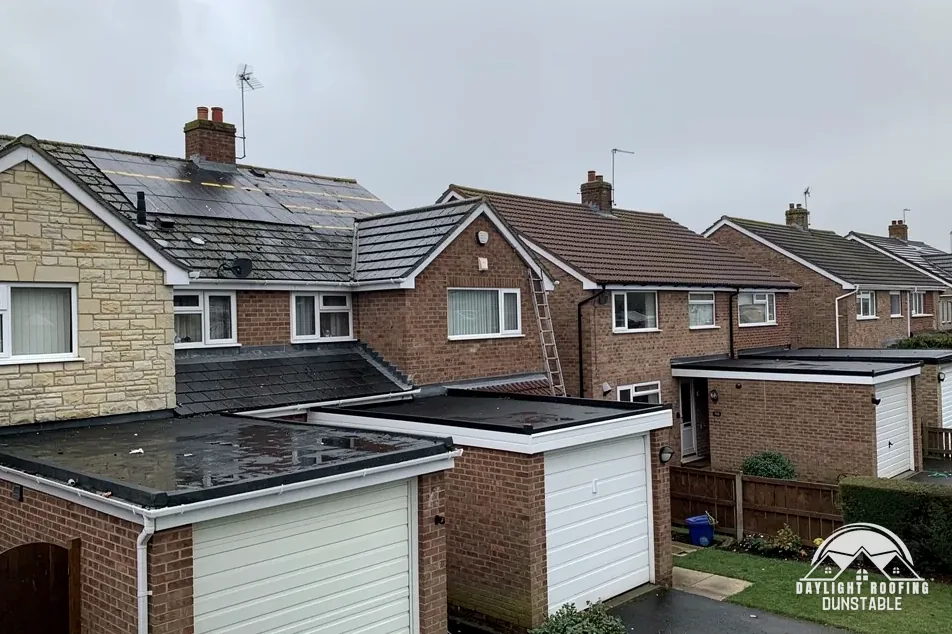
Brick semis with concrete tile roofs and flat-roofed garages

Stoke Hammond terms, in plain English

Chimney cap
A cover over the top of a flue or stack that keeps rain out.
Drip edge
A trim along the roof edge that sheds rain away from the brickwork.
Underlay
The sheet under the battens that backs up the tiles or slates.
Storm damage
Damage to a roof caused by a storm, as an insurer defines it.

The plain-as-day roof check

Four checks on a Stoke Hammond roof, cap to edge

4 checks about 3 minutes to read

  1. Chimney cap and flue top
  2. Flat roof edge trims
  3. Underlay showing at the verge
  4. Brickwork under the eaves

01 Chimney cap and flue top

From the garden, look at the very top of the chimney. A cap or a cowl over the pot keeps rain out of the flue, and a flue with no cap, or with a cracked pot, is open to every shower. Rain that gets down a flue can stain the chimney breast inside the house and drip into a fireplace that is not in use. Binoculars help if the stack stands high above the road.

Look too for a stack that leans, brickwork that is crumbling at the top and mortar that has washed out of the joints. A cap can be fitted over a pot without any change to the roof. If you see an open flue, photograph the stack against the sky and send the picture, and we can say what looks to be missing. A new cap is a small job that protects the plaster and the fireplace below.

02 Flat roof edge trims

At the edge of a flat roof, a metal or plastic trim guides water into the gutter and keeps it from running back under the membrane. Look for trims that have lifted, gaps in the joints, a gutter that sits too low to catch the flow and a dark line down the wall below the edge. Water that gets behind a trim soaks the board underneath. A torch beam along the edge of the membrane, at dusk, shows lifted sections.

NFRC's key points on BS 6229:2025 call for "a minimum 1:80 finished fall for general roof areas and internal gutters", so the roof should slope towards the edge that carries water away. A flat roof that falls back towards the house wall is a design fault, not a maintenance one, and a survey will say so plainly. A drip trim set too high will not clear the wall.

03 Underlay showing at the verge

At the sloping edge of a roof, the verge, the underlay beneath the tiles should be tucked in and covered. If you can see grey sheet sticking out past the last tile, flapping in a wind, or torn along the edge, the roof's second barrier is exposed. Sunlight breaks down some underlays, and wind can lift a loose edge and rip it. A strip of underlay flapping at the verge is easy to spot from the pavement.

Marley says since the 2015 amendments to BS 5534 mortar "could no longer be relied upon as the only means of securing the roof covering", which makes the edge of the roof a spot to check. Photograph the verge from the ground with the zoom set wide, and note which end of the house it is on, since both sides can differ. A torn underlay is a small repair compared with the rot it can cause. A loose edge can also let rain run in behind the bargeboard, so look along the underside of the board.

04 Brickwork under the eaves

Look at the top courses of brickwork where they meet the roof. Cracked mortar, a stain that runs down from the eaves, flaking brick faces and green growth are signs that water has been reaching the wall from the gutter or the roof edge. The fault might be a blocked gutter above, a failed joint in a hidden gutter or a tile that no longer overlaps. Look from the same spot after rain to see where the water runs. A line of dark stain right at the top of the wall points to the roof edge as the source.

Brick that stays wet can crumble in a hard frost, so a wall in this condition is worth attention before winter. Do not fill cracks with sealant before the cause is found. Photograph the stained area, note the date and any recent rain, and the survey follows the water uphill from the stain to its source on the roof or in the gutter. Moss on the brick below a gutter shows where the water has been running.

The dashed ring takes in the nearest towns and villages we cover around Stoke Hammond. Map tiles © Esri; map data © OpenStreetMap contributors.

Stoke Hammond roof questions, in plain English

01What does a chimney cap do for a Stoke Hammond house?

A cap or cowl sits over the pot and stops rain, birds and debris from entering the flue. Without one, water runs down the flue, can stain the chimney breast inside and can drip into the grate. Caps are fitted to flues in use as well as those that are closed off, though a closed flue still needs air so it does not stay damp. The survey looks at the cap, the pot and the top of the stack together, and the written total covers any fix that follows. A photograph from the garden shows a missing cap clearly. If the flue serves a stove or boiler, ask a specialist about the right cap, because some appliances need a particular type.

02Does the Stoke Hammond Conservation Area or an Article 4 entry affect a roof?

Stoke Hammond has a conservation area in Buckinghamshire Council's designation list, and Buckinghamshire Council has Article 4 entries on its planning records. A direction of that kind strips named permitted development rights from an area, and what any one direction removes is for the council to explain. Ask Buckinghamshire Council whether an Article 4 direction covers your address before you plan roof work. The planning guide sets out what permitted development allows on a house roof, and the council gets our question first. A call to the council before the job is booked settles the point.

03How does St Luke's Church in Stoke Hammond get roof repairs approved?

St Luke's is a Church of England church, Grade II* on entry 1115981. A church in use belonging to it gets building work approved by faculty, which stands in for listed building consent. List B lets like-for-like replacement of a lead or other roof covering proceed on the archdeacon's written notice. Separately, work to the church's exterior may call for planning permission too, as a separate question. A Stoke Hammond house never goes through this route; its roof follows the planning guide.

04Are Little Thatch, Stoke Lodge and Tyrell's Manor Farmhouse listed?

Yes. Little Thatch is listed Grade II under entry 1115980, Stoke Lodge is Grade II under entry 1115979 and Tyrell's Manor Farmhouse is Grade II under entry 1115976. Listed building consent is needed for works "in any manner which would affect its character as a building of special architectural or historic interest". Buckinghamshire Council is the body that judges whether a roof repair has that effect, and a photograph of the roof helps the council to see what is proposed. Listed homes keep their permitted development rights for roof work. Moving a ridge tile on such a house needs the same care as repairing a roof covering.

05Who licenses scaffolding for a Stoke Hammond roof repair?

Highways Act 1980, section 169, puts a licence in front of any scaffold on the footway or the carriageway, and at Stoke Hammond that falls to Buckinghamshire Council. Buckinghamshire Council charges £402.78 for 28 days, £69.09 for a renewal and £777.63 for a retrospective licence, and says: "You must be a registered scaffolding company to apply for a licence." We arrange the licence with our scaffolder, and any scaffold the roof requires sits within the single written price. A scaffold on your own land raises no highway question. Check the licence is in place before scaffolding goes up.

06Does re-covering a Stoke Hammond roof meet the Planning Portal's test?

Two limits from the Planning Portal's interactive guide mark work that normally needs no application: "Less than 25 per cent of the total 'building envelope'" and "Less than 50 per cent of the roof is affected". Re-covering all of it takes the work past the 50 per cent limit. The Portal's main page adds: "In most situations, this work will need Building Regulations approval." Building control in Stoke Hammond is Buckinghamshire Council's own service, listed on its building control page. A structural check also follows if the new covering is 15 per cent or more heavier. Heavier coverings put more load on the rafters and walls.

07How much might a Stoke Hammond garage roof cost, going by published averages?

MyJobQuote says "In 2026, the average garage roof replacement costs between £750 and £3,500." That range belongs to another publisher, from a page updated in October 2026, and it is not what we charge. The garage's size, the covering, the access and the faults found all move the total. Our figure is one written total, settled after the roof has been seen. Sheet roofing on a garage built or refurbished before 2000 may contain asbestos, so do not break it, and ask a specialist to test it. A clear photograph of the existing garage roof, from the corner of the plot, is a good start.

08What can storm damage to a Stoke Hammond roof cost to put right?

MyJobQuote says extensive storm damage repairs can cost £1,200 or more, on a page updated in October 2026. That figure comes from a published guide and is not what we charge; the extent of the damage and the access decide the total. Photograph the damage before you shift anything, then inform your insurer and keep every record. What we give is one written figure after a survey, and a photograph sent on WhatsApp, 07880 284133, gives us a first look at what has happened and what the roof needs. Your policy wording decides what the insurer will pay for, so read it early.

09How do I check flood risk around Stoke Hammond?

Flood risk is a question about one site. GOV.UK's long-term flood risk service describes the risk where an area is concerned, while a planning application finds a site's flood zone on the Environment Agency's flood map for planning. Neither tells you what will happen at your own house, and new roofing alters neither. Where the downpipes discharge after rain is worth watching, because a wet wall base in Stoke Hammond can sometimes be cured by moving an outlet or a gully. Keep a record of what you see.

Get a written price for your roof

10-year workmanship guarantee, in writing

Tell us about your roof

Call WhatsApp Written quote