
Call 01582 935272

Little Brickhill · 10 road miles north-west

Roofers in Little Brickhill

Roof work in Little Brickhill, a Buckinghamshire village reached by a 9.6-mile drive north-west from Dunstable, means a conservation area, a Grade II* church and a listed pub, and ends in one written total.

Get a written quote

Call 01582 935272WhatsApp us

Council
Milton Keynes City
Road miles
10
Conservation area
Little Brickhill
Building control
Milton Keynes Council

Roofs near the Green Man and St Mary Magdalen

The drive from Dunstable north-westwards to Little Brickhill is 9.6 miles and takes about 18 minutes. At the 2021 Census, Little Brickhill parish had 449 usual residents. Milton Keynes City Council decides planning applications in the village, and it designated the Little Brickhill conservation area on 22 March 2007. The council states "Milton Keynes has 27 conservation areas". Milton Keynes City Council's Article 4 list includes land south of Watling Street, the A5, between Bletchley and Little Brickhill, so ask the council whether any direction touches roof work at a Little Brickhill address. A short email giving the address, the covering now on the roof and the covering you want gives it what it needs.

Listed buildings can be named with grade and list entry: the Church of St Mary Magdalen is Grade II* (National Heritage List entry 1212666), White Maples is Grade II (1212671), Grade II entries are The Green Man Public House (1212674) and Home Farmhouse (1212851). Roof work on any of the houses, the pub or the farmhouse comes under listed building consent where it would affect character. Start with the planning guide, then pitched roofing and roof repairs.

  1. 01Sagging ridgesA ridge that dips between two points can mean a timber has moved or a support has failed, and it is read from the ground first.
  2. 02Tile fixingsSince the 2015 amendments to BS 5534, mortar alone is no longer relied on to hold the covering on.
  3. 03Pub and farm roofsHome Farmhouse and The Green Man are Grade II, so a covering change there is judged against the building's character.
  4. 04Verge edgesA gable's verge is open to wind on two sides, so a loose verge tile is a fixing question.
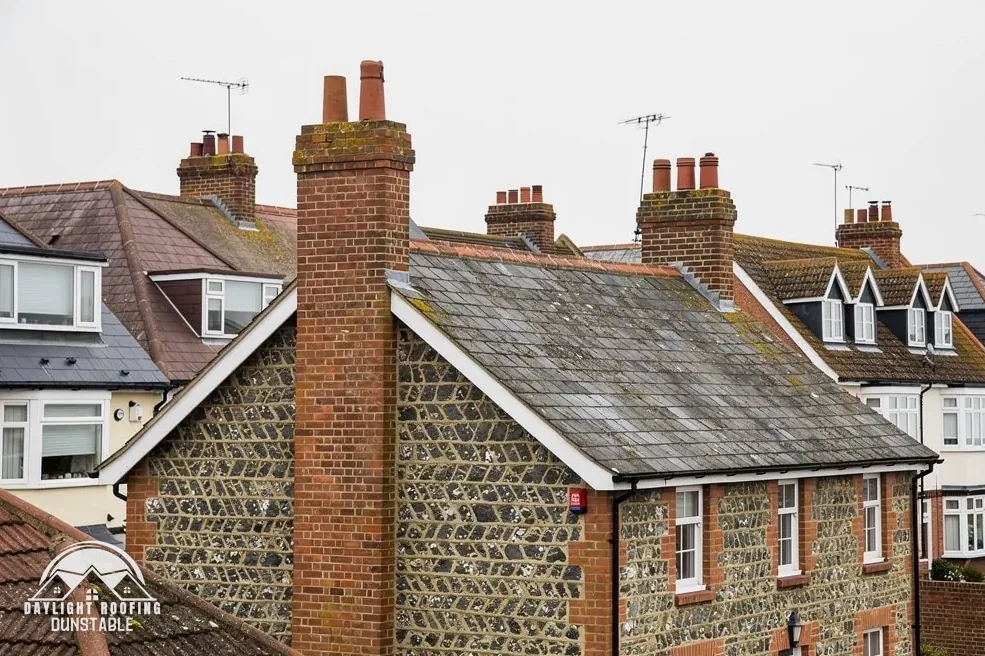
A flint and brick cottage with a grey slate roof

The roof, in plain words

Rafter
One of the inclined timbers that carry the battens and the covering.
Wall plate
The long timber bedded on a wall's top edge to take the rafters' feet.
Verge
The sloping edge where the covering stops against a gable wall.
Bedding
Mortar laid under a ridge or verge tile to seat it.

The plain-as-day roof check

Four things to read on a Little Brickhill roof

4 checks about 3 minutes to read

  1. A sagging ridge line
  2. Fixings behind the tiles
  3. Verges, bargeboards and gables
  4. Church, pub and farmhouse

01 A sagging ridge line

From the road or the garden, sight along the ridge as you would along a shelf. A gentle dip over a long span can be a sign of age in the timbers or a change in the supports below, and a sharp kink points to something more local. Look also at the chimney stack at either end: a stack that leans against the ridge line adds to the picture.

Do not guess at the cause from a photograph alone. From your own loft hatch, a bowed rafter, a dropped purlin or an opened joint may be visible. A sagging ridge is a prompt for a survey and not a job to patch from a ladder. Note the date, the angle you stood at and any cracks inside the house on the same wall. A crack that runs from a window corner across a ceiling is worth a photograph with a ruler held against it, so a later picture can be compared with the first.

02 Fixings behind the tiles

Marley says "Installing to BS 5534 isn't required by law", although BS 5534:2014+A2:2018, a code of practice, is the current edition for slating and tiling. It also notes that, since the 2015 amendments, mortar "could no longer be relied upon as the only means of securing the roof covering". Fixings follow a site-specific specification, and Marley says ridge or hip tiles "should be mechanically fixed" against wind uplift worked out for the roof.

A tile that has slid shows a pale line where it used to sit, and one that has cracked sounds different if tapped from a ladder. What matters is why it moved, so the nail or clip, the batten beneath it and the underlay are what the survey examines. Replacing a tile without finding the cause leaves its neighbours in the same condition. Where one slope has several slipped tiles and its neighbour has none, the survey looks for a reason particular to that slope, such as a failed batten run or a torn underlay.

03 Verges, bargeboards and gables

At a gable end the roof stops at the wall, and the edge is finished with a verge. A bargeboard, where there is one, hangs below the verge and covers the ends of the timbers. The verge tile has an exposed edge as well as its face, so a gust can reach it from more than one side.

Look for tiles at the edge that stand proud, mortar that has cracked and fallen, or a bargeboard that is peeling at its lower edge. Rain entering at a cracked verge runs down the inside of the gable wall, where it shows as a stain beside a bedroom window. A photograph taken along the gable from the garden, with the date, shows how far the line has moved. Gutters below a gable collect the mortar and moss that fall from a failing verge, and a blocked outlet is a second fault on top of the first.

04 Church, pub and farmhouse

Church of St Mary Magdalen is Grade II* (National Heritage List entry 1212666, first listed 17 November 1966) and is a Church of England church, and the faculty jurisdiction of the Church of England covers its roof, standing in for listed building consent. White Maples (1212671), The Green Man Public House (1212674) and Home Farmhouse (1212851) are Grade II, with White Maples and The Green Man both dating from the listing of 16 February 1984.

For those three, the test is the effect of the work on the building's special interest. A farmhouse and a pub carry large roofs with chimney stacks, valleys and outbuildings, so each part is judged separately. Sound old tiles can be lifted, set aside and reused, and the council can say what else a listing requires before any order is placed. Chimney stacks on older buildings are part of the roofline the listing protects, so their lead and pointing are repaired like for like.

The dashed ring takes in the nearest towns and villages we cover around Little Brickhill. Map tiles © Esri; map data © OpenStreetMap contributors.

Roof questions from Little Brickhill households

01What does a sagging ridge on a Little Brickhill house mean?

It can mean a timber has moved, a support has dropped or the roof has spread slightly under its own load, and from the ground you cannot say which. A gentle dip over a long span differs from a sharp kink. Sight along the ridge from two positions and photograph it with the date. Then look in the loft for a bowed rafter, a dropped purlin or an open joint, standing on a board laid across the joists and never on the ceiling. A sagging ridge needs a survey, and the written total comes after it, based on what is found.

02How do faculties work for the Church of St Mary Magdalen in Little Brickhill?

Church of England churches in use sit outside listed building consent, and for this Grade II* building that means the faculty system instead, run through the Church of England's own courts. List B holds "The like for like replacement of roof lead or other material covering the roof of a listed building", and for that sort of job the archdeacon's written notice can replace a full faculty, while bigger changes need one. Milton Keynes City Council may still need a planning application for work on the outside. House roofs here take the ordinary routes instead.

03The Little Brickhill conservation area dates from 2007: what do I ask the council?

Milton Keynes City Council gives 22 March 2007 as the designation date for Little Brickhill. Ask whether your address is inside the boundary and whether an Article 4 direction applies, and describe the covering you want. The council's borough-wide directions cover houses in multiple occupation, which means turning a home into shared housing, not its roof, so for anything else ask what applies at your address. Our planning guide gives the wider picture, and the council's written reply is the one to keep. If you are unsure whether the boundary takes in your garden or only your house, ask for the boundary on your plot.

04Who do I call about building control for a Little Brickhill roof?

Milton Keynes City Council's own building control team is on 01908 252721 in office hours, and 01908 226699 out of hours. The number 01908 691691 is the council's main line and not the building control number. The Planning Portal says "In most situations, this work will need Building Regulations approval", and a covering "15 per cent or more" heavier is sent to a structural engineer or surveyor first. The council's completion certificate follows once the work complies; a registered building control approver would instead issue a final certificate. Keep that with the papers for the house, because it shows that the roof work met the Regulations.

05How is scaffolding licensed on a Little Brickhill road?

Milton Keynes City Council lists scaffolding up to 1 month at £189 and complex scaffolding at £694, with all fees excluding VAT. We arrange the licence with our scaffolder. A scaffold on the highway needs the licence under section 169 of the Highways Act 1980, and the council says a penalty fee may apply to a scaffold that has no licence. Narrow village lanes may need a closure or a stop-and-go system, so describe the road when you ask about the work. A licence runs for the period the council sets, and a job that overruns needs the licence extended before it expires.

06Is a Little Brickhill tile roof held on by mortar, and does BS 5534 apply?

Marley says that installing to BS 5534 "isn't required by law", though it is the current code of practice in its 2014+A2:2018 edition. Since the 2015 amendments, mortar "could no longer be relied upon as the only means of securing the roof covering". Marley adds that BS 5534 minimums "will always be superseded by the generation of a Fixing Specification, which is site specific". If a roof was bedded in mortar alone, a survey picks that up, and the written total allows for any mechanical fixings the covering needs.

07How should I photograph my Little Brickhill roof to send to you?

Stand where you can see a whole slope, with the sun behind you or high overhead, and take one wide shot and next some tight shots of anything that looks wrong: a slipped tile, a lifted flashing, a stained ceiling. Add the date and which side of the house each shows. Keep both feet on the ground, and never climb for the picture. We look at a photograph you send on WhatsApp before any visit, and the survey afterwards checks what the images only suggest. Pictures taken in flat light, with no sun on the slope, show moss and staining clearly.

08Can I swap old tiles for different ones on a house near the Green Man?

For a listed house, listed building consent applies to works "in any manner which would affect its character as a building of special architectural or historic interest", and a different material can do that. For an unlisted house inside the conservation area, ask Milton Keynes City Council what it wants to see before you order. Matching the existing covering in colour, size and texture is the safe starting point. Reusing sound old tiles on the visible slope is another, with new ones placed on a rear slope where they cannot be seen from the road. The council's view of that approach is worth having in writing before the order is placed.

09Which villages beside Little Brickhill have pages of their own?

Great Brickhill, Bow Brickhill, Aspley Heath, Woburn Sands and Woburn each have one, written for that place alone. A parish boundary can run between two of these villages, so check which page is closest to your address and which council holds it. Where a roof needs a whole new covering, roof replacement describes the work from the first strip to the ridge. Roofs here belong to Milton Keynes City Council's area, so its building control team and scaffold licence apply, while places across a council boundary follow other councils' rules and are described on their own pages.

Get a written price for your roof

10-year workmanship guarantee, in writing

Tell us about your roof

Call WhatsApp Written quote