
Call 01582 935272

Woburn Sands · 11 road miles north-west

Roofers in Woburn Sands

Woburn Sands lies 11 road miles north-west of Dunstable in Buckinghamshire, and a roof job there brings in a Grade II* church, listed cottages and a conservation area before it ends in one written total.

Get a written quote

Call 01582 935272WhatsApp us

Council
Milton Keynes City
Road miles
11
Conservation area
Woburn Sands
Building control
Milton Keynes Council

Roofs by Saint Michael and Shelton House

The road from Dunstable to Woburn Sands is 11 miles, about 19 minutes, running north-west into Buckinghamshire. At the 2021 Census, Woburn Sands parish had 3,686 usual residents. Planning applications in the town go to Milton Keynes City Council. Milton Keynes City Council first designated the Woburn Sands conservation area on 17 June 2003, and the Aspley Heath and Aspley Guise conservation areas lie close by, over the boundary in Central Bedfordshire. The council states "Milton Keynes has 27 conservation areas", so a boundary is the first thing to establish for any house. Streets near a conservation area's edge are where a short enquiry saves the most guesswork.

Shelton House (1289170) and Sandpit Cottage (1300800), both in Woburn Sands parish, are Grade II. Church of Saint Michael, the town's Church of England parish church, is Grade II* (National Heritage List entry 1312016) and stands on Church Road just inside Aspley Heath parish, while Henry VII Lodge (1138057), Grade II, lies near the town in Aspley Guise parish. Milton Keynes City Council can say whether any Article 4 direction reaches your address. Our planning guide, pitched roofing and roof repairs pages cover the rest.

  1. 01Dormer cheeksA dormer has two side walls and a flat top, each with its own joints, so it has more places for a leak than a plain slope.
  2. 02Underlay choicesHigh-resistance and low-resistance underlay are treated differently for eaves ventilation, so the type is identified first.
  3. 03Ceiling stainsThe shape and position of a ceiling stain point to where water is entering, so a dated photograph is the first useful record.
  4. 04Listed cottagesSandpit Cottage and Shelton House are Grade II, so a covering change is judged against each building's character.
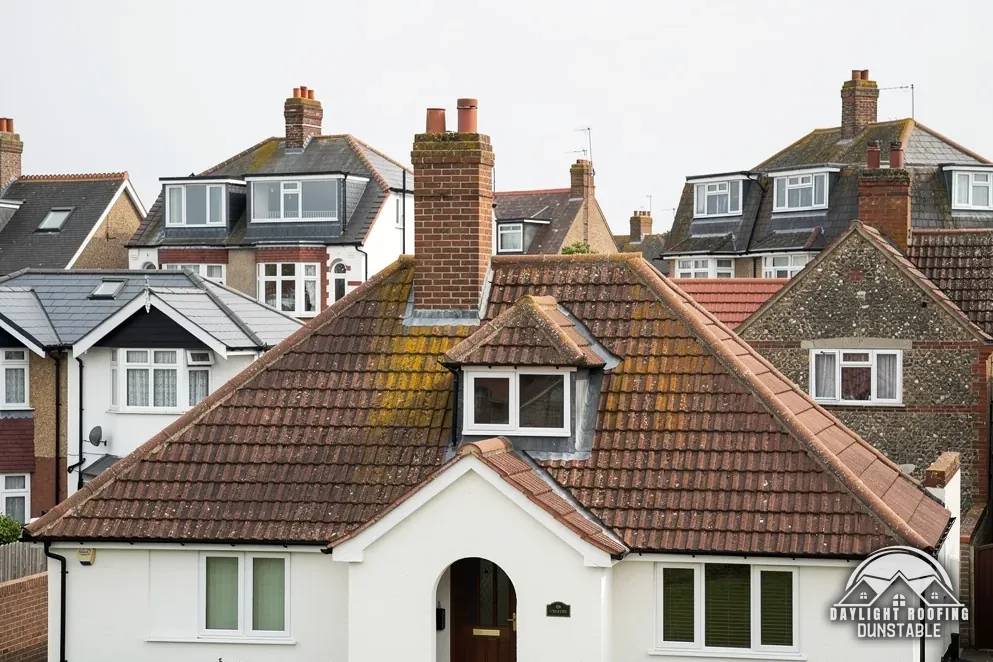
An interwar bungalow with a clay tile roof, a small dormer and an arched porch

The roof, in plain words

Cheek
Either side panel of a dormer, finished in tile, cladding or lead.
HR underlay
High-resistance underlay, which blocks vapour and so needs ventilation at the eaves.
LR underlay
Low-resistance underlay, which lets vapour pass up into the roof void.
Tide mark
The ring left on a ceiling where a damp patch has dried and grown outwards.

The plain-as-day roof check

Four things behind the tiles in Woburn Sands

4 checks about 3 minutes to read

  1. Dormer sides and flat tops
  2. Under the battens
  3. What a ceiling mark is telling you
  4. Saint Michael and its neighbours

01 Dormer sides and flat tops

Think of a dormer as a miniature house stuck onto a slope: a front, two sides called cheeks and a top that can be flat or pitched. A flat top is a roof in miniature, and each cheek meets the main slope at a junction sealed with lead or a flashing. A great many joints are packed into a small space, and each one can fail by itself.

Inspect the lead where the cheek meets the slope, the top of the dormer for ponding, and the window below for a stain in the corner. Condensation in a dormer gives speckling and a general clamminess, whereas a leak leaves a stain with a definite edge. A dated photograph looking up at the cheek from inside shows where a stain begins, and the survey then works out which fault it is. If the dormer window has a lead apron below it, check that the apron lies flat and its upper edge is tucked beneath the tiles.

02 Under the battens

Marley treats the two underlay types differently. With a high-resistance underlay in a cold roof, eaves ventilation is needed. The low-resistance type is another matter, and Marley says "fortuitous ventilation at the eaves via normal eaves construction (3mm) is all that is required, provided the requirements of UKAS Third Party certification are fully met". High resistance does not mean vapour-permeable.

The underlay is the second barrier, set under the battens to catch what passes the tiles. A tear shows from the loft as a patch of daylight or a damp stain on the felt. Which type you have decides whether the eaves openings matter, so a photograph of the label on the roll, wherever it can be read, is a help before a visit. A roll left in the loft after the roof was built sometimes carries the maker's name, and a batten label or a printed line on the felt itself does the same.

03 What a ceiling mark is telling you

A damp patch that has dried leaves a ring with a darker line at its outer edge, and a fresh ring forms beyond the old one each time water arrives. Where the patch sits hints at the source: beside a chimney breast, think of the stack; under a roof corner, a valley or hip; mid-room, water that has run along a timber before dripping.

Rule a thin line round the patch, add the day's date, and check it again once the next downpour has passed; if the damp has stepped past your line, it is active. A stain that grows only in rain is a leak, and one that appears in the cold with no rain is more like condensation. Send both pictures and the dates, with a note of what the weather did in between. A patch that grows after a dry night with the heating on is a different story from one that grows after an hour of rain, and the difference points the survey in the right direction.

04 Saint Michael and its neighbours

Church of Saint Michael, on Church Road in Aspley Heath parish, is Grade II* (National Heritage List entry 1312016, first listed 1 March 1972) and belongs to the Church of England, so the faculty jurisdiction of the Church of England takes charge of its roof in the stead of listed building consent. Shelton House (1289170) was first listed on 16 February 1984, and Sandpit Cottage (1300800) on 2 November 1993.

Henry VII Lodge (1138057), just over the parish line in Aspley Guise, is Grade II too, and the council for it is Central Bedfordshire Council. For each of these houses the question is whether the change alters what makes the building special. Repairs that match the covering already on the roof sit comfortably inside that test, and the council can say what else is expected before an order is placed. Each listing entry gives the building's name and grade, and what it protects can be wider than the walls you can see from the road.

The dashed ring takes in the nearest towns and villages we cover around Woburn Sands. Map tiles © Esri; map data © OpenStreetMap contributors.

Roof questions from Woburn Sands homes

01Why does the ceiling below my Woburn Sands dormer stain at the window corner?

Water may be entering at the cheek or at the flat top, or condensation may be forming on cold surfaces inside. A leak leaves a stain with a clear edge that grows after rain, and condensation leaves general dampness and speckling in cold weather. The lead where the cheek meets the slope is the first place to look, then the flat top for ponding. Take a dated photograph from inside. Send it with one of the dormer from the garden, and the survey will check each junction in turn.

02Which route governs a new roof covering at Saint Michael's Church, Woburn Sands?

Saint Michael's belongs to the Church of England and is Grade II* listed, so the faculty jurisdiction of the Church of England is the route for its roof, standing where listed building consent would otherwise sit. List B names "The like for like replacement of roof lead or other material covering the roof of a listed building", a lighter class of work for which the archdeacon gives written notice. Anything larger needs a full faculty. Exterior work may need planning permission too, and with the church standing in Aspley Heath parish that question goes to Central Bedfordshire Council; none of this applies to a house in the town.

03The Woburn Sands conservation area dates from 2003: what should I put to the council?

Woburn Sands carries a designation first made on 17 June 2003, according to Milton Keynes City Council. Before you order a covering, write to Milton Keynes City Council, give the address and ask two things: whether the address falls inside the conservation area, and whether an Article 4 direction is in force there. Milton Keynes City Council's HMO directions deal only with turning a home into shared housing, so the question for it is whether some other direction reaches your street. File its reply with your deeds, so the answer is to hand if the question ever comes up again.

04Who runs building control for a Woburn Sands re-roof?

Milton Keynes City Council's own building control team is on 01908 252721 in office hours, and on 01908 226699 out of hours. The council's main line, 01908 691691, is a different number from the building control team's. The Planning Portal says "In most situations, this work will need Building Regulations approval". Building control is carried out by Milton Keynes City Council's team or by a registered building control approver; 6 April 2024 is when the registration regime began. Ask which of the two will be used, and which certificate you will be given at the end.

05What is the licence fee when a Woburn Sands house needs scaffolding?

A scaffold that will stand over the footway or into the road requires a licence under section 169 of the Highways Act 1980. Milton Keynes City Council publishes £189 for scaffolding up to 1 month and £694 for complex scaffolding, both excluding VAT. We arrange the licence with our scaffolder. If parked cars or a narrow pavement limit where the poles can go, mention it when you first ask, since the width of the footway fixes how the scaffold can be laid out. Milton Keynes City Council also warns that a penalty fee may be charged on top of the licence fee where scaffolding goes up without one.

06Can natural slate be laid on the shallow roof of a Woburn Sands porch?

Only above the pitch that suits the slate and the exposure. Cupa reports that BS 5534 "indicates that the minimum roof pitch for natural slate is 20 degrees" for moderate exposure with a 500mm slate and a 115mm overlap, and says no hooks under 25°. A porch roof at a lower pitch needs a different covering, such as a membrane or metal sheet. Measure the pitch with a spirit-level app on a rafter or batten before choosing anything. A figure in degrees, sent with a photograph, lets us say which coverings are possible before a visit.

07Which underlay does my Woburn Sands roof have, and why does it matter?

High-resistance underlay blocks vapour, which is why a cold roof under it relies on eaves ventilation: Marley gives 25 mm for pitches of 15° or less and 10 mm above 15°. Low-resistance underlay lets vapour through, and for a roof whose ceiling is sealed and whose tiles let air through, 3 mm of ordinary eaves construction is enough if UKAS certification is met. Identify the type before any vent is added, blocked or changed, from the label on the roll if it shows at your loft hatch, because the wrong change can trap damp air.

08What do cost guides say about removing spray foam in Woburn Sands?

Checkatrade writes "For a three-bedroom detached house, you can expect the total roof foam insulation removal cost to come to around £3,200." For open-cell foam it gives "£50 and £75 per m²" in a July 2026 guide. MyJobQuote's total for roughly 80m² of roof space is also around £3,200. Take a specialist surveyor's advice before deciding, and ask your lender what it requires, because government guidance says removal "will not always guarantee that they will still lend". A written note from the lender settles what is needed, and a roofer cannot give that assurance on its behalf.

09Which villages round Woburn Sands have their own roofing pages?

Aspley Heath, Aspley Guise, Bow Brickhill, Woburn and Little Brickhill all do. Each of those pages carries the council, the licence fee and the planning notes for its own place, so check that the page matches your address. When a whole covering is due, roof replacement describes the work from start to finish, covering the old covering coming off, the battens and the new tiles or slates. Because Woburn Sands and its neighbours sit under more than one council, check the council named on a page before relying on its fee or its phone number.

Get a written price for your roof

10-year workmanship guarantee, in writing

Tell us about your roof

Call WhatsApp Written quote