
Call 01582 935272

Park Street · 16 road miles south-east

Roofers in Park Street

Heading south-east from Dunstable, Park Street is 15.5 road miles away and a journey of around 22 minutes. Its conservation area, church and listed houses are weighed first, and the quote that follows is a single total on paper.

Get a written quote

Call 01582 935272WhatsApp us

Council
St Albans City and District
Road miles
16
Conservation area
Park Street and Frogmore
Building control
St Albans & Watford

Holy Trinity and the listed houses on Park Street itself

Park Street lies in St Stephen parish, which had 14,653 usual residents at the 2021 Census. St Albans City and District Council has designated the Park Street and Frogmore Conservation Area, and Church of the Holy Trinity stands among Grade II listings that include 61 and 63, Park Street, 52, Park Street, and 65 and 67, Park Street. The first question on any quote here is which of those designations, if any, reach the house in question, and the answer decides what the council has to be asked.

St Albans City and District Council lists a Former Radlett Airfield direction among its Article 4 areas, and the council alone can say what such a direction removes: we check with St Albans City and District Council whether an Article 4 direction applies. For building control, St Albans and Watford councils act together as one shared team. The planning guide covers the national rules, and the pages on pitched roofing and roof windows cover two kinds of work a Park Street roof can need.

  1. 01Church of the Holy TrinityGrade II, list entry 1347115, first listed 27 August 1971. Church of England: faculty-system rules apply to work on its roof.
  2. 0261 and 63, Park StreetGrade II, list entry 1103076, first listed 27 August 1971. A listed house is judged by the effect of work on its character.
  3. 0352, Park StreetGrade II, list entry 1347133, first listed 27 August 1971. The council will want this entry number when it is asked about the house.
  4. 0465 and 67, Park StreetGrade II, list entry 1347135. Neighbours of a listed pair can ask the council whether the listing reaches their own roof.
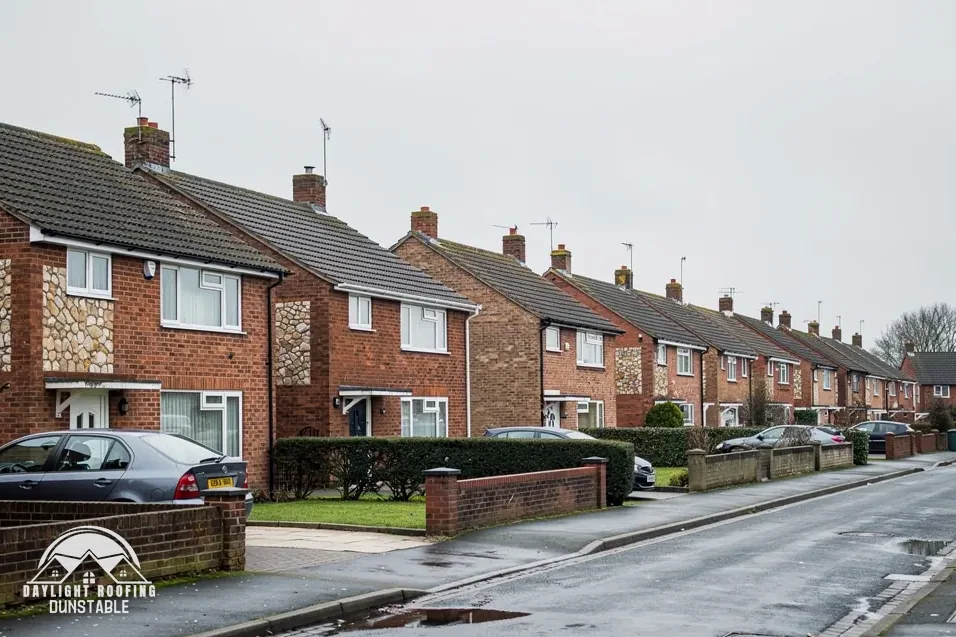
A street of brick semi-detached houses with tiled roofs

The roof, in plain words

Pitch
How steeply a slope rises, given in degrees.
Rooflight
Glazing raised on its own upstand, standing proud of the roof.
Roof window
Glazing laid in the plane of the slope, level with the tiles around it.
Eaves
Where the roof's lower edge hangs out beyond the wall below.

The plain-as-day roof check

Park Street roof checks, from pitch to moss

4 checks about 3 minutes to read

  1. Pitch against the product
  2. Air through the eaves
  3. Roof window or rooflight
  4. Moss on the slopes

01 Pitch against the product

Every tile has a floor below which it should not be laid, and the floor belongs to the product rather than the material. Marley's table runs from 40° for its clay Canterbury down to 15° for its clay Lincoln pantile, and for concrete it gives 35° for a plain tile and 15° for Mendip and Wessex. Canterbury, Anglia and Ludlow are tile names, not places. For natural slate, Cupa reports that BS 5534 "indicates that the minimum roof pitch for natural slate is 20 degrees" in moderate exposure, with a 500mm slate and a 115mm overlap.

Cupa adds that "hook fixings should not be used on any pitch below 25º". On a Park Street house the angle can be found with a pitch finder or a phone app held against a rafter in the loft, and a quote that names its tile should name the pitch it was checked against. A slope shallower than the chosen product allows is a reason to change the product, and the survey is where that gets settled.

02 Air through the eaves

Where insulation lies along the ceiling and a void sits above it, the void has to let air through. Where the underlay is high-resistance, Marley asks for 25mm along the length of the eaves at pitches of 15° or less and 10mm at pitches of more than 15°. Such an underlay does not pass vapour; whether air can pass is a matter for the covering. Where a low-resistance membrane combines with a tight ceiling and a covering that breathes, Marley says "fortuitous ventilation at the eaves via normal eaves construction (3mm) is all that is required, provided the requirements of UKAS Third Party certification are fully met."

BS 5250:2021 (current, under review) deals with moisture management in buildings. Up at the hatch, the things to note are dark spotting on the timber, insulation pressed hard into the corner where a vent should be, and a damp smell in a cupboard below the roof. The survey reads underlay, vents and covering together, since each figure belongs to one build-up and is never copied to another.

03 Roof window or rooflight

Approved Document L separates two products that shops sometimes sell under one name. A rooflight is a glazed unit "out of plane with the surface of the roof on a kerb or upstand"; a roof window sits "in the same orientation as, and in plane with, the surrounding roof". Table 4.2 of AD L 2021 asks of a replacement roof window 1.4 W/m²K, or Window Energy Rating Band B minimum, and of a rooflight 2.2 W/m²K. A flush conservation unit counts as a roof window.

For Park Street owners comparing quotes, the first thing to establish is which of the two is being priced, since the performance figure differs. MyJobQuote's average for a Velux window of standard mid-range specification is £1,100 (22 September 2026), and a straightforward swap comes in around £100 below that because the opening already exists. Where a new opening is cut into a slope, the planning guide shows where the rules start, and a listed house goes to the council first.

04 Moss on the slopes

A green or black coat on a slope invites a pressure washer, and Marley warns against it: "The use of high powered jet washes is not recommended as it can damage the surface of the slate or tile, thus reducing its expected life considerably". Checkatrade says roof cleaning typically costs £8.50 to £14 per m² (April 2026), a rate that belongs to cleaning alone and carries no VAT basis.

The question to put to any cleaning quote is what the method is, and the question to put to a survey is whether the growth hides something. Cracked pieces and slipped courses show up better on a washed roof, but a roof that is leaking needs a repair more than a clean. A rate per square metre gives no figure for an entire roof, which is why the written price waits for a visit and is not worked out at a distance.

The dashed ring takes in the nearest towns and villages we cover around Park Street. Map tiles © Esri; map data © OpenStreetMap contributors.

Park Street questions, from garden to invoice

01What can a Park Street owner see from the garden before a survey?

Walk back until the whole slope fits in view and look for lines that are no longer straight: a ridge that dips, a course of tiles sitting lower than its neighbours, a gap where the pointing has fallen out. Binoculars show a chimney's lead and the mortar around the pots. Check the gutters for plants growing in them and the wall below for a long stain. Pictures taken in the same light, sent on WhatsApp, let us look before a visit is arranged, and the survey that follows reads the slopes themselves.

02Which consent route applies to Holy Trinity's roof?

The Church of the Holy Trinity, list entry 1347115, is a Grade II listing, and its denomination is the Church of England. Work to it is governed by the faculty system while it stays in use, in place of listed building consent. List B of the Faculty Jurisdiction Rules 2015 has one line that reads "The like for like replacement of roof lead or other material covering the roof of a listed building", which calls for the archdeacon to give written notice and no more. A faculty does not settle planning, so the church roof at Frogmore can face the usual planning tests too.

03What do the listings at 52, 61 and 63 Park Street mean for a neighbouring roof?

Each is Grade II: 61 and 63, Park Street is list entry 1103076 and 52, Park Street is list entry 1347133, both first listed on 27 August 1971, with 65 and 67, Park Street under entry 1347135. Listing leaves the permitted development rights for roof work standing, and adds a need for listed building consent where work would affect "its character as a building of special architectural or historic interest". A neighbouring house is only affected if its own entry says so, so the entry number is the thing to check.

04How does the Park Street and Frogmore Conservation Area sit alongside Article 4 entries nearby?

St Albans City and District Council made the designation of the conservation area. The council's Article 4 list also names the Former Radlett Airfield, and what that entry covers is set out by the council, not read from its name. What a given direction removes is a point for the council, which is why St Albans City and District Council is asked whether an Article 4 direction applies. A house inside the conservation area is then dealt with on the council's reply, and the same goes for a roof on a house that only borders it.

05Which building control team does a Park Street re-roof go to?

St Albans and Watford councils run building control together, and a registered building control approver is the alternative route to sign-off on the work. The tests that follow come from the Planning Portal and apply whichever of the two routes is taken. Under the Planning Portal's guide a re-roof needs no application normally if "Less than 25 per cent of the total 'building envelope'" and "Less than 50 per cent of the roof is affected". Past the second limit lies a full re-roof. The Planning Portal also says "In most situations, this work will need Building Regulations approval."

06What does Hertfordshire charge for a scaffold on a Park Street pavement?

A scaffold licence on a Park Street street comes under section 169 of the Highways Act 1980, and Hertfordshire County Council grants it. Hertfordshire County Council charges £134 for a 14-day licence and £59 for every week after, and states "It usually takes 3 weeks to process an application." The licence page also asks that "A 1.2m clear walkway must be maintained at all times on the footway." For a house that needs scaffold, we arrange the licence with our scaffolder, and the written total accounts for the scaffold.

07How should a cement-sheet garage roof in Park Street be treated?

HSE says "If the building was built or refurbished before 2000, assume that there is asbestos in it." It lists "asbestos cement products, (eg roof sheeting and rainwater goods) provided the material is carefully handled/removed without breaking up" as non-licensed work, while asbestos cement "where the material has been substantially damaged or broken up" is notifiable non-licensed work. HSE adds that "AC roofs are always fragile". Use a lockable skip for asbestos; household asbestos falls outside the consignment-note exemption, which covers hazardous waste "other than asbestos waste".

08Is there VAT relief for insulating a Park Street roof or loft?

HMRC's Notice 708/6 puts a zero rate on installing the energy-saving materials it lists, among them insulation of "roofs or lofts" in supplies "made between 1 May 2023 and 31 March 2027"; the reduced rate of 5% follows. It is a relief for insulation, and ordinary roof repairs get no rate of their own from it. For the Warm Homes: Local Grant, GOV.UK sets an Energy Performance Certificate band and a household income that "must usually be £36,000 a year or less"; the grant pays towards insulation and heating, never towards a new roof.

09What do CDM duties mean for a Park Street homeowner who hires one roofer?

Under CDM 2015 a householder counts as a domestic client, and regulation 7(1) names "the contractor for a project where there is only one contractor" as the person who carries out those client duties. If several contractors are working, the principal contractor takes them over instead. "A construction phase plan" is drawn up by the contractor, whatever the size of the job. HSE treats someone as a domestic client when the building work is for their home, or a relative's, and has nothing to do with running a business.

Get a written price for your roof

10-year workmanship guarantee, in writing

Tell us about your roof

Call WhatsApp Written quote