
Call 01582 935272

Bricket Wood · 16 road miles south-east

Roofers in Bricket Wood

Bricket Wood is 16 road miles from Dunstable, bearing south-east, and the road takes about 23 minutes. Every roof there is surveyed before a price is given, and what is given is a single total in writing.

Get a written quote

Call 01582 935272WhatsApp us

Council
St Albans City and District
Road miles
16
Building control
St Albans & Watford

Bricket Wood's Grade II railway control centre and pub

Bricket Wood lies in St Stephen parish, which had 14,653 usual residents at the 2021 Census. Among its Grade II listings are the Air-Raid Precaution Railway Control Centre (list entry 1459132, first listed 21 November 2018) and The Black Boy Public House (list entry 1175495, first listed 27 September 1984). The Replica of the Mohne Dam, in the grounds of the Building Research Establishment, Garston, is a scheduled monument (entry 1020749) near Bricket Wood. Old Bricket Wood and Park Street and Frogmore are conservation areas near the village, and a particular address is placed in or out by St Albans City and District Council.

Planning applications for a Bricket Wood house go to St Albans City and District Council, and building control for the work is the shared service that St Albans and Watford councils run together. The planning guide sets out the national rules. The pages on flat roofing and roof repairs describe the surveys behind the four checks below.

  1. 01Air-Raid Precaution Railway Control CentreGrade II, list entry 1459132, first listed 21 November 2018. The entry number identifies it when the council is asked about a neighbour.
  2. 02The Black Boy Public HouseGrade II, list entry 1175495, first listed 27 September 1984. Listing turns on the character of the building, not the size of a job.
  3. 03Replica of the Mohne DamScheduled monument, list entry 1020749, in the grounds of the Building Research Establishment, Garston. Works need scheduled monument consent.
  4. 04Old Bricket WoodA conservation area close to the village. Whether an address falls inside it is a question for St Albans City and District Council.
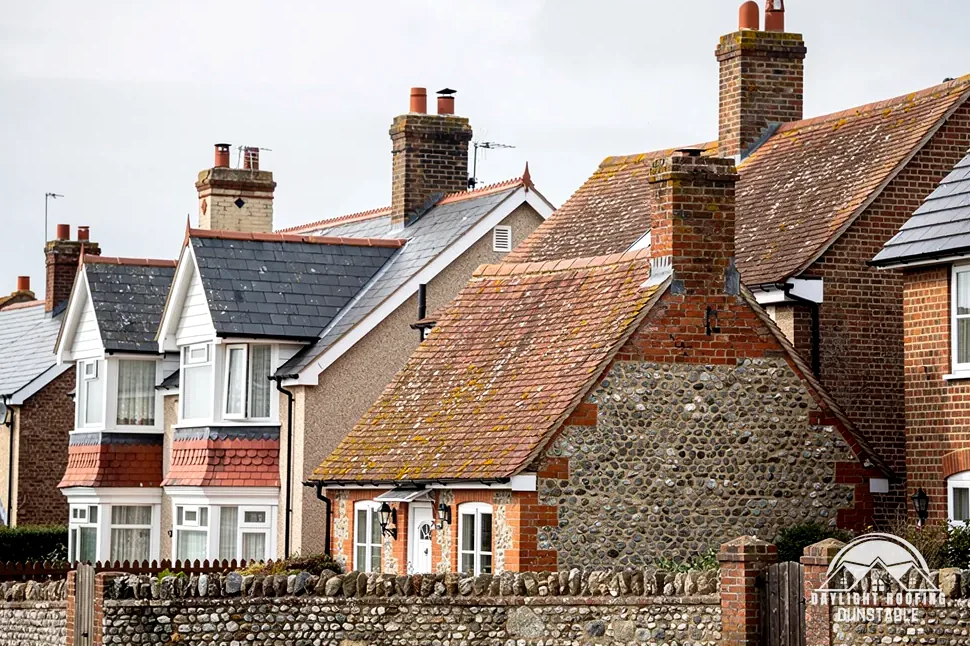
A flint and brick cottage with a weathered clay tile roof

The roof, in plain words

Fall
The slight slope that carries water across a flat roof towards its outlet.
Upstand
A short vertical return of the roof covering where it meets a wall.
Soffit
The panel closing the gap beneath the overhanging eaves.
Polycarbonate
A rigid plastic sheeting laid as the roof of some conservatories.

The plain-as-day roof check

Four roof checks for Bricket Wood, from flat roofs to soffits

4 checks about 3 minutes to read

  1. Flat covering and its age
  2. Where the water goes
  3. Asbestos in sheets and soffits
  4. Conservatory roof choices

01 Flat covering and its age

Two guides rate the same four flat-roof coverings and give different spans. HomeBuilding has EPDM at 25-30 years, GRP at 25-30, felt at 10-15 and lead at 60-100. Less has EPDM at 30 to 50, GRP at 25 to 40, torch-on felt at 10 to 20 "depending on quality and installation" and lead at 50 to 100. Anyone comparing quotes can hold both ranges against whichever covering is named. EPDM and TPO count as single-ply membranes; GRP and built-up felt belong to other systems.

On cost, Which? Trusted Traders gave felt at £1,400-£3,500 and EPDM rubber or PVC laid on new boards at £1,950-£4,000, both for a single garage measuring 6m x 3m, excluding VAT (November 2025). MyJobQuote's page of 20 October 2026 says "In 2026, the average flat roof replacement costs between £1,500 and £6,000." All three are other people's jobs. A Bricket Wood roof is surveyed first, and the written total reflects how large it is, how it is reached and what the survey turns up.

02 Where the water goes

A flat roof is a drainage problem with a covering on top. BS 6229:2025 is the current code of practice, BS 6229:2018 having been withdrawn, and its scope is flat roofs, or curved roofs up to 10 degrees, with continuously supported flexible waterproof coverings, so lead is outside it. NFRC reports that it sets "a minimum 1:80 finished fall for general roof areas and internal gutters", and IKO reports that "To achieve a 1:80 fall, the code of practice says that the roof should be designed for a fall of 1:40".

A pool that remains a day after rain marks a low spot, and a low spot means the finished fall is not carrying water to the outlet, or the outlet is blocked. A seam lifting at an upstand, a bubble in the membrane or a brown ring spreading on the ceiling below are worth a dated photograph. The page on flat roofing covers how the survey reads the outlets, the upstands and the boards.

03 Asbestos in sheets and soffits

HSE's rule of thumb sits in one sentence: "If the building was built or refurbished before 2000, assume that there is asbestos in it." Garage and shed roofs of cement sheet fall under that, and so can the underside of the eaves, since HSE lists "AIB white soffit panels to underside of roof eaves" among asbestos insulating board locations. Most work on insulating board is licensed work, and HSE's guidance says "AC roofs are always fragile".

Nothing on such a roof should be drilled, scrubbed or walked on until its material is known. MyJobQuote's page dated 9 September 2026 puts the average asbestos removal for a roof at around £2,750, and its page dated 2026 puts an asbestos survey at around £325. Broken-up cement sheet is notifiable non-licensed work; waste goes in a lockable skip, and a Bricket Wood householder cannot rely on the consignment-note exemption, which covers hazardous waste "other than asbestos waste".

04 Conservatory roof choices

Replacing a conservatory roof brings Building Regulations into play. The Planning Portal says "A new roof must comply with building regulations to ensure it is structurally safe, energy efficient and properly ventilated." Separately, AD L 2021 para 0.14 lifts the energy rules from a conservatory only if all five conditions are met: it stands at ground level, covers no more than 30m2, has glazing that meets Part K, retains a wall, door or window between it and the dwelling, and "The heating system of the dwelling is not extended into the conservatory or porch."

Lifespans are quoted by two voices. HomeBuilding itself says of polycarbonate "They have a typical lifespan of 10 years." Roofing Megastore's managing director, quoted by HomeBuilding, says "A glass conservatory roof will likely last in excess of 30 years." and "A tiled conservatory roof will typically last in excess of 50 years with little maintenance being required." On price, MyJobQuote's page of 20 October 2026 says "In 2026, the average conservatory roof replacement costs between £3,200 and £6,000." A conservatory roof being replaced is a roof job for the survey to read as a whole: the frame, the gutter fixed to it and the join where it meets the house wall are all read side by side.

The dashed ring takes in the nearest towns and villages we cover around Bricket Wood. Map tiles © Esri; map data © OpenStreetMap contributors.

Bricket Wood questions, from puddles to storms

01What does standing water on a Bricket Wood flat roof point to?

Water that is still lying a day after the rain has stopped marks a low spot. That means the finished fall is not carrying it to the outlet, or the outlet itself is clogged with leaves or moss. Look for staining on the ceiling directly underneath and for a seam that has lifted where the covering meets a wall. Photograph the pool beside a tape measure with the date written on a note, and send it on WhatsApp so we can look before a visit; the survey then reads the boards, the outlet and the covering.

02How does the scheduled monument at Garston bear on roof work around Bricket Wood?

The Replica of the Mohne Dam, in the grounds of the Building Research Establishment, Garston, is a scheduled monument (list entry 1020749) near Bricket Wood. Under the Ancient Monuments and Archaeological Areas Act 1979 works are an offence "unless the works are authorised". The Secretary of State is the one who grants scheduled monument consent, and Historic England is where an application is sent. Section 61 of the Planning (Listed Buildings and Conservation Areas) Act 1990 says the listed building consent provisions "shall not apply to any building for the time being included in the schedule of monuments". The monument's list entry includes a map of the scheduled area, so an owner can see exactly where it runs.

03What does listing change for the Black Boy and the railway control centre?

Each is Grade II: the Air-Raid Precaution Railway Control Centre is list entry 1459132 and The Black Boy Public House is list entry 1175495. Listing does not strip away the permitted development rights for roof work, but it brings listed building consent into play for work done "in any manner which would affect its character as a building of special architectural or historic interest". The council is the body that decides whether a particular job does. When asking, the entry number is the reference to quote, and a neighbouring house that is not itself listed is unaffected by the listing next door, so the entry settles that too.

04Do the Old Bricket Wood and Park Street conservation areas reach a Bricket Wood roof?

Old Bricket Wood and Park Street and Frogmore are both conservation areas close to the village, and being close does not put an address inside either one. For an address, check with St Albans City and District Council, which designated both. An Article 4 direction can remove further permitted development rights, so we check with the council first, and the council's answer then shapes the route a roof job takes. The roof replacement page covers what a full re-cover involves.

05Which building control route covers a Bricket Wood re-roof or a heavier covering?

Building control for a Bricket Wood house comes from the shared St Albans and Watford service, or from a registered building control approver. The Planning Portal's guide lists as a trigger "You use a new covering material which increases the weight of the roof covering by 15 per cent or more." and adds "you are advised to check with a structural engineer or surveyor before commencing with works". It also says "In most situations, this work will need Building Regulations approval." A small repair falls under the two limits of 25 and 50 per cent.

06What lead time should a Bricket Wood scaffold licence be allowed?

Hertfordshire County Council issues the scaffold licence, since it is the highway authority for Bricket Wood's roads. The council's licence page reads "It usually takes 3 weeks to process an application." Hertfordshire County Council charges £134 for a 14-day licence and £59 for every week after, and a 1.2m clear walkway has to stay open on the footway. Where the house needs scaffold on the pavement, we arrange the licence with our scaffolder, and scaffold is part of the written quote.

07Can spray foam under a Bricket Wood roof hold up a sale or a mortgage?

In March 2023 RICS reported "concern within specific sectors of the lending market". Government guidance published 22 October 2026 says "Many mortgage providers are open to lending on properties with spray foam, subject to their own requirements." It adds that removing the foam "will not always guarantee that they will still lend". According to the Energy Saving Trust, some lenders may ask for extra checks. Before any removal, take advice from a specialist surveyor and ask your own lender what it requires.

08What notice applies to a roofing contract agreed at the kitchen table in Bricket Wood?

A contract made at your home after a survey carries a cancellation period that ends "at the end of 14 days after the day on which the contract is entered into". If you want work to begin earlier, the request has to be made in writing; such a request leaves the right to cancel intact, and payment for work done in the meantime may be due. An urgent repair visit you specifically asked for is the exception to all of this. Citizens Advice's consumer helpline is 0808 223 1133.

09How is a storm defined when a Bricket Wood roof claim is made?

The Financial Ombudsman Service explains: "We say that a storm usually involves violent winds, usually with rain, hail or snow." It also states "Rain, hail or snowfall by itself can constitute a storm" and "We take into account the Beaufort Scale." Where an insurer relies on an exclusion, "The insurer has to prove that the exclusion applies - for example, with an inspection report." Photograph damage before anything is moved, tell the insurer, and note that the Ombudsman's number is 0800 023 4567.

Get a written price for your roof

10-year workmanship guarantee, in writing

Tell us about your roof

Call WhatsApp Written quote