
Call 01582 935272

Abbots Langley · 16 road miles south

Roofers in Abbots Langley

Heading south from Dunstable, Abbots Langley is 15.7 road miles away, a journey of about 26 minutes by road. The survey is done first, and the figure that comes after it is one total, in writing.

Get a written quote

Call 01582 935272WhatsApp us

Council
Three Rivers District
Road miles
16
Conservation area
Abbots Langley
Building control
Check with the council

Grade I church and tithe barn at Abbots Langley

At the 2021 Census, Abbots Langley parish had 21,968 usual residents. The Church of St Lawrence the Martyr is Grade I (list entry 1296433, first listed 1 September 1953), the Tithe Barn About 20 Metres North East of Parsonage Farm is Grade II* (entry 1100908, first listed 17 October 1977), and The Old Maltings, Including Kiln and Stable Block (entry 1348183, first listed 3 October 1985) and Abbot's House (entry 1296402) are Grade II. Three Rivers District Council designated the Abbots Langley Conservation Area, so a roof quote here begins by finding out which designation, if any, touches the house.

Planning applications go to Three Rivers District Council, and for building control the advice is to check with Three Rivers District Council's building control team. The planning guide sets out the national tests. The roof replacement and pitched roofing pages describe the surveys behind the first two checks below.

  1. 01St Lawrence the MartyrChurch of England, Grade I, list entry 1296433, first listed 1 September 1953. Roof work falls under the faculty system.
  2. 02Tithe Barn, Parsonage FarmGrade II*, list entry 1100908, first listed 17 October 1977. Anything touching its character needs listed building consent.
  3. 03The Old MaltingsGrade II, list entry 1348183, first listed 3 October 1985, with its kiln and stable block. Quote the entry number to the council.
  4. 04Abbot's HouseGrade II, list entry 1296402. A neighbouring house is checked against its own entry, never assumed from this one.
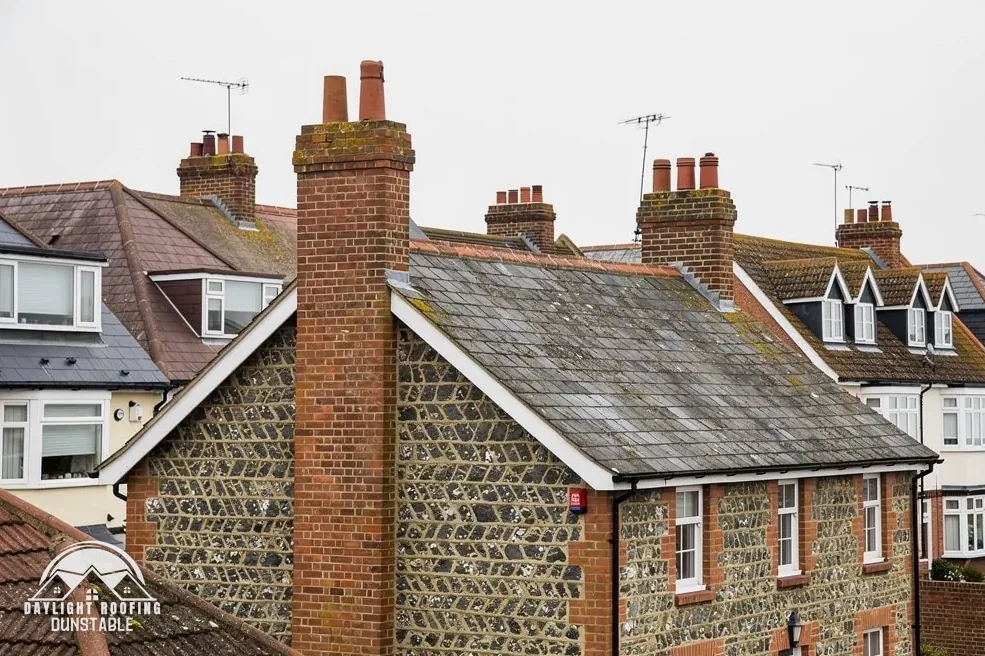
A flint and brick cottage with a grey slate roof

The roof, in plain words

Grade I
A listing grade that sits above Grade II* and Grade II.
Building envelope
Walls, floor, roof, windows, door, roof windows and roof-lights taken together.
Open-cell foam
Spray insulation whose rot risk, the Energy Saving Trust says, "should be much lower".
Part K glazing
Glass meeting the safety rules in Part K of the regulations.

The plain-as-day roof check

Four checks for an Abbots Langley roof, from thresholds to foam

4 checks about 3 minutes to read

  1. The re-roof threshold, in full
  2. Slate and clay lifespans
  3. Conservatory roof conditions
  4. Spray foam and a mortgage

01 The re-roof threshold, in full

Two limits decide whether a re-roof normally needs an application. In the Planning Portal's guide, none is needed if "Less than 25 per cent of the total 'building envelope' (walls, floor, roof, windows, door, roof windows and roof-lights) is affected; and" "Less than 50 per cent of the roof is affected." Both must hold. The envelope is the whole shell of the house, so a repair that touches a slope and a chimney sits well inside the first limit but can approach the second if the slope is a small one.

Past either limit, approval is needed, and the full re-roof of a house is past the second. The Portal also lists a covering that "increases the weight of the roof covering by 15 per cent or more" and a covering whose fire performance "will be significantly different". Approved Document A para 4.4 says "A significant change in roof loading is when the loading upon the roof is increased by more than 15%." The Portal's main page adds "In most situations, this work will need Building Regulations approval." For Abbots Langley, check with Three Rivers District Council's building control team.

02 Slate and clay lifespans

A quote that says a roof will last a stated number of years should name the number's author. HomeBuilding (updated 30 September 2025) lists Welsh slate at 100+ years, Spanish natural slate 75-100, reclaimed Welsh slate 50-80, clay tiles 60-80 and plain concrete tiles 40-50. The BRE's minimum life expectancy of 60 years, passed on by Marley, belongs to clay tiles alone and is not a figure for concrete.

The same Marley page says of its own tile figure "This is not a guarantee or warranty of its longevity." Reading these as ranges rather than dates is the safer course: the condition of the nails, the battens and the underlay can end a covering's useful life before the tile itself gives out. On an Abbots Langley roof, the survey looks at the fixings and at any batten exposed where a tile has slipped, as well as the surface, since a perfectly sound tile is of little use on a rotten batten.

03 Conservatory roof conditions

A conservatory can sit outside the energy rules, and the conditions are listed in AD L 2021 para 0.14: "a. The extension is at ground level." "b. The floor area of the extension does not exceed 30m2." "c. The glazing complies with Part K of Schedule 1 to the Building Regulations." Condition d keeps a wall, door or window between the extension and the dwelling, and condition e says "The heating system of the dwelling is not extended into the conservatory or porch."

All five must hold. A new solid roof is a separate question, since the Planning Portal says "A new roof must comply with building regulations to ensure it is structurally safe, energy efficient and properly ventilated." HomeBuilding itself says polycarbonate has "a typical lifespan of 10 years", and MyJobQuote says "In 2026, the average conservatory roof replacement costs between £3,200 and £6,000." Where a conservatory roof is in question, we check the route with building control first. Roofing Megastore's managing director, quoted by HomeBuilding, says "A glass conservatory roof will likely last in excess of 30 years." and that a tiled roof "will typically last in excess of 50 years with little maintenance being required".

04 Spray foam and a mortgage

Spray foam under a roof has two worries attached: what it hides and what a lender thinks. RICS says "If the timber roof structure is covered with spray foam it cannot be fully seen or inspected", and advises "Do check with your mortgage provider whether their lender policy allows the installation of such products." In March 2023 RICS reported "concern within specific sectors of the lending market, such as equity release mortgages".

Government guidance published 22 October 2026 says "Many mortgage providers are open to lending on properties with spray foam, subject to their own requirements." It also says removal "will not always guarantee that they will still lend", and recommends advice from a specialist surveyor. The Energy Saving Trust says the foam "doesn't automatically prevent you from getting a mortgage, but some lenders may ask for extra checks", and that rot risk "should be much lower with open-cell foam".

The dashed ring takes in the nearest towns and villages we cover around Abbots Langley. Map tiles © Esri; map data © OpenStreetMap contributors.

Abbots Langley questions, from Grade I to lenders

01What should an Abbots Langley owner photograph before asking about a re-roof?

Take pictures that show each slope in full from the garden, then close-ups of anything that looks wrong: slipped tiles, damaged ridge pieces, flashings at the chimney. Add loft photographs of the timbers and the underside of the covering, with the date written on a sheet of paper in frame. If a ceiling is marked, photograph that too. Sending them on WhatsApp means we can look before a visit, and the survey then covers the roof from edge to edge, with anything else seen reported to you plainly.

02How does the faculty system treat roof work at the Church of St Lawrence the Martyr?

The Church of St Lawrence the Martyr (list entry 1296433) is Grade I and is a Church of England church. The 2010 Order states "The ecclesiastical exemption is retained for church buildings within the faculty jurisdiction of the Church of England." Listed building consent therefore does not apply while the church is in use. List B of the Faculty Jurisdiction Rules 2015 covers "The like for like replacement of roof lead or other material covering the roof of a listed building" with the archdeacon's written notice, and planning permission can still be needed.

03What does listing mean for the Tithe Barn, The Old Maltings and Abbot's House?

The Tithe Barn About 20 Metres North East of Parsonage Farm is Grade II* (entry 1100908), The Old Maltings, Including Kiln and Stable Block (entry 1348183) is Grade II, and so is Abbot's House (entry 1296402). Section 7 of the 1990 Act requires listed building consent for work "in any manner which would affect its character as a building of special architectural or historic interest". Permitted development rights for roof work are not themselves removed. Quote the entry number to Three Rivers District Council.

04How does the Abbots Langley Conservation Area bear on a roof quote?

Three Rivers District Council designated the Abbots Langley Conservation Area, and the council confirms whether a particular address sits inside it. An Article 4 direction can remove further permitted development rights, so we check with the council first, and its answer decides how the work is approached. The planning guide shows how national rules and a designation like this fit together, and a neighbour's house is a separate question for the council, answered from the council's own records of that address and not from the look of the street or the age of the roof.

05Who is asked about building control for an Abbots Langley roof?

Check with Three Rivers District Council's building control team about the route; a registered building control approver is the alternative. The tests for a plain re-roof come from the Planning Portal, and a whole-roof replacement goes beyond the 50 per cent limit, so approval is expected for it, as the Planning Portal's own main page indicates. A smaller job, such as renewing a few tiles, falls inside both limits, and the council's team can confirm what applies to a particular address.

06How does a scaffold licence work on an Abbots Langley road?

Hertfordshire County Council is the highway authority, and a Highways Act 1980 s169 licence is needed for scaffolding that obstructs the highway. The fee is £134 for 14 days and then £59 for each further week. "It usually takes 3 weeks to process an application." Under the licence, "A 1.2m clear walkway must be maintained at all times on the footway." We arrange the licence with our scaffolder when a house needs it, and the scaffold is covered by the written quote.

07Do nesting birds in Abbots Langley eaves stop roof work?

Section 1 of the Wildlife and Countryside Act 1981 is aimed at a person who intentionally "takes, damages or destroys the nest of any wild bird while that nest is in use or being built". The word intentionally is part of the offence, and so is the nest being in use or being built. What applies depends on the species and the address, and a nest seen in a soffit or gable is worth mentioning when booking the survey, so the work around it can be planned. Bats are different: the Habitats Regulations protect a breeding site or resting place whatever the intent.

08Can an Abbots Langley contract signed at home be cancelled?

Regulation 30 puts it this way: "the cancellation period ends at the end of 14 days after the day on which the contract is entered into". The count starts the day after signing. An early start needs a written request, and the customer may owe for work done if they cancel. A visit "specifically requested" for "urgent repairs or maintenance" has no cancellation right. Citizens Advice's consumer helpline is 0808 223 1133, and it can explain how the days are counted for a particular contract and what a written request has to say.

09Does an Abbots Langley neighbour have a say over a chimney breast removal?

Only through the notice procedure. The government's party wall guidance says "You cannot assume that no response means they agree to the works." A neighbour who does not consent within the period of fourteen days is deemed to have dissented, and then a surveyor is appointed under s10 of the 1996 Act. "You must appoint a surveyor if you and your neighbour cannot agree." The Planning Portal says "Building regulations approval will always apply when removing chimney breasts as they are part of the building's structure." The neighbour's rights are about the notice and the surveyors, and the approval is a separate matter between the owner and the council, so each runs alongside the other and neither replaces it.

Get a written price for your roof

10-year workmanship guarantee, in writing

Tell us about your roof

Call WhatsApp Written quote