
Call 01582 935272

How Wood · 16 road miles south-east

Roofers in How Wood

How Wood lies 16.2 road miles out of Dunstable towards the south-east, about 23 minutes by road. The survey comes first, and the number that comes after it is a single written total.

Get a written quote

Call 01582 935272WhatsApp us

Council
St Albans City and District
Road miles
16
Building control
St Albans & Watford

How Wood's Grade II* Burstone Manor and two listed homes

How Wood lies in St Stephen parish, which had 14,653 usual residents at the 2021 Census. Burstone Manor House is Grade II* (list entry 1102862, first listed 19 October 1953), The Homestead is Grade II (entry 1102864, first listed 7 February 1974) and Orchard Cottage is Grade II (entry 1175499). The Park Street and Frogmore Conservation Area, designated by St Albans City and District Council, is close to How Wood, which is a different thing from How Wood being inside it.

A roof question for a How Wood address goes first to St Albans City and District Council, with building control handled by the joint team of the St Albans and Watford councils. The planning guide covers the national rules. The pages on lead roofing and roof replacement relate to the first and second checks below.

  1. 01Burstone Manor HouseGrade II*, list entry 1102862, first listed 19 October 1953. Listed building consent is needed for anything touching its character.
  2. 02The HomesteadGrade II, list entry 1102864, first listed 7 February 1974. Its entry number is the reference to give the council.
  3. 03Orchard CottageGrade II, list entry 1175499. A listing belongs to one building, so a neighbouring house needs its own entry checked.
  4. 04Park Street and FrogmoreA conservation area close to How Wood, designated by St Albans City and District Council. Close to is not inside.
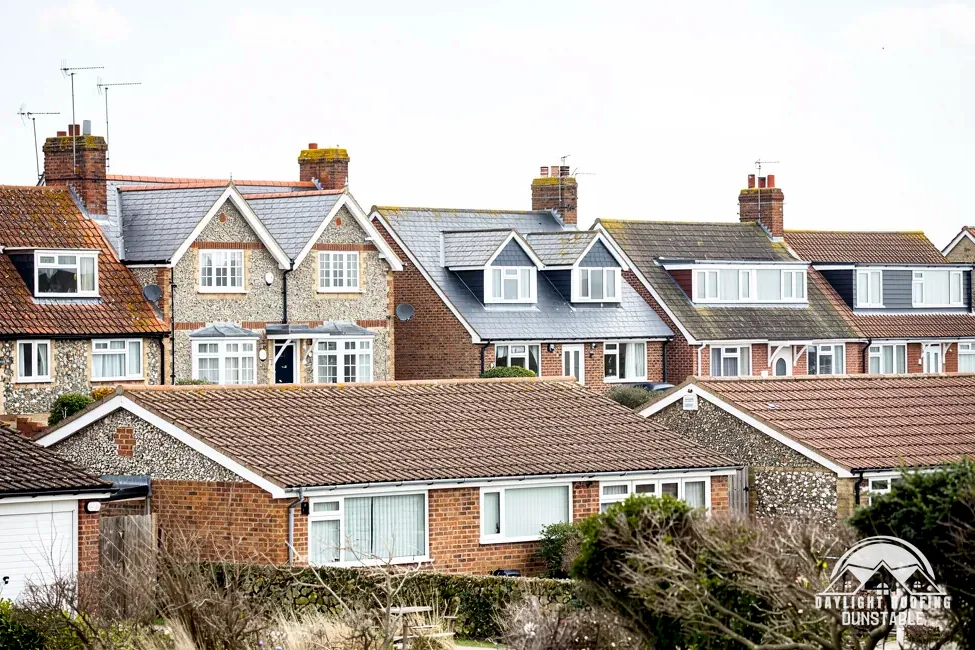
A row of low bungalow roofs on the flat land of the Selsey peninsula

The roof, in plain words

Zinc
A silver-grey metal sheet laid as a roof covering.
Roost
Where bats breed or shelter, which the law protects.
Batten
A thin timber strip fixed across the rafters for tiles to hang from.
Roof void
The space between the ceiling below and the covering above.

The plain-as-day roof check

Four roof checks in How Wood, from metal to the nest box

4 checks about 3 minutes to read

  1. Metal coverings and their claims
  2. Weight of a new covering
  3. Roof space airflow
  4. Nests and roosts in the eaves

01 Metal coverings and their claims

Metal roofs come with long numbers attached. VMZinc, a maker, says "When correctly designed and installed a zinc roof can last in excess of 100 years." The conditions are the part to read: design and installation both have to be right. For lead on a flat roof, HomeBuilding gives 60-100 years and Less says "Lead is the longest-lasting option at 50 to 100 years." MyJobQuote's page on chimney leadwork says "When correctly installed, lead flashing can last for over 80 years (over 100 years for higher codes) with minimal maintenance."

Each figure is a maker's or a guide's claim about a correctly installed material, and none of them describes a How Wood roof already in place. Where a roof is already metal, the survey looks at the joints between sheets, the details where it meets a wall and any place where a fixing has worked free. A quote that proposes metal should say which metal, and for lead which code, because the specification sets the code for each detail.

02 Weight of a new covering

Changing the covering changes the load on the roof structure, and the rules watch for it in two places. The Planning Portal lists as one trigger for Building Regulations approval "You use a new covering material which increases the weight of the roof covering by 15 per cent or more." Approved Document A, para 4.4, says "A significant change in roof loading is when the loading upon the roof is increased by more than 15%." The two wordings differ by a hair, so each is quoted with its name.

No material is lighter or heavier than another here by reputation; what matters is the figure for the actual roof. The Planning Portal says "you are advised to check with a structural engineer or surveyor before commencing with works" where a covering adds weight. Going past the 50 per cent limit, as any replacement of the whole roof does, brings Building Regulations approval anyway, so for a How Wood house the weight question is one of several that the survey and the council's route settle together.

03 Roof space airflow

Warm air from a house carries moisture up into the roof void, and the roof has to get rid of it. BS 5250:2021 is the standard on managing moisture in buildings, and Marley turns it into numbers. Its figures apply when the roof is cold and the underlay is high-resistance: 25mm along the length of the eaves for pitches of 15° or less, and 10mm for pitches of more than 15°. High resistance means the underlay is not vapour-permeable, and any air permeability belongs to the covering.

Marley also describes a case in which only 3mm is needed, quoting "fortuitous ventilation at the eaves via normal eaves construction (3mm) is all that is required", on condition that UKAS Third Party certification is fully met. From inside the loft, look at the eaves: whether the opening is clear, whether the timber is dark or spotted near it, and whether anything in the loft smells damp. The pitch and the underlay are both facts for the survey to establish before any figure above is applied.

04 Nests and roosts in the eaves

Wildlife law reaches the roof edge. A person who intentionally "takes, damages or destroys the nest of any wild bird while that nest is in use or being built" commits an offence under section 1 of the Wildlife and Countryside Act 1981. Section 9(4) protects a protected animal's shelter too: it catches anyone who "intentionally or recklessly" disturbs the animal there or obstructs access to it. GOV.UK says "All bat species, their breeding sites and resting places are fully protected by law".

The Habitats Regulations have no intent word for roost damage. That is why a bat sighting, droppings below a gable or a bird nest in a soffit is a point to raise before the survey, not after a tile is lifted. GOV.UK's bat guidance puts "repairing or replacing a roof" on its list of activities in question and sends the owner to Natural England for a licence. What applies depends on the address and the species, which is why a nest or a roost seen in the eaves of a How Wood house is mentioned when the survey is booked and not afterwards.

The dashed ring takes in the nearest towns and villages we cover around How Wood. Map tiles © Esri; map data © OpenStreetMap contributors.

How Wood questions, from ceiling stains to standards

01How should a How Wood owner read a damp mark that has appeared overhead?

A mark that grows after rain points to water arriving from above, but the entry point can sit some distance from the stain, as water runs along timber before it drips. A mark that stays the same size and appears with the heating on may have another source. Draw round its edge and write the date by it, photograph it, and look in the loft above for a wet rafter or damp insulation. Sending the photographs on WhatsApp lets us look before a survey, which then follows the water back along the roof and reports what else it sees.

02Which How Wood buildings are listed, and what follows for a neighbouring roof?

Burstone Manor House is Grade II* (list entry 1102862); The Homestead (entry 1102864) and Orchard Cottage (entry 1175499) are Grade II. Listing does not itself take away permitted development rights for roof work, and adds a layer: listed building consent where works would affect the building's "special architectural or historic interest". Whether a house next door is listed is settled by its own entry on the National Heritage List, which Historic England publishes, and consent questions go to the council, quoting the number, whenever a neighbour's roof is in question. The grade tells you how a building is ranked on the list, and the consent test, whether work would affect its character, is the same question whichever grade a house carries.

03Is a How Wood house covered by the Park Street and Frogmore Conservation Area?

The Park Street and Frogmore Conservation Area, designated by St Albans City and District Council, is close to How Wood. Close to means near; it does not put a How Wood address inside the area, and the council confirms where the boundary falls for a particular house. An Article 4 direction can remove further permitted development rights, so we check with the council first. The conservation area is named here and its extent is left to the council, whose answer for one house is the one that counts for that house. A planning guide is a useful map of the national rules, and the council's reply is the local detail that sits on top of them.

04Who checks a How Wood re-roof under the Building Regulations?

St Albans and Watford councils run a shared building control service, and a registered building control approver is the other route. The Planning Portal's own interactive guide sets the test: normally no application is needed where "Less than 25 per cent of the total 'building envelope'" is affected and "Less than 50 per cent of the roof is affected", and its main page says "In most situations, this work will need Building Regulations approval." Replacing the whole roof exceeds the 50 per cent limit.

05How much notice does a scaffold licence need for a How Wood house?

Hertfordshire County Council, the highway authority for How Wood, grants scaffold licences under Highways Act 1980 s169: £134 covers 14 days and each week after costs £59. The council's page says "It usually takes 3 weeks to process an application." and wants "A 1.2m clear walkway" kept free on the footway. A renewal has to be applied for "no later than five working days before the expiry". We arrange it with our scaffolder when the pavement is involved, and the scaffold is covered within that single written figure.

06What do outside sources say a How Wood re-roof might cost?

Which? Trusted Traders priced "Replacing entire roof on an average three-bedroom house." at £7,000-£21,000 excluding VAT (a survey of 11 traders, November 2025). HomeBuilding says "a standard three-bedroom semi with a 65m² roof and plain concrete tiles may cost between £10,000 and £15,000", and a Welsh slate roof for the same property "might reach £18,000" (page last updated 30 September 2025). MyJobQuote's page of 3 November 2026 gives "around £5,250" as the UK average. A How Wood roof is priced after the survey, as one written total.

07Can a signed How Wood roofing contract be cancelled after a visit?

After signing at home, a customer has until "the end of 14 days after the day on which the contract is entered into" to cancel under regulation 30 of the Consumer Contracts Regulations, which puts the first day on the morrow of signing. Early starts are possible on a written request; the request leaves cancellation available, with payment possibly due for work already carried out. A visit the customer has asked for to carry out "urgent repairs or maintenance" carries no cancellation right at all. Citizens Advice can be reached on 0808 223 1133, and the helpline can explain how the 14 days are counted.

08What care and skill must a How Wood roofing service show?

Section 49 of the Consumer Rights Act 2015 requires a "Service to be performed with reasonable care and skill". That applies to a roofing service as to any other. If a customer is unhappy, Citizens Advice's consumer helpline is 0808 223 1133. Citizens Advice, not Trading Standards, is the service that advises individual customers, so a How Wood owner with a complaint about how a job was carried out starts there, with the dates, the written price and any photographs of the work to hand.

09Does storm damage to a How Wood roof need evidence for the insurer?

The Financial Ombudsman Service says it will "usually look at expert reports and photos", so pictures of the slopes and the debris, taken before anything is cleared away, help. It also says "Rain, hail or snowfall by itself can constitute a storm". The rule reads: "For most complaints, a business has up to 8 weeks to consider a complaint." The Ombudsman's number is 0800 023 4567. MyJobQuote's page of 22 October 2026 says extensive storm damage repairs can cost £1,200 or more.

Get a written price for your roof

10-year workmanship guarantee, in writing

Tell us about your roof

Call WhatsApp Written quote