
Call 01582 935272

Wheathampstead · 13 road miles south-east

Roofers in Wheathampstead

Lead roofs, bay and porch roofs, tile repairs and re-covers get a survey first in Wheathampstead, a Hertfordshire village 13 road miles from Dunstable, and then one written total.

Get a written quote

Call 01582 935272WhatsApp us

Council
St Albans City and District
Road miles
13
Conservation area
Wheathampstead Conservation Area
Building control
St Albans & Watford

Roofs on High Street and round St Helen's

Dunstable to Wheathampstead is a 23-minute trip, 13 miles of road heading south-east. The 2021 Census counted 6,622 usual residents in Wheathampstead parish. By grade and heritage-list number, a Grade I church and three High Street buildings at Grade II appear below, along with a scheduled earthwork close to the village, and for each of them a call to the council comes before any roofing decision is made. That order matters because a listing can rule out the covering a householder had in mind, and it is cheaper to learn that before a quote is requested than after one is signed.

St Albans City and District Council decides Wheathampstead's planning applications. The village has a conservation area of its own, with a second, Amwell, in the area round it, both of them marked out by that same council. Whether an address sits inside either line is for the council to say. The planning guide covers the roof rules, and the lead roofing page describes sheet lead, the metal behind most of the questions on this page.

  1. 01Church of St HelenGrade I, National Heritage List entry 1103657, first listed on 19 October 1953, a Church of England church.
  2. 0232 and 34, High StreetGrade II, entry 1103655, first listed on 27 September 1984, so roof work is weighed against character.
  3. 03Bell and CrownThe Bell and Crown Public House, Grade II, entry 1175777, first listed on 15 June 1971.
  4. 04Devils Dyke earthworkThe earthwork incorporating Devils Dyke and the Slad is a scheduled monument, entry 1003521, near Wheathampstead.
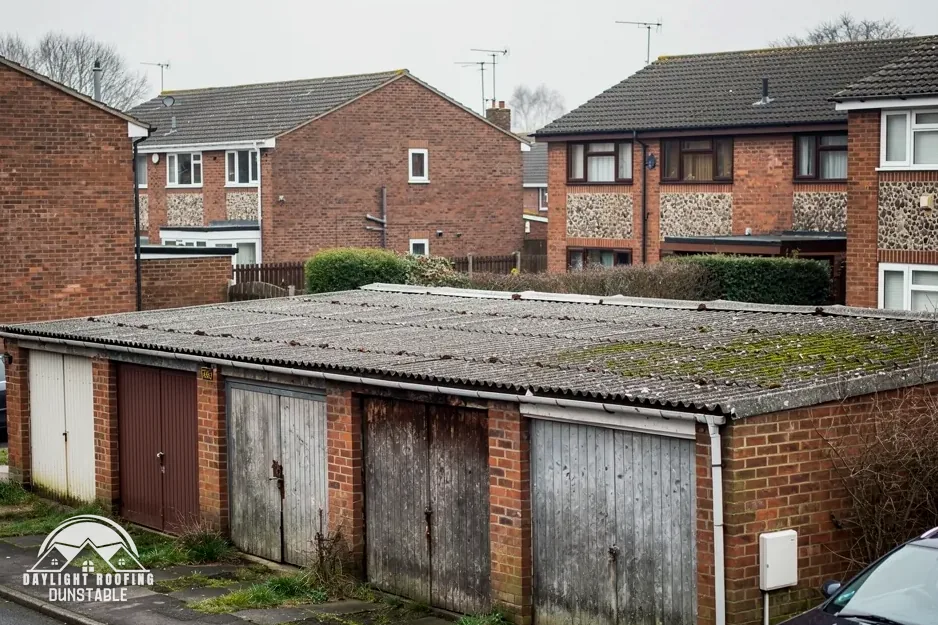
A row of brick garages with an old flat roof behind houses

Lead and listing words, Wheathampstead style

Code 4
A weight of rolled lead sheet, 1.80 mm thick.
Bay roof
A small covered top above a projecting window.
Scheduled monument
A protected earthwork or ruin; works need authorising.
Parapet gutter
A lead-lined channel running behind a short wall at the roof edge.

The plain-as-day roof check

Lead on Wheathampstead roofs: four places to look

4 checks about 3 minutes to read

  1. Lead over a bay window
  2. Lead beside a chimney
  3. Lead in a parapet gutter
  4. Cracks that run with the roofline

01 Lead over a bay window

Above a projecting window sits a small roof, sometimes clad in sheet lead, which can be seen from the street or from an upstairs window across the road. A bay on the front of a house packs a lot of joints into a small space. Check the lead for splits along its ridges, a seam that has parted, or a stain on the brick beneath the window head. Some bay roofs end in a short lead-lined gutter at the front edge, so a drip from the lower edge is also worth noting. Lead that has crept down its slope into a bulge is no longer held where it was laid.

Lead sheet is made to BS EN 12588 in codes 3 to 8, and code 4 is 1.80 mm thick. The specification hands each detail its code, and Calder and Ecobat, the sheet makers, give different weights for codes 3 and 6, so each weight is quoted alongside the name of its maker. A bay roof is small, which makes the survey's call between repair and renewal a close one, and a patch of new lead beside old can fail at the join if the old lead has hardened and cracked.

02 Lead beside a chimney

At a chimney, a lead strip is dressed from the stack onto the slope. Watch for a top edge that has lifted, a crease cracked across, or crumbling mortar along the line where the lead is let into the wall. A brown stain on a bedroom chimney breast can mean the flashing has failed, though a cracked pot or cap higher up can leave the same mark.

MyJobQuote says correctly installed lead flashing "can last for over 80 years", a line about a good fit and no floor for an old strip in poor order. Lead and pointing are read together at the survey, because new lead pushed into crumbling mortar will not stay in place. The chimney repairs page covers the stack itself, brickwork and pots included, and a stack that leans is a separate matter from a flashing that has lifted.

03 Lead in a parapet gutter

When a roof ends behind a low wall, its gutter may be lined in lead and drain through an outlet in the wall. Because such a channel is hard to see, an upstairs window is the place to check for standing water, a blocked outlet or a damp patch spreading down the wall beneath it. After a long dry spell, a tide-mark of dirt in the channel shows how high the water has stood. Water lying in the channel for days means the lining or its fall is failing. Leaves and moss build up behind a parapet, where nobody looks, and a gutter that has been clear for years can block in a single autumn.

The lining carries its own load of water, so a small split does more harm here than on a slope. Where the specification fixes the lead code and the fall, a survey that cannot see the lining says so in plain words. The flat roofing page covers roofs that are not pitched, and a parapet gutter sits between the two kinds.

04 Cracks that run with the roofline

A crack running down a gable wall from the verge, or along the wall beneath the eaves, can mean the roof is pushing on the wall or the wall is moving under the roof. Note whether the crack is wider at one end, whether a gap has opened between a stack and the slope, and whether the ridge has shifted against the gable.

Photograph a crack with a ruler or a coin beside it, then again a month later from the same spot. The pair of pictures shows movement. Sent by WhatsApp to 07880 284133, they are looked at before the survey, and the pair shows where the movement is. A moving crack raises a structural question and may call for a structural engineer, which is a separate trade from a roofer's. A roofer's survey can say whether a slope or a gutter is loading the wall, and a hairline crack that has not changed in a year is a lesser matter.

The dashed ring takes in the nearest towns and villages we cover around Wheathampstead. Map tiles © Esri; map data © OpenStreetMap contributors.

Wheathampstead lead and roof questions, answered

01How long does sheet lead last on a Wheathampstead flat roof or bay?

Two sources are named, and they disagree. HomeBuilding puts lead on a flat roof at 60-100 years, while Less puts it at 50 to 100. For flashing in particular, MyJobQuote says correctly installed lead "can last for over 80 years". These are ranges for well fitted material. A given Wheathampstead roof turns on the lead code, the details, the fixings and the support beneath, and the survey checks each before one written total is set, with anything else on the roof reported in plain words.

02Do the Wheathampstead and Amwell conservation areas affect a roof repair?

Both areas came from St Albans City and District Council, and a house within either may meet stricter control of exterior work, and the council says which addresses are inside. The council's Article 4 page names Manor Road, Wheathampstead among its other direction areas. Ahead of a new covering, a street-facing lead detail or glazing in the slope, ask St Albans City and District Council whether an Article 4 direction applies to the address, as only the council knows what a particular direction removes.

03How are repairs to the Grade I church of St Helen in Wheathampstead approved?

St Helen's is Grade I (entry 1103657) and is a Church of England church. Whilst a congregation uses it, the faculty jurisdiction of the Church of England covers the work, with the faculty system standing in for listed building consent. If a repair renews roof lead or tiles to match what was there, the archdeacon can deal with it by giving notice in writing, with no full faculty. Planning permission for exterior work depends on how the ordinary tests fall, so a faculty cannot answer everything for a Grade I building.

04Are 32 and 34 High Street, the Bell and Crown and 25 High Street treated differently?

Yes. 32 and 34, High Street (entry 1103655), the Bell and Crown Public House (entry 1175777) and 25, High Street (entry 1102855) are each Grade II. A listed building holds its permitted development rights where roof work is concerned, but the listed-building system requires consent for works "in any manner which would affect its character as a building of special architectural or historic interest". The council decides whether a new covering or lead detail counts, so that question belongs at the start of the project, ahead of any design, and the answer can be kept for later.

05Does the earthwork with Devils Dyke and the Slad change what a roof needs?

The Wheathampstead earthwork incorporating Devils Dyke and the Slad is a scheduled monument (entry 1003521), near Wheathampstead. Works there cannot start without authorisation: the Secretary of State gives consent, applications go to Historic England, and the listed-building route is not the one a monument takes. A scheduled monument is protected by its own consent regime, whatever the status of any house beside it. The ordinary planning tests judge a house roof in the village, which leaves what a re-roof needs unchanged by an earthwork elsewhere in the parish.

06Who sorts scaffolding permission and building control for a Wheathampstead roof?

In Wheathampstead the highway authority is Hertfordshire County Council, and not the district. Hertfordshire County Council charges £134 for a 14-day scaffold licence and £59 for every week after, and "It usually takes 3 weeks to process an application." The footway keeps a 1.2 m clear walkway. We arrange the licence with our scaffolder. A joint arrangement between the St Albans and Watford councils provides building control here, and a complete re-roof passes the Planning Portal's limit of "Less than 50 per cent of the roof is affected", so Building Regulations approval is needed.

07Which lead code suits a Wheathampstead flashing, and how thick is it?

The roof specification decides which code goes where, so a flashing, a valley and a bay can each differ, and the weight chosen follows the detail. BS EN 12588 is the standard for rolled lead sheet, in codes 3 to 8, and code 4 is 1.80 mm thick. Calder and Ecobat, the sheet makers, give different weights for codes 3 and 6, which is why any weight is quoted with its maker named. No single code is called usual here: the choice follows the detail, the exposure of the roof and the survey's findings.

08What if a new covering on a Wheathampstead house is 15 per cent or more heavier?

For any new covering that is "15 per cent or more" heavier than the old one, as a Wheathampstead household replacing a covering would need to know, the Planning Portal says Building Regulations approval is needed, and it advises a structural engineer or surveyor to look first. Approved Document A treats a roof load "increased by more than 15%" as a significant change. No material is named as heavier than another, because direction of change is not what the figure measures. The roof structure was designed for the covering it carries, and the survey judges what the rafters and walls look able to take, since a heavier choice would load them differently.

09How can a Wheathampstead owner check flood risk before roof drainage work?

Each site has its own flood risk. GOV.UK's long-term flood risk service reports on an area, not on whether one house will flood, while the Environment Agency's flood map for planning is where the flood zone for a planning application is found. Rainwater from a roof is another matter: a lead-lined parapet gutter or a downpipe is built to suit the roof area draining into it, and an overflowing outlet is a fault in the roofline itself, which a look along the roof edge can find, whatever the flood map says about the street.

Get a written price for your roof

10-year workmanship guarantee, in writing

Tell us about your roof

Call WhatsApp Written quote