
Call 01582 935272

Codicote · 17 road miles east

Roofers in Codicote

Storm damage, ceiling stains and overflowing gutters at Codicote houses, 16.7 road miles east of Dunstable, 29 minutes by road, with insurance steps set out in plain words.

Get a written quote

Call 01582 935272WhatsApp us

Council
North Hertfordshire
Road miles
17
Conservation area
Codicote
Building control
Hertfordshire BC Ltd

The Bury, St Giles and storm damage in Codicote

Codicote is a village in Hertfordshire, 16.7 road miles east of Dunstable, and the road takes about 29 minutes. The 2021 Census counted 3,586 usual residents in Codicote parish. Planning questions go to North Hertfordshire Council, which designated Codicote Conservation Area and counts 44 across the district (in its own wording, "North Hertfordshire has 44 Conservation Areas"). Whether a house falls inside the boundary is the council's call, and roof work in the area begins with that enquiry. Storm repairs that merely replace what was there sit apart from a switch to another covering, and the council is the one to ask about both.

Under Hertfordshire Building Control Ltd, which North Herts Council owns jointly with other Hertfordshire local authorities (01438 879990), building control is a single service for the village. A scaffold on a road or pavement needs a licence from Hertfordshire County Council, the body that controls the highway: we arrange the licence with our scaffolder, which matters after a storm because the licence has a lead time of its own. The roof repairs page deals with damage, the guttering, soffits and fascias page with overflow, and the planning guide with the ordinary planning tests.

  1. 01Church of St GilesThe parish church is Grade II* listed and Church of England, so roof repairs follow the faculty system.
  2. 02The BuryListed Grade II*, The Bury needs listed building consent for any roof change that would affect its character.
  3. 03The Noggins, St Albans RoadThe Noggins and numbers 2 and 4 St Albans Road are Grade II, so the council is asked about any new covering.
  4. 04Storm damagePhotograph the damage before moving anything, and then tell the insurer; the Financial Ombudsman Service defines a storm.
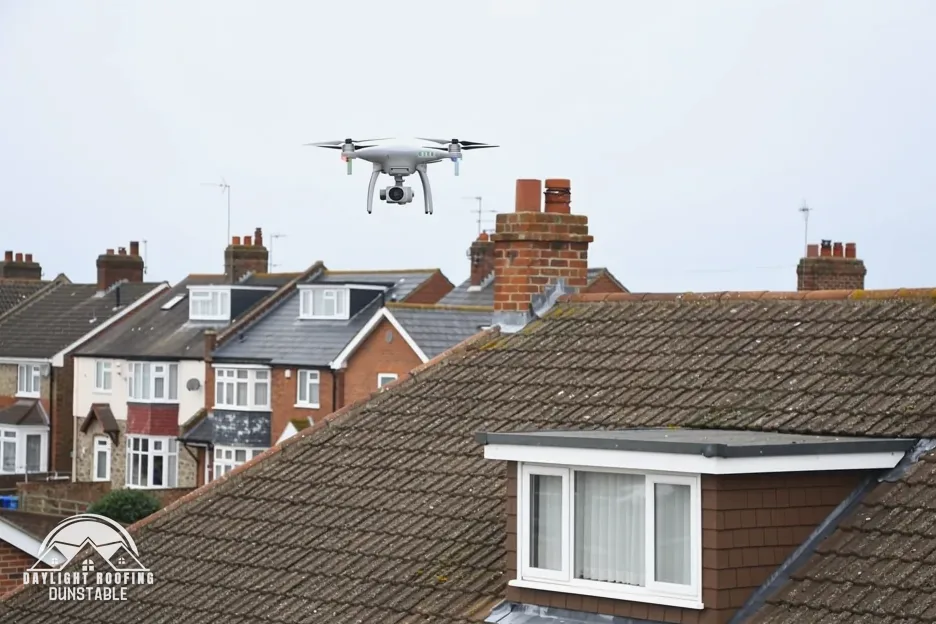
A small grey drone hovering above the tiled roof of a chalet bungalow

The roof, in plain words

Make-safe
A temporary step that holds a roof together until the full repair is possible.
Excess
The part of an insurance claim that the policyholder pays.
Eaves
The bottom edge of the roof, where it sticks out past the wall.
Rafter foot
The lower end of a rafter, resting on the wall plate.

The plain-as-day roof check

Codicote roofs: four after the storm checks

4 checks about 3 minutes to read

  1. Tiles and ridge after wind
  2. Ceiling stains and the loft
  3. Gutters after heavy rain
  4. Evidence for an insurer

01 Tiles and ridge after wind

Once a gale has passed, walk round the house and look at the ground first. Pieces of tile, a loose ridge segment or a length of lead on the lawn tell you where to look up. Then scan each slope from a safe spot on the pavement, using binoculars if you have them. A gap in the pattern, a ridge that no longer runs straight along the top and a flapping sheet of underlay are all visible from below, and a tile hanging by its nail can fall without warning.

Do not go up to fix it yourself, and do not lean a ladder against a damaged gutter or ridge: a lifted ridge piece or a cracked tile can shift under your weight, and a ladder on a bent gutter can slip. MyJobQuote says "Emergency roofer call-out costs typically range from £150 to £300, while extensive storm damage repairs can cost £1,200 or more." (22 October 2026). That is a third-party guide and not our price, and the written price here follows a survey. Which? Trusted Traders put one to six broken or missing tiles at £75 to £400, excluding VAT (November 2025).

02 Ceiling stains and the loft

A brown ring on a ceiling shows water has come through, but not where it entered. Where the hatch opens safely, run a torch beam along the rafters from the joists and look for darkened timber, wet insulation and daylight where none belongs. A stain that grows after dry weather may be condensation or a plumbing leak and not a roof fault, which is why the survey follows the water to its source instead of patching the nearest tile.

Put a bowl or bucket under any active drip and move anything valuable, including rugs, electrical items and paperwork, away from the wet area. Photograph the stain, the loft and the outside of the roof, with a date on each, and write down roughly when the drip began and which way the wind was blowing, since an insurer may ask. The Financial Ombudsman Service will "usually look at expert reports and photos", and it adds that "The insurer has to prove that the exclusion applies - for example, with an inspection report." Send us a photo on WhatsApp at 07880 284133 and we will look at it.

03 Gutters after heavy rain

Stand outside during a downpour, if it is safe, and watch the gutters. Water cascading over the front edge points to a blockage upstream, a parted joint, or a length that no longer slopes to the outlet. Check the brackets as well: one that has come loose from the fascia board lets the gutter sag and spill. After the rain, look for tide marks on the wall and green streaks below the joints, and for stains on the soffit above where the water went over the edge.

Brett Martin advises a fall of 1 mm for every 600 mm towards the outlet. Which? Trusted Traders price "Clear out all gutters at front and back of property" at £75 to £350, excluding VAT (November 2025). MyJobQuote's average gutter replacement is around £1,000 to £1,600 (20 October 2026). Both are guide figures, and neither one is a quote for a particular house, since the length of gutter and the access change the work. Our guttering, soffits and fascias page describes the work.

04 Evidence for an insurer

Insurers decide claims, and a roofer cannot promise the outcome. What helps is evidence: dated photographs taken before any debris is shifted, a note of the day the damage was noticed, and any receipt for emergency work. Keep tiles that have come down, since they show what failed and where, and note which slope each one fell from.

The Financial Ombudsman Service says "a storm usually involves violent winds, usually with rain, hail or snow", and that "Rain, hail or snowfall by itself can constitute a storm". It also says "We take into account the Beaufort Scale." Tell the insurer about the damage, and keep the roofer's written price and any report. If a claim is declined, "For most complaints, a business has up to 8 weeks to consider a complaint".

The dashed ring takes in the nearest towns and villages we cover around Codicote. Map tiles © Esri; map data © OpenStreetMap contributors.

Codicote storm, stain and insurance questions

01What should be done straight after storm damage to a Codicote roof?

Keep everyone away from the foot of any damaged area, children and pets included, put a container under any drip, and photograph the damage with the date before anything gets moved. Then tell the insurer. Do not go up on the roof, and do not climb a ladder to look. A photo sent to 07880 284133 gets a look from us, and the survey follows once it is safe to make one. MyJobQuote says emergency call-outs "typically range from £150 to £300", with "extensive storm damage repairs" at £1,200 or more, as guide figures.

02What does the Financial Ombudsman Service say a storm is?

The Financial Ombudsman Service says: "We say that a storm usually involves violent winds, usually with rain, hail or snow." It also says "Rain, hail or snowfall by itself can constitute a storm" and that it takes into account the Beaufort Scale. It will "usually look at expert reports and photos", so photographs taken before repairs matter. The Financial Ombudsman Service is on 0800 023 4567, and the six months for a complaint run from the date on the final response, not from the date of the damage, so keep every letter the insurer sends.

03Which consent route covers roof repairs at St Giles' church in Codicote?

The Parish Church of St Giles holds a Grade II* listing (National Heritage List entry 1102834, first listed 27 May 1968) and is a Church of England church. In use, it falls under "the faculty jurisdiction of the Church of England", which replaces listed building consent. Under List B, renewing roof lead like for like calls only for the archdeacon's written notice. Exterior work at St Giles can bring a planning question too, which North Hertfordshire Council answers on its ordinary tests.

04What do the listings of The Bury, The Noggins and St Albans Road mean for roofs?

The Bury is Grade II* (entry 1347253, first listed 9 June 1952), The Noggins is Grade II (entry 1102774, first listed 21 March 1984) and 2 and 4, St Albans Road is Grade II (entry 1347304). Listed owners keep permitted development rights for roof work, and storm damage does not change a building's status, but listed building consent is required for work "in any manner which would affect its character as a building of special architectural or historic interest". Whether switching to another covering after a storm needs consent is the council's call, so ask it before anything new is ordered for the roof.

05What does Hertfordshire County Council charge for a scaffold licence in Codicote?

Hertfordshire County Council charges £134 for a licence of 14 days and £59 for every week after. The council states "It usually takes 3 weeks to process an application." and requires a 1.2 m clear walkway on the footway, with a fine of up to £5,000 for scaffolding that has no licence. Because of that lead time, an urgent repair that needs staging cannot be assumed to start at once. We arrange the licence with our scaffolder, and the cost sits inside the written price.

06Does the Codicote Conservation Area affect repairs after storm damage?

North Hertfordshire District Council designated Codicote Conservation Area, and the council confirms whether an address lies inside it. An Article 4 direction can remove further permitted development rights, so we check with the council first. Storm damage to a Codicote roof in the conservation area can still be repaired, and North Hertfordshire Council rules on whether a change of look needs an application, so ask it before a different covering is chosen. The planning guide explains the ordinary tests that apply to a roof.

07Can a Codicote customer cancel a roofing contract?

Regulation 30 of the consumer regulations puts it this way: "the cancellation period ends at the end of 14 days after the day on which the contract is entered into". That covers a contract signed at the kitchen table after a survey. Asking in writing for work to begin early does not remove the right, and the customer can still be asked to pay for work already carried out. There is no right where "the consumer has specifically requested a visit from the trader for the purpose of carrying out urgent repairs or maintenance". Citizens Advice's consumer helpline is 0808 223 1133.

08Does a Codicote homeowner pay reverse-charge VAT on a roof job?

On a domestic roof the VAT reverse charge for construction services is a matter for businesses reporting under the Construction Industry Scheme. HMRC's technical guide says it "does not apply for supplies to end users", provided the end user has told the supplier so in writing. A Codicote householder is a different case, since HMRC's guide says "if services are provided to a private domestic customer, the reverse charge does not apply because the customer will not be VAT registered". HMRC's Notice 708/6 is separate and covers installing insulation in "roofs or lofts" at the zero rate until 31 March 2027.

09Which places near Codicote are covered by the same team?

Welwyn, Woolmer Green, Knebworth, Kimpton and Digswell are all on the list, each on its own page. Welwyn, Woolmer Green and Digswell sit under a different council from Codicote, so the page for your own village matters, and a house on a parish boundary is worth a call, because the planning council, its conservation areas and the building control route can change at a parish boundary, though Hertfordshire County Council licenses scaffold on both sides. Send a postcode and a photo from the ground to 07880 284133 and the right page is named.

Get a written price for your roof

10-year workmanship guarantee, in writing

Tell us about your roof

Call WhatsApp Written quote