
Call 01582 935272

Ashwell · 26 road miles north-east

Roofers in Ashwell

Birds, bats and roof work in Ashwell, 25.8 road miles north-east of Dunstable, 43 minutes by road: what the law says, what to look for and who to tell before the covering comes off.

Get a written quote

Call 01582 935272WhatsApp us

Council
North Hertfordshire
Road miles
26
Conservation area
Ashwell
Building control
Hertfordshire BC Ltd

The Bear House, Town House and Ashwell's roof space

Ashwell is a village in Hertfordshire, 25.8 road miles from Dunstable going north-east, and the journey takes about 43 minutes by road. At the 2021 Census, Ashwell parish had 1,980 usual residents. North Hertfordshire Council takes planning applications for the village and has designated Ashwell Conservation Area, one of the 44 in its words ("North Hertfordshire has 44 Conservation Areas"). The council is the one to ask whether a given house is inside the boundary, and our first step on a roof here is that question.

Building control here is Hertfordshire Building Control Ltd, which North Herts Council owns jointly with other Hertfordshire local authorities (01438 879990). Where scaffold has to take up the pavement, the highway authority is Hertfordshire County Council, and we arrange the licence with our scaffolder. The roof repairs page covers repair work and the pitched roofing page covers re-covering, with the planning guide for the planning tests.

  1. 01St Mary's, AshwellListed Grade I and in Church of England use, St Mary's follows the faculty system for roof repairs.
  2. 02Bear House and Town HouseBear House, the Rose and Crown and Town House (Ashwell Museum) are Grade II* listed, so consent attaches to character changes.
  3. 03Ring ditch crop marksThe crop marks west of Station Road are a scheduled monument near the village, where works need authorisation.
  4. 04Birds and batsRoof work can disturb protected animals, so any sign of them is reported before the covering comes off.
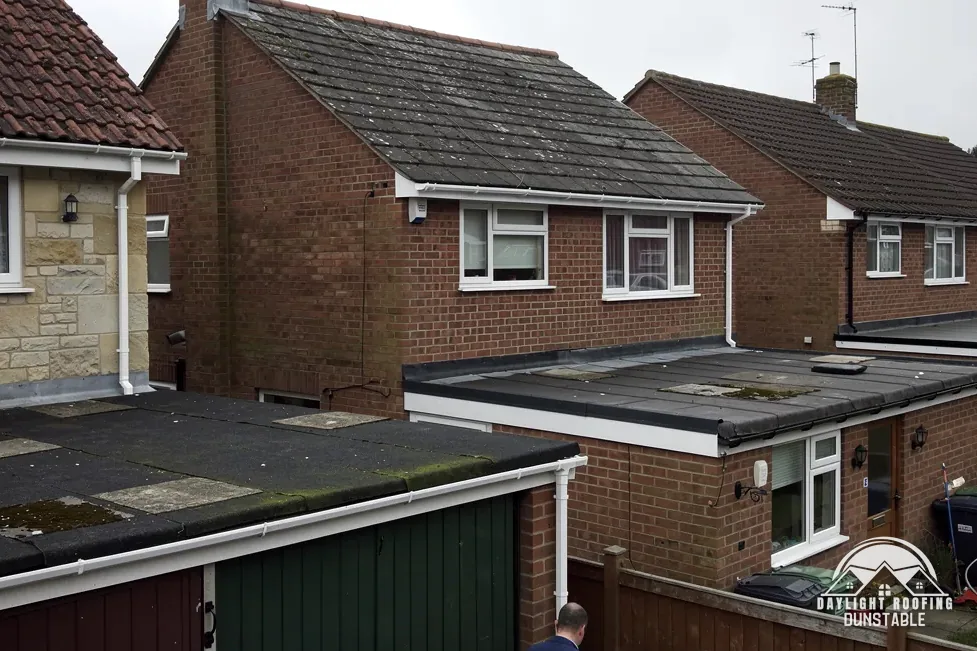
Flat-roofed garages behind brick semi-detached houses

The roof, in plain words

Roost
A place where bats rest or breed, protected by law.
Eaves gap
A hole where the roof meets the wall that an animal can use.
Licence
Written permission from Natural England for work that affects a protected species.
Ridge
The line along the top of a roof where two slopes meet.

The plain-as-day roof check

Ashwell roofs: four birds and bats checks

4 checks about 3 minutes to read

  1. Signs at the eaves
  2. Droppings in the loft
  3. Nests on and under the roof
  4. Gaps that animals use

01 Signs at the eaves

Walk round the house at dusk or early in the morning, and watch the eaves for several minutes, because activity at a gap comes in short bursts. Small birds flying in and out of one spot, droppings streaking the wall beneath a gap, or scraps of nesting material hanging from the soffit show that something is using the roof. Bats are harder to see than birds, but a regular small stain below a gap deserves a note of where and when, and so does a smell of ammonia near a hatch.

Write down what you see, with the date, and take a photo from the ground. A picture sent to 07880 284133 lets us look at it before the survey, and the survey can then plan work around what is found. Do not poke, block or spray a gap to see what happens, and do not push a hose or a broom handle into it. Blocking a hole can trap an animal inside or shut it out of its place of shelter.

02 Droppings in the loft

If the hatch can be opened safely, look at the loft floor and the top of the walls with a torch. Dark pellets that crumble to a dust of insect fragments can mean bats. Larger, softer droppings and bits of nest can mean birds or rodents. Do not handle droppings with bare hands or sweep them up into the air, and leave them in place for whoever comes to look.

Take a photograph and leave things where they are. GOV.UK says "All bat species, their breeding sites and resting places are fully protected by law". The Habitats Regulations, regulation 43, name the offence of damaging or destroying "a breeding site or resting place of such an animal", and it has no intent word. Anyone who finds a roost mid-job should stop and tell the owner, because the next step is a licence matter, and the work that follows has to wait for the answer.

03 Nests on and under the roof

A nest in a roof corner, behind a fascia or under the ridge can look abandoned when it is not. A nest that is occupied or still being built is protected, and the nest of a bird that has left is a different matter. A nest under the tiles is hard to judge from outside, so the safe approach is to leave the area alone until someone has looked. A mud nest under the eaves or an untidy one behind a fascia is easy to walk past without noticing, even when it is in plain view.

Under section 1 of the Wildlife and Countryside Act 1981 a person commits an offence who "intentionally" "takes, damages or destroys the nest of any wild bird while that nest is in use or being built". Section 9(4) covers "intentionally or recklessly" disturbing such an animal in a place of shelter or obstructing access to it. These are legal wording, not a promise about any roof, and what is living in the roof has to be known before the work is planned. If a nest or a roost turns up during a job, work in that spot has to wait until the position has been settled.

04 Gaps that animals use

Look for gaps where the roof meets the wall, loose or missing ridge tiles, lifted lead, and boards with a gap behind them. Each is a way in for a bird or a bat, and each is also a way in for rain, so the same gap raises both a roofing question and a wildlife question. A repair that closes such a gap is a roofing job, and it has to be timed and planned around the law.

GOV.UK includes "repairing or replacing a roof" among the activities for which a licence from Natural England may be needed in bat cases. The licence is Natural England's to give, and nobody should assume it can be obtained quickly, so a leak that comes with a roost in the roof is a harder job than the leak alone. The survey looks at the roof as it stands and takes in any evidence you have reported, and the written price follows it as one total.

The dashed ring takes in the nearest towns and villages we cover around Ashwell. Map tiles © Esri; map data © OpenStreetMap contributors.

Ashwell bird, bat and roof work questions

01What if there is a bird's nest in an Ashwell roof when repairs are due?

The law protects a nest "while that nest is in use or being built", and the offence needs the act to be done "intentionally". A nest that a bird has already left behind is therefore a different case. Telling which is which is a judgement for someone who can see the nest, and a householder looking from the ground cannot always tell. The sensible course is to tell the roofer, leave the area alone, and decide the timing once the position is clear. A nest that is thought to be in use stays where it is until it has been looked at.

02What happens if bats are found in an Ashwell loft?

Work has to stop in that area. Regulation 43 of the Habitats Regulations makes it an offence to damage or destroy "a breeding site or resting place of such an animal", with no intent test, and GOV.UK says bats and their roosts are fully protected. Natural England licenses activities that affect them, and "repairing or replacing a roof" is among the activities named on its guidance. The owner and the roofer then wait for advice before any covering is touched. A licence is Natural England's decision, and the timetable is not ours to promise, so any price for the job rests on that caveat, with the start date left open until the position is clear.

03How does a roof repair at St Mary's church in Ashwell get consent?

St Mary's, the village church, is listed Grade I (National Heritage List entry 1102715, first listed 27 May 1968) and is a Church of England church. As a working church of that kind, it falls within "the faculty jurisdiction of the Church of England", so the faculty system takes the place of listed building consent. Under List B, a like-for-like renewal of roof lead may need only a written notice from the archdeacon. Work on the outside of St Mary's can bring in planning permission as a separate matter, on which North Hertfordshire Council rules.

04What does listing mean for the Bear House, the Rose and Crown and Town House?

Bear House is Grade II* (entry 1347312, first listed 27 May 1968), the Rose and Crown Public House is Grade II* (entry 1102708, first listed 9 June 1952) and Town House (Ashwell Museum) is Grade II* (entry 1102724). A roof change that reaches "in any manner which would affect its character as a building of special architectural or historic interest" needs listed building consent, though permitted development for roof work is not removed by listing. The council is asked before any covering is ordered.

05Do the ring ditches west of Station Road affect roofs in Ashwell?

The crop marks of five ring ditches west of Station Road, Ashwell, are a scheduled monument (National Heritage List entry 1451703), near Ashwell. The Secretary of State grants consent for works to scheduled monuments, Historic England receives the applications, and listed building consent plays no part. On the National Heritage List, the ring ditches' entry includes a map of the ground west of Station Road, and consent for scheduled ground follows its own rules, separate from anything needed to re-roof an Ashwell house.

06What does Hertfordshire County Council require for a scaffold in Ashwell?

Hertfordshire County Council licenses scaffolding on the highway. Its fee is £134 for 14 days and £59 for every week after, and its application guidance says "It usually takes 3 weeks to process an application." A 1.2 m clear walkway has to be kept on the footway. If wildlife evidence delays work, the staging may stand longer than 14 days, and the weekly charge then applies, so the licence may need renewing, and Hertfordshire County Council asks for that application no later than five working days before the expiry. We arrange the licence with our scaffolder, and the cost is part of the written price.

07Is an Ashwell house inside the conservation area?

North Hertfordshire District Council designated Ashwell Conservation Area, and only the council can say whether a given house is within it. An Article 4 direction can remove further permitted development rights, so we check with the council first. The designation does not stop roof repairs, and the council decides whether a change of covering on an Ashwell house needs an application, and that is worth asking before you choose one. The planning guide explains the ordinary tests, and a WhatsApp message to 07880 284133 with the address starts the enquiry.

08Which roof jobs in Ashwell need building control?

A full re-cover goes past "Less than 50 per cent of the roof is affected", the second of the Planning Portal's two limits, so it needs approval, and a covering "15 per cent or more" heavier needs it too. Hertfordshire Building Control Ltd, which North Herts Council owns jointly with other Hertfordshire local authorities (01438 879990), is the provider, or a registered building control approver. Work that disturbs wildlife is a separate legal question from building control, and approval under one does not answer the other.

09Which places around Ashwell does the same team cover?

Steeple Morden, Guilden Morden, Litlington, Stotfold and Dunton each have a page of their own, and several sit under a different council from Ashwell. Read the page for your own village, or send the postcode and a snapshot of the roof from the ground to 07880 284133 on WhatsApp. Each page covers its own place and nothing else, so read the one for your village, and some of these villages are in Cambridgeshire or Bedfordshire, where another council, building control service and highway authority apply.

Get a written price for your roof

10-year workmanship guarantee, in writing

Tell us about your roof

Call WhatsApp Written quote