
Call 01582 935272

Steeple Morden · 28 road miles north-east

Roofers in Steeple Morden

Roofs in Steeple Morden, a Cambridgeshire village 27.9 miles by road north-east of Dunstable, are repaired, re-covered and rebuilt by us, with one written total price after the survey.

Get a written quote

Call 01582 935272WhatsApp us

Council
South Cambridgeshire District
Road miles
28
Conservation area
Steeple Morden - Morden Green
Building control
3C Shared Services

Roofs on Hay Street, Cheyney Street and Morden Green

Steeple Morden lies 27.9 road miles north-east of Dunstable, roughly 46 minutes by car, and at the 2021 Census the parish had 1,188 usual residents. The parish church and three listed homes are picked out below, with grade and list entry for each. Any of them puts heritage rules in front of a roof job, so the status of the building is settled before a covering is chosen, never afterwards. That order saves a client from pricing a roof that the council would not allow.

South Cambridgeshire District Council is the local planning authority for the village. Steeple Morden has a conservation area at Morden Green, and the land round it takes in a second, St Peter and St Paul, both designated by that council. The council confirms where the lines run, address by address. The planning guide covers the roof rules, and our pitched roofing page describes the work on a sloping roof from stripping to ridge.

  1. 01Steeple Morden parish churchListed Grade II*, National Heritage List entry 1164121, first listed on 22 November 1967, a Church of England church.
  2. 0240, Hay StreetListed Grade II, entry 1164218, first listed on 4 September 1986, so a roof change must respect the character of the house.
  3. 03Cheyney Street terraceNumbers 15, 17 and 19 are listed Grade II as a group, entry 1330885, first listed on 4 September 1986.
  4. 04Victoria HouseListed Grade II, National Heritage List entry 1128223, in the village, and subject to the same consent questions as its neighbours.
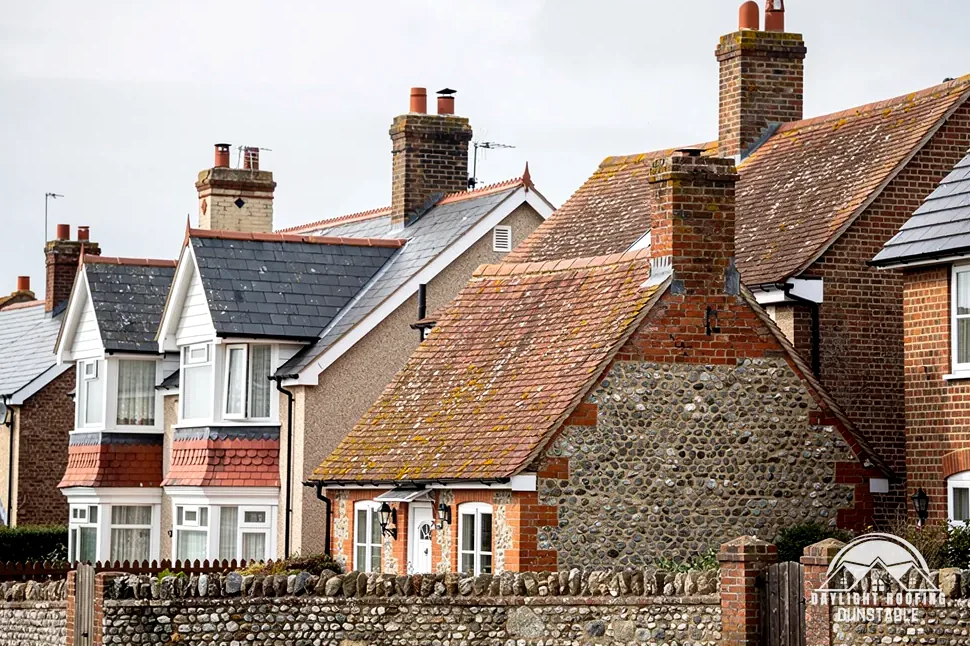
A flint and brick cottage with a weathered clay tile roof

Steeple Morden roofing words, explained

Faculty
Church of England consent for work on a church still in use.
Verge
The slanting row of finishing tiles beside a gable wall.
Abutment
A slope butting against a wall that stands taller than the roof.
Article 4 direction
A council order that withdraws some permitted development rights.

The plain-as-day roof check

On a Steeple Morden roof, what to read from the ground

4 checks about 3 minutes to read

  1. Verges at the gable ends
  2. Valley channels between slopes
  3. Lead beside a taller wall
  4. Felt and battens seen from the hatch

01 Verges at the gable ends

Where a gable wall rises, the tiles stop short of it, and the line of finishing tiles along that slanting edge is the verge. From the lane, watch for edge tiles that stand proud of their neighbours, hairline cracks in the mortar underneath them, or green growth on the brickwork below. Once a verge loses its pointing, rain can reach the head of the wall, and the damp stays out of sight until a stain turns up indoors.

A verge can be bedded in mortar, or held by the clips that BS 8612:2018 sets out for dry-fixed verge, ridge and hip work. Whichever is chosen, the fixings are matched to the uplift calculated for that particular site, a figure that depends on how exposed the roof itself is, not on a guess about the district. The survey reads how the present edge is held before a method is picked, and notes whether the wall top beneath has taken in water. A render crack or a patch of lifted paint on the gable wall can be a clue to the same fault.

02 Valley channels between slopes

A valley forms where two slopes meet in a V, and the run-off from both passes through it. Look for cracked tiles along its sides, leaves or moss packed into the channel, or a shadow where the lining has lifted. A valley that runs towards a dormer cheek or a porch roof also deserves a glance at the point where it ends. When a valley fills with debris, water backs up and spills sideways under the tiles, so a small blockage can cause a leak much bigger than the blockage itself.

Valleys may be lined in lead, and lead sheet is made to BS EN 12588 in codes 3 to 8, with code 4 at 1.80 mm thick. The specification picks the code for each position, which means the metal for a valley is settled once the survey has measured it. Our lead roofing page covers sheet lead from valleys to flashings.

03 Lead beside a taller wall

Where a slope ends against a wall that stands higher than the roof, a strip of lead is pushed into a raked joint and bent down across the tiles below. Check that it lies flat, that no gap has opened along the top edge and that the pointing above it is still sound. Press nothing and pull nothing, because a loose strip can fall as soon as it is touched; a zoomed picture taken from the garden records it without risk. A brown stain on the inside face of that wall points to water running down behind the lead.

MyJobQuote says correctly installed lead flashing "can last for over 80 years", a line about a well fitted job, not a promise for an old one in poor condition. A strip that has split at a fold or lifted off the wall is repaired or replaced, and loose pieces are worth reporting before the next downpour, not after it. A corner, where the lead turns from one face of the wall to the next, is a spot to look at closely.

04 Felt and battens seen from the hatch

Run a torch beam along the roof's inner face. Battens should run true, and the felt stretched across them should be whole, with its laps lying flat. A dark patch on a batten, felt sagging between rafters, or a pinprick of daylight all show where weather is getting through. Keep to the joists as you look, because a ceiling will not take your weight.

A cold roof depends on air moving at the eaves. For a high-resistance underlay Marley gives 25 mm of eaves ventilation at 15 degrees pitch or less and 10 mm above 15 degrees, and since that type of underlay does not pass vapour, the gap has to stay clear. A photograph of anything odd, sent by WhatsApp to 07880 284133, gets looked at before the survey.

The dashed ring takes in the nearest towns and villages we cover around Steeple Morden. Map tiles © Esri; map data © OpenStreetMap contributors.

Roof questions from Steeple Morden

01What does a survey of a Steeple Morden roof check at the verges and valleys?

The survey follows the path of rainwater: the ridge and hips, the verge at each gable, the valleys between slopes, the lead where a slope meets a wall, the gutters and the boards under the eaves. Your own look from the loft hatch, at the felt, the battens and the timber beneath, adds to what the survey sees outside. Expect a straight report on what turned up, with anything else noticed, then the figure for the whole job as one total in writing. A photograph sent through WhatsApp gives a first look ahead of a visit, though the slope itself still needs seeing, and a flat porch roof or lean-to on the same house is read in the same way as the main slopes.

02Do the Morden Green and St Peter and St Paul conservation areas affect a re-roof?

Both were designated by South Cambridgeshire District Council, so a house inside either line may meet extra planning control over outside changes. Which addresses are inside is a point for the council, and the council also holds the answer on any other planning restriction attached to a particular plot. Before you settle on a covering, ask South Cambridgeshire District Council whether an Article 4 direction applies, because a direction can withdraw permitted development rights that would otherwise cover roof work. The planning guide holds the normal rules for a house roof, and reading them helps frame the question for the council.

03How are repairs to the Church of St Peter and St Paul in Steeple Morden approved?

The church is listed Grade II* (entry 1164121) and belongs to the Church of England. While the Church of England keeps it open, the faculty jurisdiction of the Church of England governs repairs, and the faculty system stands in for listed building consent. At St Peter and St Paul's, a repair putting back roof lead or tiles in the same material falls in List B, so the archdeacon gives written notice and no full faculty is needed. Even so, the ordinary planning tests may still call for planning permission on exterior work, so the faculty route does not settle every question about the building in Steeple Morden.

04Are the roofs of 40 Hay Street and Cheyney Street held to special rules?

Yes. 40, Hay Street is listed Grade II (entry 1164218), numbers 15, 17 and 19 Cheyney Street are listed Grade II (entry 1330885) and Victoria House is listed Grade II (entry 1128223). Listed homes keep their permitted development rights, but the Planning (Listed Buildings) system asks for consent before works "in any manner which would affect its character as a building of special architectural or historic interest". A switch of tile, slate or ridge detail on these houses goes to the council before it goes to a price.

05How does scaffolding get licensed for a roof in Steeple Morden?

Poles and boards that stand on a pavement or a road need a licence under section 169 of the Highways Act 1980, granted by the highway authority. In Steeple Morden that is Cambridgeshire County Council. We arrange the licence with our scaffolder, so the application is not left to the homeowner, and the scaffold for the job sits within the written total. Where there is a drive or a garden with space for the tower, the highway may not be involved at all, and the survey looks at which case applies.

06Which building control team deals with a full re-roof in Steeple Morden?

The service is 3C Shared Services building control, a partnership of Cambridge City Council, Huntingdonshire District Council and South Cambridgeshire District Council. On re-roofing, the Planning Portal sets a test. It says nothing is normally needed by way of application where "Less than 25 per cent of the total 'building envelope'" and "Less than 50 per cent of the roof is affected". Renewing the covering across a whole Steeple Morden roof exceeds the second limit, so Building Regulations approval is required, and the 3C team answers questions on the route for a particular address.

07Does removing a chimney breast in Steeple Morden call for a party wall notice?

Removing a chimney breast calls for Building Regulations approval every time, since it is part of the building's structure, in the Planning Portal's words. If that breast belongs to a wall the house shares with next door, the Party Wall etc. Act 1996 adds a duty on the owner to serve notice "at least two months before the date on which the proposed work will begin". A surveyor enters the picture only if the neighbour dissents, or does not answer inside 14 days. Party wall questions belong with a party wall surveyor, and building control does not advise on them.

08What if starlings or bats are nesting under Steeple Morden tiles?

Birds and bats are both protected. Taking, damaging or destroying the nest of any wild bird is an offence when done intentionally, and the nest has to be "in use or being built". For bats, the offence of damaging a roost has no test of intent at all, and Natural England can license work such as "repairing or replacing a roof". Repairs near a nest or a roost are held back until the position is clear, which can shape the order a roof is tackled in on a Steeple Morden house.

09Does flood risk in Steeple Morden affect how a roof drains?

Judging flood risk is a site-by-site matter. GOV.UK's long-term flood risk service shows the position for an area, not for one house. Where planning is involved, a site's flood zone is read from the Environment Agency's flood map for planning. A lane under water and a gutter overspilling are separate faults. Each downpipe is matched to its share of the roof, a fall of 1 mm for every 600 mm towards the outlet being the figure Brett Martin gives, and the gutters, soffits and fascias page covers the roofline fittings in detail.

Get a written price for your roof

10-year workmanship guarantee, in writing

Tell us about your roof

Call WhatsApp Written quote