
Call 01582 935272

Biddenham · 25 road miles north

Roofers in Biddenham

Biddenham roof leaks, repairs and re-roofs, 24.8 road miles from Dunstable, with the water traced to its source and a written price after the survey.

Get a written quote

Call 01582 935272WhatsApp us

Council
Bedford Borough
Road miles
25
Conservation area
Biddenham
Building control
Bedford Borough Council

A conservation-area village and the leaks that start in it

Biddenham is a village 24.8 road miles from Dunstable, about 35 minutes by road heading north, and at the 2021 Census the Biddenham parish had 3,201 usual residents. When a ceiling drips, the first need is to find where the water comes in, because the place it shows is not always the place it enters. A survey traces it back from the roof surface, and a picture taken up through your own loft hatch helps place it; the outcome reaches you in everyday language, together with any other fault spotted on the way. The roof repairs page covers the jobs that follow.

Biddenham has a conservation area designated by Bedford Borough Council, and its listed buildings include Grove Farmhouse, 20-28 Main Road and White Cottage, all Grade II. Where a roof job might touch any of that, the council is asked before work is agreed. An Article 4 direction can remove further permitted development rights, so we check with the council first. The planning guide explains the ordinary permission tests, and the pitched roofing page the covering itself.

  1. 01Tracing a leakA ceiling stain is the starting point, and the opening in the covering is found on the roof above, not always straight over it.
  2. 02Temporary coversA sheet or tarpaulin keeps rain out for a while, and it also hides the fault, so the real repair follows the cover.
  3. 03Conservation areaBiddenham has a conservation area, and the council is asked what applies at an address before a covering is chosen.
  4. 04Grade II housesGrove Farmhouse, 20-28 Main Road and White Cottage are listed, and consent applies to work affecting their character.
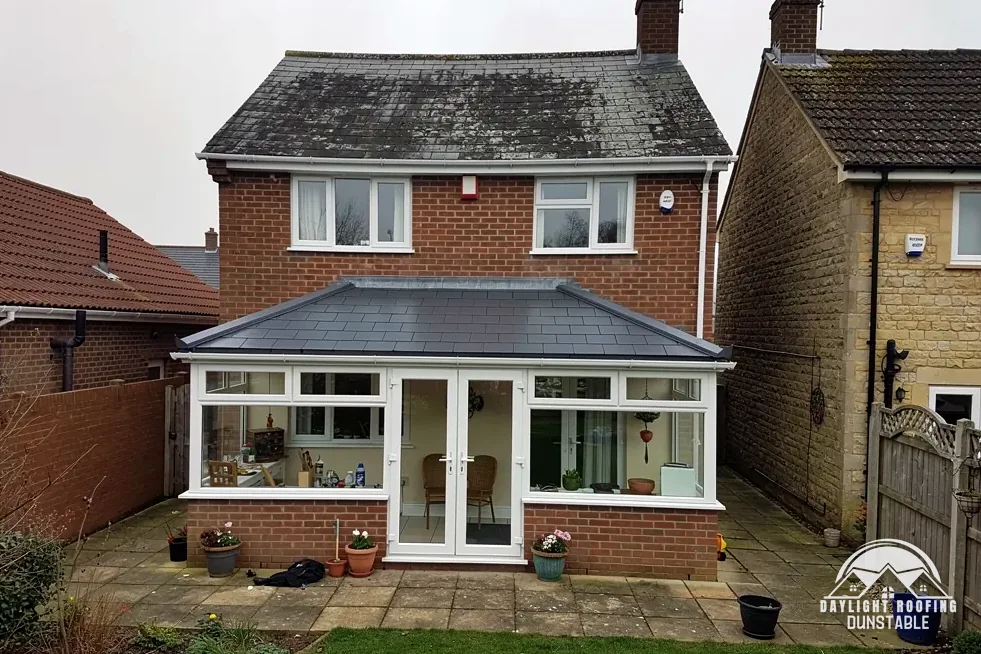
Lean-to conservatory with a new solid slate-effect roof Brick house with a new grey tiled conservatory roof

The roof, in plain words

Make-safe
A short-term fix that stops water entering until a proper repair.
Tarpaulin
A waterproof sheet fixed over a damaged roof as a temporary cover.
Tide-mark
A ring-shaped stain left where damp has spread and dried.
Source
The opening in the roof where water first gets in.

The plain-as-day roof check

Where the water goes in: four checks for a Biddenham leak

4 checks about 4 minutes to read

  1. Where water enters and where it shows
  2. Reading a ceiling stain
  3. Temporary covers and what they hide
  4. After a gale: what to photograph

01 Where water enters and where it shows

Water follows the slope of the roof, and then the line of a rafter, a batten or a pipe, until it reaches somewhere it can drop. So the stain on a ceiling is not always under the hole. A leak at a chimney flashing can appear as a brown patch in a bedroom a metre or two away, and a slipped tile above a landing can show in the hall. The way to find the source is to climb, in thought, from the stain along the line of the slope towards the ridge. A leak that runs down a wall, or appears at the junction of wall and ceiling, can come from the roof edge, the gutter or a chimney, and each is worth looking at in turn.

In the loft, shine a torch along the rafters and across the underside of the covering, working upslope from the stain. Dark tracks on timber, a pale line where a nail has rusted, or damp insulation point to the path. Mark the place on the ceiling below with a pencil. A photograph taken in daylight from the loft, showing the track and the stain together, lets us read a good deal from the ground. If the stain is close to a chimney breast, say so, because the stack is a likely path for water to follow.

02 Reading a ceiling stain

A ceiling stain says something about the leak. A ring with a darker edge that grows after rain and dries between showers is a leak that comes and goes. A stain that stays damp through dry weather, or that spreads without rain, points to something else, such as condensation, a plumbing leak or a tank. A bulging ceiling is a safety matter: the plasterboard holds water, and it can fall, so keep clear of the area. A leak that shows only in a strong wind probably enters at an exposed edge, whereas one that follows every shower points to the main covering.

Set a bucket under a drip, and keep well clear of a bulge rather than trying to drain it. Move furniture and any electrical items away. If water is near a light fitting, switch that circuit off, and do not use it again until it has been checked. Take dated photographs before anything is moved, because they help an insurer and they help the survey. Do not paint over a stain until the cause is found, since fresh paint hides the very mark that tells you whether the leak has stopped.

03 Temporary covers and what they hide

A temporary cover is a sheet of tarpaulin or a patch of membrane fixed over the damaged area to keep rain out. It is a make-safe, not a repair, and it hides the fault underneath it, so the cover is lifted when the real work starts. A cover has to be fixed so that it does not flap, and it is not something to attempt from a ladder in the wind. The risk of a fall is greater than the risk of a stained ceiling. A tarpaulin held down with bricks, or weighted with anything loose, can become a hazard in its own right in wind.

"Emergency roofer call-out costs typically range from £150 to £300, while extensive storm damage repairs can cost £1,200 or more", says MyJobQuote (22 October 2026). Those are published guides and not our prices. Our price follows a survey, and it takes in the access needed, what the roof turns out to need and the work to make good. If the leak is bad, say so in your first message. Temporary protection is worth photographing before it goes on, so that the damage underneath is on record.

04 After a gale: what to photograph

After wind has blown, look from the ground for tiles that have moved, ridge pieces that have shifted, and debris that has landed on the roof. A pair of binoculars helps, and so does a phone with a zoom. Photograph the whole elevation first and then the damaged part. Note where the pieces fell. Do not collect fallen tiles from a roof or a path where more may follow, and keep children and pets away from the area below. Look in the gutters and on the path for pieces of tile, slate or ridge, and note which side of the house they fell from.

The Financial Ombudsman Service says it will "usually look at expert reports and photos", so photographs taken before anything is moved are worth having. It also says "Rain, hail or snowfall by itself can constitute a storm", and describes a storm as one that "usually involves violent winds, usually with rain, hail or snow". Tell your insurer promptly, and keep any receipt for temporary protection. A written note of when the damage was noticed, and the weather before it, can help any claim you make.

The dashed ring takes in the nearest towns and villages we cover around Biddenham. Map tiles © Esri; map data © OpenStreetMap contributors.

Biddenham roof leaks: what to do

01A Biddenham ceiling is dripping: what should I do before anyone arrives?

Set a bucket or bowl beneath the drip, and shift furniture and electrical items clear. If water is near a light fitting, turn that circuit off at the consumer unit. Take dated photographs of the stain, the drip and the roof if it is safe to look. If the ceiling bulges, keep clear of it. Send the photographs to 07880 284133 with a line about where the water appears and how fast it is coming. If water is coming in quickly, say so at the start of the message.

02Is an emergency roof call-out in Biddenham priced differently from a planned repair?

MyJobQuote's page reads "Emergency roofer call-out costs typically range from £150 to £300, while extensive storm damage repairs can cost £1,200 or more." That is a published guide, not our price. Our price follows a survey either way. A consumer who has "specifically requested a visit from the trader for the purpose of carrying out urgent repairs or maintenance" has no cancellation right for that visit, under regulation 28(1)(e) of the consumer contracts regulations. Our price for any job takes in the access, the work to make good and the repair itself, and arrives as a total in writing.

03What does the Biddenham Conservation Area mean for a roof repair?

Biddenham has a conservation area designated by Bedford Borough Council. The council says whether a given house lies inside it and what that means for the work. A repair that matches what is already on the roof raises fewer questions than a change of covering, but the council decides what applies. Whether an Article 4 direction applies to your address is another question for the council, and we ask it before work is agreed. The planning guide gives the general tests. A call to the council belongs before any date is set.

04Which Biddenham houses are listed, and does listing slow an emergency repair?

Grove Farmhouse is listed Grade II (National Heritage List entry 1158150, first listed 28 February 1986), 20-28, Main Road is Grade II (entry 1114212, first listed 21 August 1978) and White Cottage is Grade II (entry 1432299). Listed building consent applies to work "in any manner which would affect its character as a building of special architectural or historic interest". Tell us at the start if the house is listed. Each list description is published by Historic England under its entry number.

05What will an insurer want to see after a Biddenham roof leak?

The Financial Ombudsman Service says it will "usually look at expert reports and photos". Photograph the damage and the stain before anything is moved, keep receipts for any temporary protection, and tell the insurer. "For most complaints, a business has up to 8 weeks to consider a complaint." The Financial Ombudsman Service helpline is 0800 023 4567, and it gives you "6 months from the date on the final response". Keep copies of what you send to the insurer. Dates matter, so note them.

06Why would a Biddenham ceiling stain sit nowhere near the damaged tile?

Water runs along rafters, battens and pipes until it reaches a place where it can drop, so the stain can sit a metre or more from the hole. A survey works from the roof surface to find the opening, and a photo of the track in your loft points it in the right direction. Replacing a tile above the stain without following the track can leave the real fault in place. That is why a photo of the loft side is as useful as one of the roof. A stain that stays wet in dry weather suggests a source other than the roof, such as a pipe or condensation.

07What standard of work does the law expect from a Biddenham roof repair?

The Consumer Rights Act 2015 says services must be performed with reasonable care and skill: the wording is "Service to be performed with reasonable care and skill". Citizens Advice runs a consumer helpline on 0808 223 1133 for advice on what to do next. A written price, agreed before work starts, gives both sides something to refer back to. If something goes wrong, raise it with the trader first and keep dated copies of what you send before taking it further.

08How should I photograph a Biddenham roof fault for a WhatsApp message?

Take one wide shot of the whole elevation, one of the damaged area from as close as is safe, and one of any stain inside, with a daylight source. Add a short note: where it is, when it started and whether it changes with rain. Send it to 07880 284133. A photo cannot show hidden damage under the covering, so a survey follows. Do not climb up to take the picture. If the fault is dangerous, such as a hanging tile above a door, phone as well as message.

09Does the same leak advice hold for Biddenham's neighbours?

Great Denham, Bromham, Kempston, Bedford and Clapham are covered on pages of their own, with the council details set out for each. A postcode sent on WhatsApp shows which one fits your street. All five sit in Bedford Borough Council's area, so the same council deals with each, while their listed buildings and conservation areas differ. Each page is written for its own place. A boundary street can sit on either page, so a postcode settles it. Message us if unsure.

Get a written price for your roof

10-year workmanship guarantee, in writing

Tell us about your roof

Call WhatsApp Written quote