
Call 01582 935272

Clapham · 27 road miles north

Roofers in Clapham

Clapham roofs surveyed and priced in writing: valleys, tiles, flat extensions and leaks. The village is 26.7 road miles north of Dunstable, about 38 minutes by road.

Get a written quote

Call 01582 935272WhatsApp us

Council
Bedford Borough
Road miles
27
Building control
Bedford Borough Council

Roofs by the Horse and Groom and the church

Clapham parish had 4,500 usual residents at the 2021 Census. Its listed buildings include the Church of St Thomas of Canterbury (Grade I, National Heritage List entry 1114251), the Horse and Groom Public House (Grade II, entry 1311129) and Clapham Park Farmhouse (Grade II, entry 1114249). A listed home keeps its permitted development rights for roof work, but listed building consent must be obtained for work affecting the building's character, and a listed pub or church has its own consent questions to settle before any work begins.

Bedford Borough Council receives planning applications for Clapham and runs its own building control service, so check with Bedford Borough Council's building control team before a re-roof or a structural change. Bedford and Biddenham have conservation areas close to Clapham; for a single address, ask the council. The planning guide sets out the permitted development tests. Repairs are covered under roof repairs, and extension roofs under flat roofing.

  1. 01Listed churchSt Thomas of Canterbury is listed Grade I (entry 1114251), so work to it sits outside the ordinary household routes.
  2. 02Listed pubThe Horse and Groom is Grade II listed (entry 1311129); anything that would affect its special interest needs listed building consent.
  3. 03Park FarmhouseClapham Park Farmhouse is Grade II listed (entry 1114249); the permitted development rights stay, but its character is protected.
  4. 04Everyday housesUnlisted houses follow the Planning Portal re-roofing test and the council's building control route, covered in the checks below.
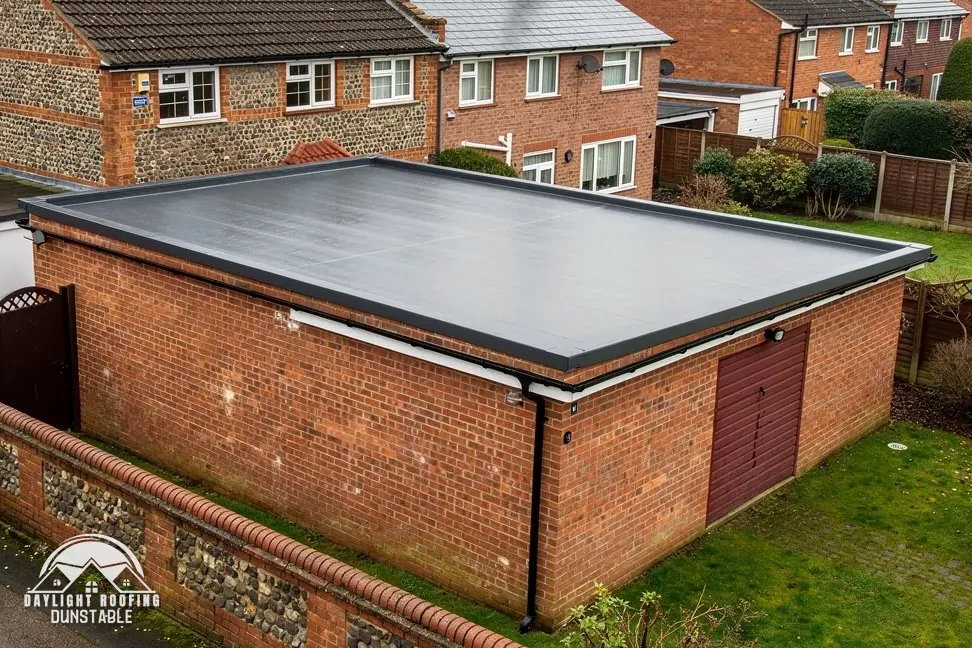
A brick garage with a new flat roof in a back garden

The roof, in plain words

Valley
The sunken channel formed by two roof slopes coming together, which sheds water between them.
Flashing
Lead or other metal strips sealing the line at which a roof meets a wall.
Underlay
The membrane under the tiles that catches whatever gets past the covering.
Listed building consent
Permission for work that affects a listed building's special architectural or historic interest.

The plain-as-day roof check

Where a Clapham roof gives itself away

4 checks about 3 minutes to read

  1. Valleys between slopes
  2. One slipped tile
  3. Extension and garage flat roofs
  4. A stain on the ceiling

01 Valleys between slopes

The valley is the angle in which one slope's runoff joins another's. It is lined with lead, a trough or tile-and-mortar, and every one of those fails in its own way: lifted lead edges, a split in the trough, mortar that has cracked and let moss in. Look along the channel for debris, as a blocked valley sends water sideways under the tiles on either side. Valleys also hold leaves and seed heads blown off nearby trees, and a few weeks of those can dam the channel after autumn rain.

Dark streaks on the wall or ceiling beneath a valley are one clue. Because a valley collects the flow from two roofs, a small defect there passes more water than the same defect on a plain slope. MyJobQuote says correctly installed lead flashing can last for over 80 years, so a valley lining that has failed much earlier points at the detailing or the fixing, and the survey looks for that rather than assuming age. Replacing the lining is a repair that touches the tiles each side, so it is better planned than patched in a hurry.

02 One slipped tile

A single slipped or cracked tile looks small from the lawn and can still be the entry point for a stain two rooms away. Check the slope after a windy night, and look for tiles that sit lower than their neighbours, or a ragged line in the course. Slipped tiles on a roof that is otherwise sound are a small repair, not a reason to re-cover the whole slope. Binoculars help, because a tile that has dropped by a few millimetres shows as a shadow line from a distance, long before it shows from the lawn.

Which? In November 2025, 11 Which? Trusted Traders priced swapping a handful of tiles, between one and six, at £75 to £400 before VAT. Your own figure depends on access and on whether the battens and felt under the tile are sound, which a roofer can only judge up close. A tile that slipped because its nail head rusted through is a sign to look at the tiles beside it, since they share the same fixings and the same age.

03 Extension and garage flat roofs

A flat roof is built with a slight fall; water left standing sits on every seam and upstand, and the membrane has to resist that. BS 6229:2025 asks for a finished fall of at least 1:80. IKO writes that "To achieve a 1:80 fall, the code of practice says that the roof should be designed for a fall of 1:40". Ponding after a day's rain on a rear extension suggests the fall has been lost. A garage roof with a sag in the middle can be a deck problem rather than a membrane one.

Lifespans are quoted differently by different guides. HomeBuilding gives felt 10-15 years and EPDM 25-30 years, while Less gives torch-on felt 10 to 20 years and EPDM 30 to 50 years. Both are approximate. The deck beneath and the upstand details at the walls also decide how long a membrane lasts, so a quote for a flat extension roof should say what is being done to each. See flat roofing for the materials. At the wall junction of a flat roof, look for edging that has lifted and for cracks in the render above.

04 A stain on the ceiling

A brown ring on a bedroom ceiling shows where water has arrived, not where it came in. It can travel along a rafter or the felt for some distance before it drips, which is why a stain below a bathroom wall may start at a flashing near the chimney. Mark the edge of the stain in pencil and date it, so any growth after the next downpour is plain to see. Photograph it each time, from the same spot, so a change in size is plain when the roofer arrives.

Run the same check in the loft with a torch: wet timber, a dark patch on the underlay, or insulation that feels damp. MyJobQuote gives emergency roofer call-out costs as typically ranging from £150 to £300, and says extensive storm damage repairs can cost £1,200 or more. The survey sets out what the repair involves, and a written total is given before any work starts.

The dashed ring takes in the nearest towns and villages we cover around Clapham. Map tiles © Esri; map data © OpenStreetMap contributors.

Before you book a Clapham roofer

01Why does a Clapham roof valley leak when the tiles look fine?

Two slopes empty into a valley, so a defect in its lining meets double the flow. The lead can lift at its edges, a trough can split, or the bedding beside it can crumble and let moss in. The tiles may be perfect while the lining below them has failed. A survey follows the valley from the eaves to the ridge and notes where the lining and the tile cut meet, because the join between lining and tile cut is where a fault can sit. Moss, a silted channel or a lifted tile at the valley edge are the other things to rule out before a repair is chosen, and each has a different fix.

02How should a Clapham flat extension roof drain?

BS 6229:2025 is today's code for flat roofs whose waterproof layer is a flexible membrane supported all over, so it deals with membranes and not with lead. NFRC says it sets a minimum 1:80 finished fall for general roof areas and internal gutters. IKO says that to reach 1:80 the roof should be designed for a fall of 1:40. A roof that holds a puddle for a day after rain has lost some of that fall or never had it. A roofer looking at an extension roof will check for the fall, the state of the edge trim and the upstands where it meets the house wall. Standing water also leaves a tide mark, which shows where the lowest spots are and gives a cheap way to see the problem without climbing up.

03What does replacing a few roof tiles cost around Clapham?

Which? The Which? Trusted Traders figure for one to six standard tiles is £75 to £400 before VAT, gathered from 11 traders in November 2025. MyJobQuote puts the average for replacing roof tiles at around £215, on a page dated 6 October 2026. Those are national guides from third parties, not our prices. We give one written total for your roof once the survey is done, and access, the number of tiles and the state of the battens all move it. Slipped tiles that look like a one-off on a sound roof can be a symptom of ageing nails or battens, in which case a repair of a few tiles is only a stopgap, and the survey says so plainly.

04Does scaffolding on a Clapham lane need a licence?

Section 169 of the Highways Act 1980 requires a licence for scaffolding on a pavement or road, and Bedford Borough Council issues it for Clapham. Bedford Borough Council's licences page gives a charge for 2026 of £178.25 per month or part thereof, and its form asks for 10 working days. Bedford Borough Council says its licence will normally only be issued to the company responsible for actually erecting the scaffolding. We arrange it with our scaffolder. A lane with parked cars and a narrow footway is a case for applying early, well before the poles go up.

05Does Clapham Park Farmhouse's listing affect roof work on the house?

Yes. Listing does not take away a home's permitted development rights for roof work. Listing brings in the need for listed building consent where work would change the home's special architectural or historic interest. Clapham Park Farmhouse is listed Grade II (National Heritage List entry 1114249). Before any roof is touched at a listed address, check with Bedford Borough Council, as the answer decides who must approve what and in what order. The same rule covers a new rooflight or a replacement porch roof on a listed home, and a pub or church is a different case again, because the consent route depends on the building's use. The council's conservation team can say which route applies and what it will want to see.

06Do I need building control for a new conservatory roof in Clapham?

A conservatory can be exempt from the energy rules in England where all five conditions are met: it is at ground level, no larger than 30 m² in floor area, glazed to Part K, with a wall, door or window still dividing it from the house, and outside any extension of the home's heating. A new roof must comply with building regulations, so check the route with Bedford Borough Council's building control team before work starts. A conservatory with a tiled or glazed roof is treated the same way: ask first, then price. Where the exemption fails, one of the five conditions has been missed, and a missing door or window between house and conservatory is one way that happens.

07What are my cancellation rights after agreeing a roof job at my Clapham kitchen table?

Under the Consumer Contracts Regulations, the cancellation period ends at the end of 14 days after the day on which the contract is entered into, where the contract is signed at home after a survey. Starting inside those 14 days takes a written request from you. Cancelling stays possible afterwards, though payment for work already done may be due. There is no right to cancel for an urgent repair visit that you specifically requested. Keep your signed copy with its date, since day one is the morning after the contract is made.

08Is a corrugated garage roof near Clapham asbestos?

HSE's advice is: "If the building was built or refurbished before 2000, assume that there is asbestos in it." HSE also says "AC roofs are always fragile", so never walk on one. Removing asbestos cement sheets intact, with no breakage, is non-licensed work, but broken-up material is notifiable. Use a lockable skip for asbestos. For taking asbestos off a roof, MyJobQuote's average is around £2,750, on a page dated 9 September 2026. A lockable skip, never an open one, is what asbestos waste goes in, and household asbestos is not covered by the consignment-note exemption, which applies to waste other than asbestos waste. Where a sheet looks suspect, do not touch it; have it identified first, before any drill or saw goes near it.

09How wide is the price range for re-covering a three-bedroom roof in Clapham?

Which? Trusted Traders give "Replacing entire roof on an average three-bedroom house" as £7,000 to £21,000 excluding VAT, from a survey of 11 traders in November 2025. HomeBuilding, updated 30 September 2025, says a semi-detached house with three bedrooms, a 65m² roof and plain concrete tiles may cost between £10,000 and £15,000. Those ranges are wide because roofs differ. For your own house, one written total follows our survey of the roof. Neither guide says where a particular house falls within its range, which is why the survey of your own roof sets the figure.

Get a written price for your roof

10-year workmanship guarantee, in writing

Tell us about your roof

Call WhatsApp Written quote