
Call 01582 935272

Chartridge · 18 road miles south-west

Roofers in Chartridge

Chartridge roofs, from leak repairs to pitched re-roofs and rainwater goods, each looked at in person before a single written total is put to you.

Get a written quote

Call 01582 935272WhatsApp us

Council
Buckinghamshire
Road miles
18
Building control
Buckinghamshire Council

Chartridge roofs on Chilterns planning ground

Chartridge is a village in Buckinghamshire, 18.4 road miles to the south-west of Dunstable, roughly a 34-minute drive. At the 2021 Census, Chartridge parish had 1,682 usual residents. Planning in the village is handled by Buckinghamshire Council, which also runs its own building control service, and the contact details are on its building control page. Chartridge sits inside the Chilterns National Landscape, and a Chesham conservation area is close to the village; for any particular address, the answer on conservation status comes from Buckinghamshire Council. Because the village is inside the National Landscape, new dormers and other changes to the roof shape have their own section in our planning permission guide, and that is the page to read before anything is drawn up.

Listed buildings in Chartridge include the Barn to West of Chartridge Green House (Grade II, entry 1162737), Chartridge Green House (Grade II, entry 1332484) and Oak Cottage (Grade II, entry 1124903). Whichever roof you have, it is surveyed first and the price follows. We say plainly what the roof needs and mention any other faults seen on it, so that you can decide what to do about each one, and a photograph sent to WhatsApp can help plan the visit. Ask for each part of any quoted job to be described in words, not codes, so that you can follow what is being proposed on each slope and at each chimney.

  1. 01Chartridge Green HouseGrade II (entry 1332484, first listed 23 November 1983). Consent is needed for work that touches its character.
  2. 02The barn beside itThe Barn to West of Chartridge Green House is Grade II as well (entry 1162737), so a roof or rooflight change there is a listed question.
  3. 03Oak CottageGrade II (entry 1124903). Ask Buckinghamshire Council what a change to the covering, ridge or chimney would involve.
  4. 04Chilterns rooflinesApplications still go to the council; the Chilterns Conservation Board advises and responds to consultations.
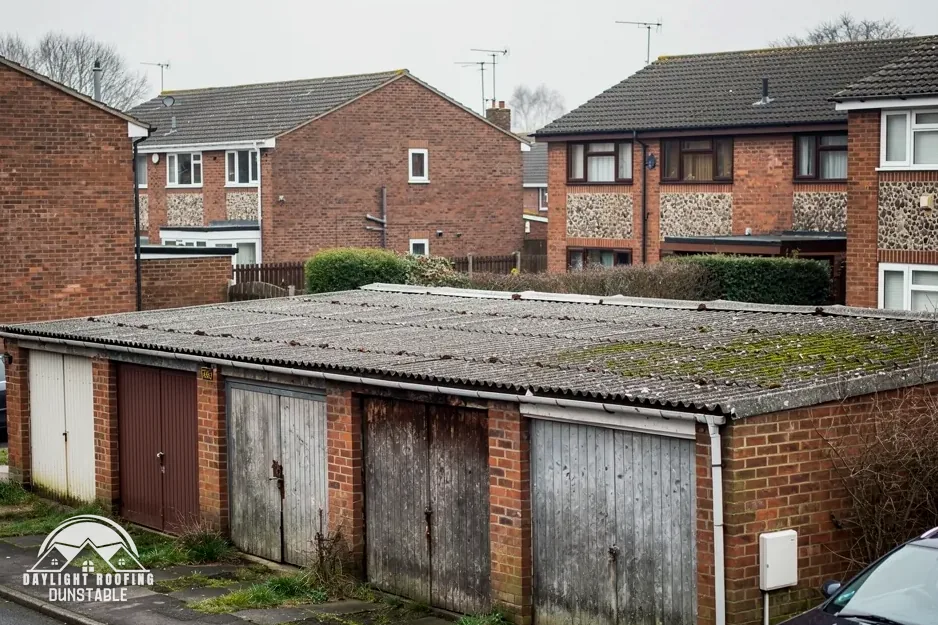
A row of brick garages with an old flat roof behind houses

The roof, in plain words

Dormer cheek
A dormer's flank wall, covered in tile or lead.
Rafter
A sloping timber that carries the battens and covering.
Cowl
A cap on a chimney pot that shields the flue.
Article 4 direction
A council order withdrawing some permitted development rights.

The plain-as-day roof check

Four spots on a Chartridge roof worth a good look

4 checks about 3 minutes to read

  1. Dormer cheeks and tops
  2. Insulation under the rafters
  3. Moss and algae on tiles
  4. Chimney pots and cowls

01 Dormer cheeks and tops

A dormer packs several joints into a small area: two cheeks, a front, a top and the valleys where it meets the main slope. Look at the lead or tile on each cheek for lifted edges, and at the top for standing water after rain. Peeling paint beside a window frame can point to a flashing that has opened above it, and a brown stain on the ceiling beside the window tells you the water has already come in. Lead on a dormer cheek is dressed in short pieces, so check each join rather than looking only at the overall shape.

Anything new on the roofline is a planning matter, and our guide is where to start. For a dormer that is already there, the lead at the cheeks is the detail to ask about, and a survey can say whether it needs a repair or a renewal, and what the work would take.

02 Insulation under the rafters

Roof insulation is covered by Approved Document L. In its 2021 edition, Table 4.2 gives 0.15 W/m2K for a roof in new fabric, such as the roof of an extension. When more than half of the roof's area is renovated, para 11.3 asks for the whole element to be upgraded where feasible, and para 4.13 sets a simple payback of 15 years or less as the test. Table 4.3 sets a 0.35 threshold for a retained roof, with 0.16 as the improved figure. Those numbers are why a re-roof raises an insulation question. None of this applies to a roof that is only being repaired in a small area, where the figures stay in the background.

You can see the insulation's condition from the loft hatch: compressed or damp material, gaps at the eaves, and daylight through the boards. Stay on the joists. Knowing what is already there before the survey saves time, and a photograph of the loft floor from the hatch is a useful thing to send. If the hatch shows insulation pushed hard against the eaves, the ventilation gap at the edge may be blocked.

03 Moss and algae on tiles

Green or black patches show where a slope stays damp, so look closely at any slope that sits in shade. Moss holds water against the tile and lifts the edges of its neighbours. Checkatrade says roof cleaning typically costs £8.50 to £14 per m2 (April 2026), with no VAT basis stated. Marley does not recommend using high-powered jet washes, because the surface of a tile or slate can be damaged and its expected life reduced considerably. Branches that overhang the slope drop leaves and keep the surface damp, so the shaded patches are worth a separate note when you describe the roof.

Cleaning treats the surface only. If the tiles under the moss are cracked, or the nails have corroded, cleaning does not mend the roof. A survey separates the two jobs, and it also shows whether the covering is worth keeping or has reached the point where a re-cover is the better route for the money. Ask whoever quotes to say which of the two they are pricing, in plain words, so the paper trail is clear.

04 Chimney pots and cowls

A pot sits in a bed of mortar called flaunching, and a cowl or cap goes on top. From across the lane, look for a pot that leans, a cap that has slipped or a flaunching with a gap at its edge. Where the stack leaves the roof the lead is the next thing to look at, and cracks in the brick face higher up can let water into the flue. Birds sometimes nest on a stack, and that is a reason to look before anything is disturbed.

A chimney that is no longer used still needs its top covered and ventilated, which is a matter for chimney repairs. Taking out a breast is a larger job: removing one always needs Building Regulations approval, because the structure above depends on it, and the survey comes before any such plan is priced.

The dashed ring takes in the nearest towns and villages we cover around Chartridge. Map tiles © Esri; map data © OpenStreetMap contributors.

Roof questions asked in Chartridge

01Is there a conservation area close to Chartridge?

A Chesham conservation area lies close to Chartridge, though that does not place the village inside it. Whether a particular Chartridge address falls inside a conservation area is a question for Buckinghamshire Council, so check with Buckinghamshire Council before booking work that changes the outside of the roof. Conservation areas matter for roofs because they affect what can be done without planning permission, and the planning guide explains the position for dormers and for ordinary re-roofing. Ask the council about your own address and keep its reply with your papers. A neighbour who is told about a conservation area is not necessarily inside one.

02What are the Article 4 entries near Chartridge about?

Buckinghamshire Council's Article 4 list has entries near the village for the land beside Asheridge Road and along Chartridge Lane. Only Buckinghamshire Council can say what each of those directions removes, and from which land. To find out whether a direction applies at your address, check with Buckinghamshire Council, and ask for the answer in writing so that it can be shown to a roofer. Different parcels of land have different directions, so one answer for Asheridge Road does not stand for Chartridge Lane.

03Who decides planning for a roof inside the Chilterns National Landscape?

Applications go to Buckinghamshire Council. The Chilterns Conservation Board is in an advisory role and responds to consultations; it does not approve or refuse anything. Its published notes describe plain clay tiles as "universally predominant" on traditional Chilterns buildings, and flint as something that "is often combined with brick" in older buildings and boundary walls. Those notes describe the local building tradition. They do not turn a re-roof into a planning application, and they are guidance for the design of work, not a rule for it. Where a roof is also part of a listed building, the listing sits on top of this.

04What is listed at Chartridge Green?

The Barn to West of Chartridge Green House (entry 1162737) and Chartridge Green House (entry 1332484) are both Grade II and were first listed on 23 November 1983. Oak Cottage (entry 1124903) is Grade II too. For a listed building, consent is needed for any works that affect its character. A roof survey can describe what is on the roof and what it needs, and the consent question goes to Buckinghamshire Council before work starts, not after. Nothing about a listing is decided by how a roof looks from the road, so even a modest-looking barn is covered by the same rules as a house.

05How is the scaffold licence handled in Chartridge?

A scaffold that blocks the pavement or the lane is something the highway authority licenses, and here that is Buckinghamshire Council. Its fee for a 28-day licence is £402.78; renewing costs £69.09 and applying afterwards costs £777.63, and Buckinghamshire Council's application guidance reads: "You must be a registered scaffolding company to apply for a licence." We arrange the licence with our scaffolder. The cost sits within the written quote, so there is no need to approach the council yourself. The licence is a separate matter from planning permission and building control.

06Does a re-roof bring loft insulation into Building Regulations?

It can. Where more than half of a roof's area is renovated, Approved Document L asks for the whole element to be improved where feasible, so a re-roof can bring insulation requirements with it. Buckinghamshire Council's own building control service covers the village, and contact details are on its building control page. Replacing the waterproof membrane on a flat roof also counts as renovation, which is worth raising when you ask for a quote on an extension roof, not only the main house. The council can say whether a particular piece of work needs an application.

07Does roof cleaning cost less than replacing tiles?

Cleaning and tile replacement are priced on different bases, so the two figures cannot be set against each other. Checkatrade's April 2026 guide puts roof cleaning at typically £8.50 to £14 per m2. Replacing damaged tiles is a different job: Which? Trusted Traders give £75 to £400 for one to six tiles, excluding VAT (November 2025). A roof that needs both has a cost with separate causes, and the survey sets out which of them applies to your roof, so that you are not paying for cleaning on tiles that need replacing. Brushing off and treating moss is a different job from the cleaning priced in that guide.

08Does my neighbour need to be told about chimney breast removal?

Where the chimney breast sits on a party wall, the Party Wall etc. Act 1996 obliges the building owner to give notice at least two months before cutting starts. A surveyor is needed only if the neighbour dissents, or does not reply within 14 days. Dissent leads to the surveyor procedure and is not a veto; written consent from the neighbour allows an earlier start. Questions about party walls go to a party wall surveyor, not to building control. Keep any letters between neighbours, because they settle later questions about who was told what and when.

09Can I send a photo of the roof before a survey?

Yes. Photographs taken in the garden or from an upstairs window help. Send them to WhatsApp on 07880 284133, or ring 01582 935272. A photo shows what is visible from the ground, but it cannot show the underside of the covering, so the quote is set after a survey. Do not climb on the roof to take the pictures. Include the whole slope in the frame where you can, and a second shot of any chimney stack or dormer that worries you. What you send gets looked at, and you are told plainly what can be made out from it.

Get a written price for your roof

10-year workmanship guarantee, in writing

Tell us about your roof

Call WhatsApp Written quote