
Call 01582 935272

Little Missenden · 21 road miles south-west

Roofers in Little Missenden

Roof repairs, re-roofing and roof windows for Little Missenden homes inside the Chilterns National Landscape, surveyed before anything is priced, with a single written total to follow.

Get a written quote

Call 01582 935272WhatsApp us

Council
Buckinghamshire
Road miles
21
Conservation area
Little Missenden
Building control
Buckinghamshire Council

A Chilterns roof in Little Missenden: what applies

Little Missenden stands in Buckinghamshire, 21 road miles south-west by road from Dunstable, about 35 minutes in the car. The parish had 6,593 usual residents at the 2021 Census. It sits within the Chilterns National Landscape and has a conservation area of its own, which Buckinghamshire Council designated. Planning applications still go to that council. Around Little Missenden, the Chilterns Conservation Board's job is advice and consultation responses; the decisions are not its to make.

Those layers explain why a roof job here begins by asking what rules the address carries, and only then moves on to the covering. In its roofing note the Board describes plain clay tiles as "universally predominant" on traditional buildings of the Chilterns, which is design guidance for the region, not a statement about your house. The roof is surveyed, you are told what is up there, and the quote is a single written total. Our roof replacement and roof window pages cover the work itself.

  1. 01St John the Baptist churchGrade I (list entry 1332450) and in Church of England use, which places roof repairs under the faculty system rather than listed building consent.
  2. 02Smithy Cottage and neighboursSmithy Cottage and Ridgewell House are Grade II (entries 1309898 and 1124956), both first listed on 17 March 1982.
  3. 03The White HouseGrade II (entry 1332472). A listed house's roof is tested against one question: would the work alter its character?
  4. 04Castle Tower earthworksA motte and bailey castle near the village is a scheduled monument (entry 1009534); work to scheduled land is authorised separately.
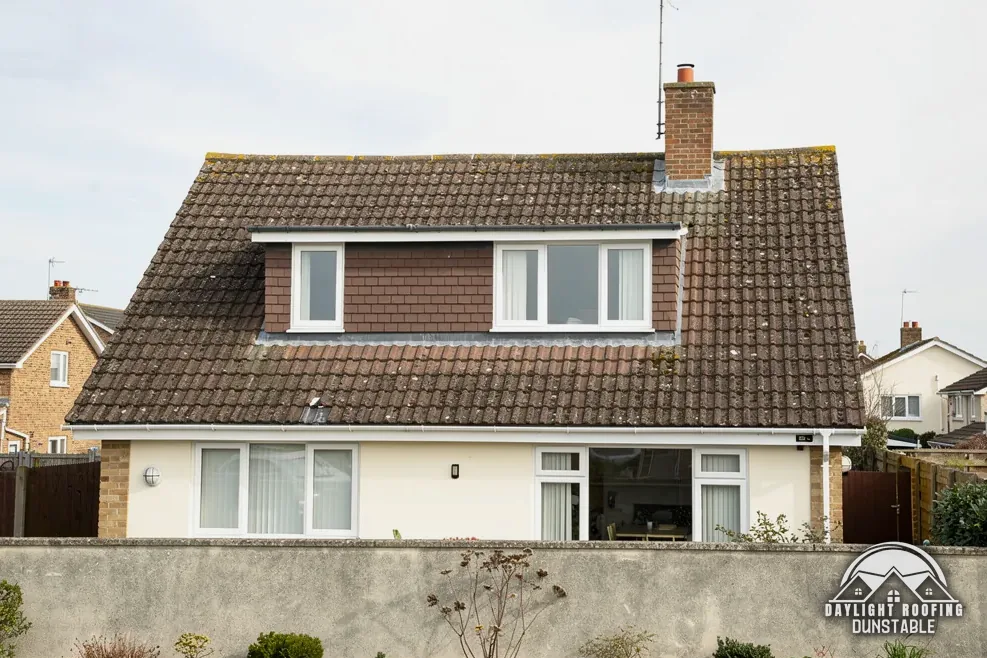
A chalet bungalow with a wide front dormer and a concrete tile roof

Little Missenden terms explained

National Landscape
A protected area, once called an AONB, where the Chilterns Board advises councils.
Plain clay tile
A small, gently curved, flat fired-clay tile hung in staggered rows.
Rooflight
A glass unit on an upstand, raised above the slope.
Roof window
A window fitted level with the slope and following its line.

The plain-as-day roof check

The roof you can read from Little Missenden lanes

4 checks about 4 minutes to read

  1. Plain tiles, course by course
  2. Underlay and battens beneath
  3. Roof windows and rooflights
  4. Walls of brick and flint

01 Plain tiles, course by course

A plain tile roof is built from small tiles laid in overlapping rows, each hung by two nibs from a timber batten and fixed with nails or clips. Look from the lane for a row that has dropped, a tile that has tilted outward, or a flaky surface where the face of the clay has begun to peel. A sharp-edged, bright patch among weathered tiles marks an earlier repair, and several of them close together say something about the whole slope. Walk round to the north side as well; slopes that never dry out grow moss, and moss holds water against the tile surface.

Marley, citing BRE, gives a minimum life expectancy of 60 years for clay roof tiles. That figure is about the product in general, which is why the survey judges your tiles on their condition, not their age. A re-cover can reuse sound tiles where they are fit to go back on the roof, and the survey says whether yours are, tile by tile, before a total is put in writing. Where a roof has been patched several times with different tiles, a re-cover gives one even surface and removes the guesswork about which patch is next to fail.

02 Underlay and battens beneath

Under the tiles lie the battens and a membrane, the underlay, that drains off whatever the covering lets through. You can see them from the loft, or at the eaves where the felt shows below the first course. Look for a sagging or torn membrane, battens that are dark and soft, or a dark tide mark on a rafter. A beam of daylight through the roof is the clearest sign of all. Torn felt at the eaves can also show that the first row of tiles is sitting too high or the felt has been tucked in wrongly, a fault that lets water into the fascia timbers.

With a high-resistance underlay in a cold roof, Marley gives 25 mm of eaves ventilation at 15 degrees or less and 10 mm above 15 degrees. That detail is easy to lose when a roof is re-covered, because insulation can be pushed into the eaves, so the ventilation path is checked during any re-cover, and the loft-side signs are worth noting beforehand. Photograph anything you see in the loft before you ring; a marked rafter or a patch of damp insulation tells us which slope to look at first.

03 Roof windows and rooflights

A loft conversion or a new skylight changes the shape of a roof. Appendix A of Approved Document L separates the two: a rooflight sits "out of plane with the surface of the roof on a kerb or upstand", while a roof window is "in the same orientation as, and in plane with, the surrounding roof". The two have different energy standards, so the words are not interchangeable. A roof window comes with a flashing kit from its maker, and that kit is part of what keeps the opening weathertight.

A replacement roof window is held to 1.4 W/m²K or Window Energy Rating Band B minimum, while a rooflight's figure is 2.2 W/m²K. A listed house, or one under an Article 4 direction, can need consent before a window is added to a slope, so read our planning guide and raise the address with Buckinghamshire Council before a unit is ordered. If the opening is in an existing slope, a roof window needs its own flashing and a clear route for water around the frame, not just a sealed glass unit.

04 Walls of brick and flint

Where a roof meets a garden wall, an outbuilding or the side of the house, the joint is sealed with a flashing set into a groove in the masonry. On flint, the Chilterns Conservation Board notes that it is often combined with brick in older buildings and boundary walls. Mixed walls have uneven joints, and that makes a neat flashing line harder to cut. Cracks in a brick-and-flint wall below a flashing line show up as step-shaped gaps in the mortar and are worth reporting.

Look for lead that has pulled out of its groove, a mortar fillet that has cracked away, or damp at the foot of the wall. A roofer's part is the flashing and the roof junction. Repairs to flint or brick walls themselves are for a mason, and a wall that is moving needs that attention before any new flashing is dressed against it. Where an old flashing is sound, it is left in place and repointed rather than replaced for the sake of it.

The dashed ring takes in the nearest towns and villages we cover around Little Missenden. Map tiles © Esri; map data © OpenStreetMap contributors.

Little Missenden roof questions for a Chilterns village

01What does the clay tile note mean for a Little Missenden roof?

The Board's roofing note calls plain clay tiles "universally predominant" on the Chilterns' traditional buildings. It is guidance about the region's character, not a description of every roof in the village, and the covering on your house is found at the survey, not assumed. If a tiled roof is repaired, the colour and texture of the replacement tiles affect how the building reads from the lane, and any doubt about your own address goes to Buckinghamshire Council. Close-up photos of the existing tiles help with that conversation.

02Does the Chilterns National Landscape change who I apply to for roof work?

No. The application still goes to Buckinghamshire Council; the Board's role is to comment and to answer consultations, and it neither grants nor refuses anything. What the designation alters is the planning treatment of certain roof changes. Our planning permission guide collects those rules in one place. For ordinary like-for-like re-roofing the standard tests stay in force. If the council has a published guide for your address, ask for it by name when you ring. Writing the question down beforehand lets you file the reply alongside the quote, which keeps the later planning of the work straightforward.

03Where does the Little Missenden conservation area run?

Buckinghamshire Council designated the Little Missenden Conservation Area, and where its line falls at your house is for the council to confirm. The village also lies inside the Chilterns National Landscape, which leaves applications with the council, and the planning guide explains what that designation does and does not change for a roof. The same enquiry should ask Buckinghamshire Council whether an Article 4 direction applies to your house. Ring or email the council's planning team with your address and it can tell you.

04Whose permission covers re-leading or re-tiling at St John the Baptist, Little Missenden?

The Parish Church of St John the Baptist, listed Grade I on 22 December 1958 (entry 1332450), belongs to the Church of England. In use, it comes under the faculty system in place of listed building consent. The lighter path of the archdeacon's written notice exists for replacing lead or another covering with the same. Outside work may still need planning permission, so the church and Buckinghamshire Council are both asked at the start. Parish and village groups caring for a church should keep a written note of each reply they receive.

05What is Castle Tower, and does it matter to a house roof nearby?

Castle Tower is a motte and bailey castle near Little Missenden and a scheduled monument (list entry 1009534). It has no relevance to a house roof. Works to scheduled land need separate authorisation: the Secretary of State grants scheduled monument consent, and requests are sent to Historic England. The listed building route is not used for a scheduled monument, so no scaffold, skip or ground work should go onto such land until consent exists. A note of the list entry number, 1009534, is what to quote if you contact the authorities.

06Do a roof window and a rooflight meet different energy standards?

Yes. The definitions decide which row applies. A rooflight is a unit raised on a kerb and out of line with the slope, where a roof window lies in the slope itself. A flush conservation rooflight therefore counts as a roof window. Each has its own limit, set out in the roof windows and rooflights check above. We use the two words as the regulations do and never as synonyms, so a quote for one is not a quote for the other. If a quote names the wrong one, query it before you sign anything.

07Can spray foam under a Little Missenden roof stop a mortgage?

Not automatically. Spray foam, says the Energy Saving Trust, "doesn't automatically prevent you from getting a mortgage, but some lenders may ask for extra checks". Government guidance published on 22 October 2026 puts it this way: "Many mortgage providers are open to lending on properties with spray foam, subject to their own requirements." The same guidance warns that taking the foam out will not always guarantee that they will still lend. Take advice from a specialist surveyor, and ask your lender, before deciding anything about the foam. RICS's consumer guide adds that timber under a covering of spray foam "cannot be fully seen or inspected", which is why surveyors raise the point.

08Is any grant available towards a new roof around Little Missenden?

No government scheme open in England today pays for a new roof or for roof repairs around Little Missenden. What the schemes fund is insulation, such as loft insulation, and heating upgrades. The Warm Homes: Local Grant is open to a privately owned home rated D to G on its Energy Performance Certificate, where household income is usually £36,000 a year or less. Buckinghamshire Council has an allocation, but how it runs the money is for you to check with the council. A free roof is never on offer. Check whether you live in an owner-occupied home with an EPC; a home with no certificate cannot show a rating.

09How does scaffolding on a narrow Little Missenden lane get licensed?

Where the scaffold would stand in the road or on the footway, the licence comes from Buckinghamshire Council as highway authority. Buckinghamshire Council charges £402.78 for 28 days, £69.09 for a renewal and £777.63 for a retrospective licence, and it states: "You must be a registered scaffolding company to apply for a licence." We arrange the licence with our scaffolder. A tight lane is a reason to tell us its width at the survey, since where the poles can stand sets the licence question. A licence is also not needed where the scaffold stands wholly within your own boundary.

Get a written price for your roof

10-year workmanship guarantee, in writing

Tell us about your roof

Call WhatsApp Written quote