
Call 01582 935272

The Lee · 17 road miles south-west

Roofers in The Lee

Cottages and village houses in The Lee are surveyed before any figure is set, whether the job is a re-roof, a repair, a chimney or gutters, and the answer comes as one written total.

Get a written quote

Call 01582 935272WhatsApp us

Council
Buckinghamshire
Road miles
17
Conservation area
The Lee
Building control
Buckinghamshire Council

A roof in The Lee, Grade I church to cottage

The Lee is a village in Buckinghamshire, 17 road miles south-west of Dunstable, which works out at about 31 minutes in the car. At the 2021 Census, The Lee parish had 690 usual residents. Planning applications from the village are Buckinghamshire Council's to handle, and so is building control, whose team can be found through the council's building control page. The Planning Portal's test governs a re-roof here. The Lee is inside the Chilterns National Landscape and has its own conservation area, designated by Buckinghamshire Council. A roof question in the village can therefore begin with where an address sits and what is listed next door. Our guide to planning permission deals with dormers and any other change to a roof's outline.

Listings in The Lee include Guild Cottage (Grade II, entry 1163265), Sunnycot and the Old Post House (Grade II, entry 1124885) and The Old Cottage (Grade II, entry 1163257), alongside the Old Church of St John the Baptist (Grade I, entry 1124881). Pricing waits for the survey, and faults you did not mention are still passed on. If the building is the Old Church, a Church of England church, its roof work is a faculty matter in place of listed building consent, while the council deals with any planning question about outside work.

  1. 01Old church, Grade IA Church of England church listed Grade I (entry 1124881), so its roof follows the faculty system, not listed building consent.
  2. 02Guild CottageGrade II (entry 1163265, first listed 23 November 1983). Listed building consent covers works that affect its character.
  3. 03Sunnycot and Old Post HouseOne Grade II listing (entry 1124885) covers both names, so a roof change to either needs the same listed-building check.
  4. 04The Old CottageGrade II (entry 1163257). Check with Buckinghamshire Council before changing the covering, ridge or chimney.
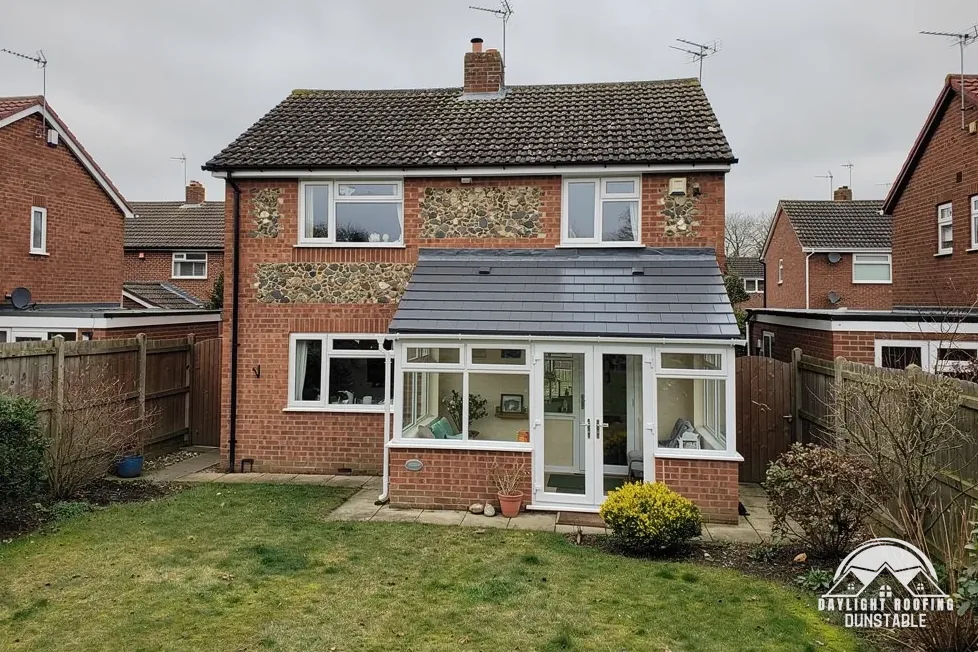
A brick house with a tiled roof and a conservatory at the back

The roof, in plain words

Verge
Where the roof finishes against the end wall of a gable.
Batten
A thin timber strip that the tiles hang from.
Underlay
A lining under the battens that deals with wind-blown rain.
Rooflight
Glazing raised on an upstand, sitting proud of the slope.

The plain-as-day roof check

Reading The Lee's rooflines from the lane

4 checks about 3 minutes to read

  1. Verge edges at gable walls
  2. Damp stains in the loft
  3. Porch and lean-to roofs
  4. Rooflights and roof windows

01 Verge edges at gable walls

At a gable wall the final row of tiles projects past the brickwork and is bedded or clipped down. From the lane, look along that line for gaps in the mortar, tiles that have slid towards the edge, and moss lines that stop abruptly. A verge tile that has come loose may lift in a gust, and with the bedding cracked, rain can run behind it into the wall. Take a photograph of the edge from the same spot each year so that any movement shows.

Marley reports that mortar "could no longer be relied upon as the only means of securing the roof covering" once the 2015 amendments to BS 5534 came in. Verges repaired now therefore carry a mechanical fixing as well as a bed of mortar. Dry-fixed systems of this kind fall under BS 8612:2018, and a written price ought to name the one being proposed.

02 Damp stains in the loft

After a spell of rain, a torch held up through the loft hatch shows what the outside hides. Dark rings on the underside of the underlay, damp rafters or daylight at a join in the covering mark where water is entering. Stay on the joists, and leave insulation undisturbed if you are unsure what is beneath it. A photograph of any stain, with the date, is worth keeping. Staining that follows a rafter downhill from a single spot is a better clue than a general damp smell.

Condensation can look similar. In a cold roof lined with high-resistance underlay, Marley specifies 25 mm of eaves ventilation up to a 15-degree pitch and 10 mm beyond it; it also notes that the underlay does not pass vapour. Wet timber beside the eaves, in place of a stain under a joint in the tiles, points towards ventilation as the suspect, and the survey sorts one cause from the other.

03 Porch and lean-to roofs

Small roofs against the front or back wall of a house are easy to overlook. Look at the line where the lean-to meets the main wall, since that abutment carries a strip of lead or a flexible flashing, and if its edge has lifted, water can run down behind the cladding. Check the gutter at the low edge as well, because it is the only drainage the little roof has. If the porch roof is a small hip or a flat section, say so in your photograph message.

Polycarbonate and glass sheeting age differently from tiles. HomeBuilding says of polycarbonate roofs: "They have a typical lifespan of 10 years." Clouded sheets, brittle edges and screws that have worked loose all show up from the ground, and they are the cue for a closer look. A solid tiled replacement is a bigger step, and it brings the question of Building Regulations with it.

04 Rooflights and roof windows

Two kinds of glazing appear in Approved Document L, and the thermal limits differ between them. Raised glazing, standing on a kerb or upstand clear of the roof plane, counts as a rooflight and meets 2.2 W/m2K. Glass lying in plane with the roof around it, in the same orientation, is a roof window, limited to 1.4 or Band B on the Window Energy Rating. Whatever the quote calls a lantern on a flat roof, it is a rooflight. The skylights and roof windows page covers both.

Look at the seals and the surrounding flashing for stains, and at the glass for misting between the panes. For a listed building, or a home inside the conservation area, check with Buckinghamshire Council before adding a roof window or changing the design of an existing one, because that alters the roofline. Misting is a sign the sealed unit has failed, and the unit is replaced as a unit.

The dashed ring takes in the nearest towns and villages we cover around The Lee. Map tiles © Esri; map data © OpenStreetMap contributors.

Roof questions asked in a Chilterns village

01Does the Chilterns National Landscape change how a roof in The Lee is repaired?

The National Landscape does not take over planning. Advice and responses to consultations are the Board's role; an application itself goes to Buckinghamshire Council. The Chilterns Conservation Board's 2007 roofing note calls plain clay tiles "universally predominant" among traditional Chilterns buildings, and a separate Board note on flint says that flint "is often combined with brick" in older buildings and boundary walls. As design guidance, these notes do not decide planning applications; the Board's role is advisory. What a like-for-like re-roof or a dormer needs is explained in the planning guide.

02How is consent handled for roof work on The Lee's Old Church?

The Old Church of St John the Baptist is listed Grade I (entry 1124881, first listed 22 December 1958), and it is a Church of England church. In use, a Church of England church comes under the faculty system instead of listed building consent, and List B treats a job such as renewing lead or another covering in the same material, like for like, as settled once the archdeacon gives written notice. Because the exemption covers the listed building consent step only, a planning application for outside work may still arise, and Buckinghamshire Council answers that question.

03What does listing mean for Guild Cottage or The Old Cottage?

Guild Cottage (entry 1163265, first listed 23 November 1983) and The Old Cottage (entry 1163257) are both Grade II, as is Sunnycot and the Old Post House (entry 1124885). The Planning (Listed Buildings and Conservation Areas) Act 1990 requires listed building consent for works carried out "in any manner which would affect its character as a building of special architectural or historic interest". If a listed roof is involved, raise it with Buckinghamshire Council before any contractor starts. Listing takes in the entire building, and that means roof, stacks and gutters alike, so a repair that looks minor may still touch protected fabric.

04How do I find out whether my house is in The Lee's conservation area?

The conservation area was designated by Buckinghamshire Council, which also keeps the map, so the answer for a given address has to come from there. Buckinghamshire Council has Article 4 entries on its planning records, and a label is no account of what a direction covers. The council can confirm what they remove, so check with Buckinghamshire Council whether an Article 4 direction applies to your own address before you commit to work that alters the exterior of the house. Having that answer in writing before the survey avoids surprises later.

05Who looks after a scaffold licence in The Lee?

Scaffolding that obstructs the highway needs a Buckinghamshire Council licence. Buckinghamshire Council charges £402.78 for 28 days, £69.09 to renew and £777.63 where the licence is sought retrospectively. Buckinghamshire Council's page reads, "You must be a registered scaffolding company to apply for a licence". We arrange the licence with our scaffolder. Scaffold is accounted for in the one written price, and a scaffold on private ground alone raises no highway licence question. Renewal matters on a long job, because Buckinghamshire Council's licence is valid for 28 days and a scaffold left up past that without renewal is no longer licensed.

06Does a re-roof in The Lee need Building Regulations approval?

In the Planning Portal's interactive guide, a re-roof does "normally" not call for an application when "Less than 25 per cent of the total 'building envelope'" and "Less than 50 per cent of the roof is affected" both hold. The Portal's main page carries a broader line: "In most situations, this work will need Building Regulations approval." Stripping and re-covering every slope takes the work past the 50 per cent limit. Buckinghamshire Council's own building control service answers for the village, and its building control page has contact details. If the work goes beyond a repair, the survey is also the moment the route gets confirmed with the council. The roof covering is not the only element that building control looks at.

07What do replacement tiles or a single ridge tile cost?

Which? Trusted Traders list £75 to £400 for swapping between one and six tiles and £80 to £300 to fit one ridge tile, excluding VAT in both cases (November 2025). Those are third-party ranges from its own research and not our prices. Access, the height of the roof and whether the neighbouring tiles are brittle push a small job towards one end of the range or the other. Anything beyond a few tiles gets a figure after the survey: one sum covering everything, and the work is described in roof repairs. When comparing any quote with these ranges, look at which parts of the roof the quoted total covers, since a repair to tiles, to a flashing and to a gutter are different jobs.

08How long does a glass or tiled conservatory roof last?

On polycarbonate, HomeBuilding gives a typical lifespan of 10 years. It also carries comments from Roofing Megastore's managing director, who says glass "will likely last in excess of 30 years" and tiled "will typically last in excess of 50 years"; those two are the retailer's view, not HomeBuilding's own. Where a conservatory is given a solid roof, building regulations apply to the new roof, which is why building control is asked about the route at the outset. Wherever you compare quotes, see that the covering is named and that the structure beneath it is described.

09Which roof faults can I spot from the lane at The Lee?

Walk round the house in dry light and look for tiles out of line, a sagging ridge, stained brickwork under a gutter and moss lines at a verge. Take clear photographs and send them to WhatsApp on 07880 284133, or call 01582 935272. A photo you send gets looked at; a written total comes only after someone has surveyed the roof in person. Stand on the ground or at a window to take them, and keep off the roof. Keep the photographs in a folder with the date, because a record of when a stain appeared helps the survey.

Get a written price for your roof

10-year workmanship guarantee, in writing

Tell us about your roof

Call WhatsApp Written quote