
Call 01582 935272

Cholesbury · 13 road miles south-west

Roofers in Cholesbury

Tile repairs, matching clay and re-roofs in Cholesbury, a village in the Chilterns National Landscape, reached from Dunstable by 13.2 road miles south-westward, each priced as one written total.

Get a written quote

Call 01582 935272WhatsApp us

Council
Buckinghamshire
Road miles
13
Building control
Buckinghamshire Council

Cholesbury roofs inside the Chilterns landscape

Cholesbury is 13.2 road miles south-west of Dunstable, reached in roughly 22 minutes by road, in Buckinghamshire. At the 2021 Census, Cholesbury-cum-St Leonards parish had 948 usual residents. Cholesbury is inside the Chilterns National Landscape, and Buckinghamshire Council has designated the Cholesbury and Hawridge Conservation Area here. Buckinghamshire Council still decides a Cholesbury application, and the Board that looks after the landscape offers advice and replies when it is consulted. The planning guide covers the dormer and roof rules in one place.

A roof job in Cholesbury begins with a survey, because tile type, pitch and status all matter before any figure is given. Whatever else the survey sees is mentioned with it, and the figure that follows is a single written total. For work on tiled slopes, the pitched roofing page is the place to start, and for new coverings the roof replacement page. A photograph sent to WhatsApp, 07880 284133, lets us look first.

  1. 01Church of St LawrenceListed Grade II, National Heritage List entry 1332512, first listed on 22 December 1958. It is in the Church of England.
  2. 02High ChimneysListed Grade II, National Heritage List entry 1124870, first listed on 23 November 1983.
  3. 03The BuryListed Grade II, National Heritage List entry 1309409, first listed on 30 July 1982.
  4. 04Bunbury Quiet CornerListed Grade II, National Heritage List entry 1332507, so a change at Bunbury Quiet Corner that affects its character needs consent.
  5. 05Cholesbury CampA large multivallate hillfort and scheduled monument, National Heritage List entry 1015585, near Cholesbury.
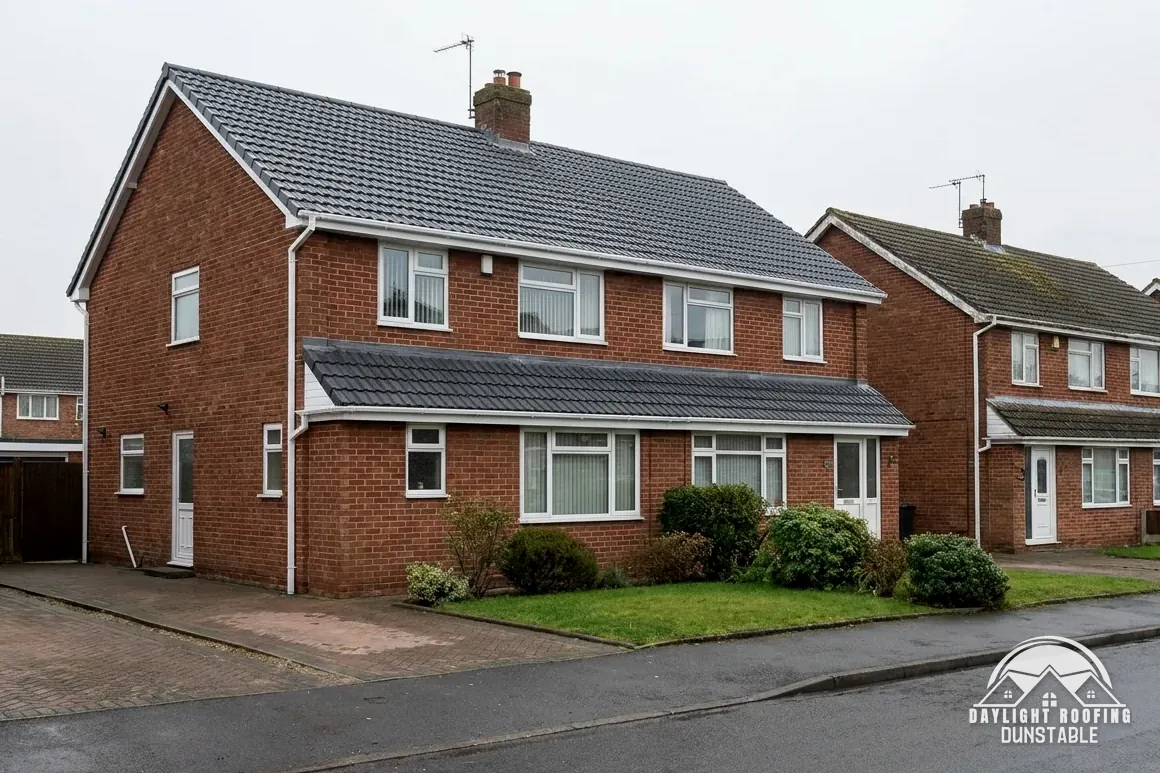
Brick semi-detached houses with new grey tiled roofs

Cholesbury terms, in plain English

National Landscape
A designated protected landscape, once called an Area of Outstanding Natural Beauty.
Plain tile
A small flat clay or concrete tile laid in overlapping rows.
Minimum pitch
The lowest roof slope on which a given tile is made to work.
Multivallate
A hillfort with several ring banks and ditches round it.

The plain-as-day roof check

Four checks for a Chilterns tile roof in Cholesbury

4 checks about 3 minutes to read

  1. Roof pitch and tile choice
  2. Matching clay tiles on an older roof
  3. Gutters on a garage or shed
  4. Ridge capping on a clay roof

01 Roof pitch and tile choice

Every tile is made to work above a minimum slope. Marley lists 40 degrees for its clay Canterbury, 35 for Ashdowne, 30 for Hawkins and for Acme Single Camber, and 15 for its Lincoln pantile. For its concrete range it gives 35 for Plain, 17.5 for Edgemere and Modern-Duo, 22.5 for Double Roman and 15 for Mendip. Canterbury, Anglia and Ludlow are product names, not places. On a hot day tiles can look different in colour from a wet one, so look more than once.

So a roof of one pitch cannot take just any tile. A roofer measures the slope before saying which covering suits it, and an owner who wants to change from one tile to another needs the pitch checked first. A phone held against the rafters with a spirit-level app gives a rough angle, but the survey takes the measurement properly. Look at the lowest course too, where the tiles meet the gutter.

02 Matching clay tiles on an older roof

In the Chilterns Conservation Board's roofing note, "universally predominant" is the phrase it uses for plain clay tiles across the area's traditional buildings. That describes the Chilterns as a whole, and says nothing about any one roof in Cholesbury. Where a tile has to be replaced, the colour, size and edge profile of the new one decide whether the repair is visible from the lane. If a tile has to be matched, send a photograph of one from each slope, since colour can change with how the tile faces.

BRE determined a minimum life expectancy of 60 years for clay roof tiles, and HomeBuilding gives clay tiles 60-80 years. Tile age matters less than condition, so a few weathered tiles do not mean the whole roof is finished. A close photograph of a tile edge, with a coin beside it for scale, shows its thickness and colour. A tile that is thick and rough on the edge is a sign of age rather than damage.

03 Gutters on a garage or shed

An outbuilding gutter is easy to forget because it is small and out of the way. Look for leaves in the run, a bracket that has dropped, a stop end that has fallen out and a downpipe that ends against the wall. Water that spills from an outbuilding roof soaks the wall behind it and the ground at its foot. A bucket under the downpipe on a rainy day shows how much comes off the roof.

Brett Martin gives a fall of 1 mm for every 600 mm towards the outlet, and on a short run that means a very small slope that is easy to lose when a bracket slips. Fixing a bracket back, or replacing a section, is a small job. Send a photograph of the gutter and the wall behind it to get a first view of what is needed. A gutter bracket fixed to a rotten fascia will not hold, so look at the board as well.

04 Ridge capping on a clay roof

Along the top of a clay roof run the ridge tiles, bedded or fixed in a line over the join between the two slopes. Look for gaps between pieces, tiles that have lifted at the end, and a ridge line that is not straight. If the bedding has gone, rain can get into the joint between the two slopes. A pair of binoculars from the lane helps.

Marley says that since the 2015 amendments to BS 5534, mortar "could no longer be relied upon as the only means of securing the roof covering". Modern ridge and hip pieces are held down by fixings sized for the uplift worked out for the particular site. A ridge that depends on mortar alone is a reason to book a survey, and any repair is priced inside the written total. A photograph of the ridge taken from either end of the house, with the sun behind you, shows gaps clearly.

The dashed ring takes in the nearest towns and villages we cover around Cholesbury. Map tiles © Esri; map data © OpenStreetMap contributors.

Cholesbury roof questions, plainly answered

01Which tile can go on the pitched roof of a Cholesbury house?

That depends on the pitch, because each tile is made to work above a minimum slope. Marley gives 35 degrees for its clay Ashdowne and 15 degrees for its Lincoln pantile, and among its concrete tiles 35 for Plain and 15 for Mendip. Canterbury, Anglia and Ludlow are Marley products, not places. A survey measures the pitch before a covering is suggested, and the tile is chosen to suit that slope. If you want to change the style of tile, say so early. A clear photograph of the whole slope, taken from the lane, helps us see the angle. Pantiles and plain tiles also look different, and the character of the roof is part of what the owner wants to keep.

02Does the Chilterns National Landscape change how a Cholesbury roof is handled?

Cholesbury is inside the Chilterns National Landscape. An application for a house here is still decided by Buckinghamshire Council itself. As for the Chilterns Conservation Board, it gives advice and replies to consultations on such applications, but it never decides one. Re-roofing like for like stays under the ordinary rules, and the planning guide covers the roof-extension rules in one place. In the Board's roofing note, "universally predominant" is its word for plain clay tiles in the Chilterns' traditional buildings, which is a description of the area, not of one house. Ask the council before you plan. A photograph and a note of what is planned help the council reply.

03Do the conservation area and Article 4 entries near Cholesbury affect a roof?

The Cholesbury and Hawridge Conservation Area is on Buckinghamshire Council's designation list, and the council's Article 4 list has entries near the village. What a direction removes is set out by the council, not read from its name, so none should be taken as a rule about a tiled house roof. Buckinghamshire Council can tell you whether an Article 4 direction reaches your address, because the answer comes from the council's own records, and a conservation area adds further planning rules on outside changes. Ask about your own address before planning any change to the outside.

04How does St Lawrence's Church in Cholesbury get roof repairs approved?

St Lawrence's is a Church of England church, Grade II on entry 1332512. While it remains in use, that church goes through the faculty system, which takes the place of listed building consent. Under List B, the archdeacon's written notice suffices where roof lead or another covering is replaced like for like. Outside work may raise a planning point of its own, as planning permission can still be needed. A house in Cholesbury follows the council's planning route instead, with the Chilterns rules above.

05Do High Chimneys, The Bury and Bunbury Quiet Corner need consent for roof work?

High Chimneys, The Bury and Bunbury Quiet Corner are all Grade II: High Chimneys under entry 1124870, The Bury under entry 1309409 and Bunbury Quiet Corner under entry 1332507. Works "in any manner which would affect its character as a building of special architectural or historic interest" need listed building consent. Buckinghamshire Council decides whether a repair has that effect. Cholesbury Camp, entry 1015585, is a scheduled monument, so no works there may begin until they are authorised, and that route is separate from listed building consent. A picture of the roofline taken from the lane makes the enquiry to the council simpler.

06Who licenses scaffolding on a Cholesbury lane?

A scaffold that obstructs a lane or pavement needs a licence under section 169 of the Highways Act 1980, and in Cholesbury that is Buckinghamshire Council's to give. Buckinghamshire Council's fee is £402.78 for 28 days, with £69.09 for a renewal and £777.63 for a retrospective licence, and it requires "a registered scaffolding company" to apply. We arrange the licence with our scaffolder, and the scaffold that the job calls for is in the written price. A scaffold wholly on private land does not meet the highway at all. If the scaffold is on a drive, the question does not arise.

07How long does a clay tile roof last, going by published figures?

Marley reports that the BRE determined a minimum life expectancy of 60 years for clay roof tiles. HomeBuilding gives clay tiles 60-80 years and plain concrete 40-50 years. They are approximate figures, not promises. The tile is only one part of a roof: battens, underlay, fixings and flashings have their own lives, and a survey looks at each of them in turn, from the covering down to the eaves. A photograph of the tile edges helps us see how weathered they are.

08Is there a cooling-off period on a Cholesbury roof contract signed at home?

There is, set by the consumer contract regulations: "the cancellation period ends at the end of 14 days after the day on which the contract is entered into". The right falls away for a call-out of this kind: "the consumer has specifically requested a visit from the trader for the purpose of carrying out urgent repairs or maintenance". Work can start earlier only if the customer asks in writing, and asking does not take the right to cancel away, though money may be owed for work already done. Citizens Advice runs the consumer helpline on 0808 223 1133. Keep the written price and any messages about the start date.

09Where do I look up flood risk for a Cholesbury property?

Flood risk belongs to a site, not a village. GOV.UK's long-term flood risk service speaks for an area and gives no answer about one particular house, while a planning application gets its flood zone from the Environment Agency's flood map for planning. New roofing leaves both unchanged. Watching where a downpipe discharges during rain is something you can do yourself, and it shows whether water is being led away from the wall or left to sit beside it. Any fault found is priced in the final written figure.

Get a written price for your roof

10-year workmanship guarantee, in writing

Tell us about your roof

Call WhatsApp Written quote