
Call 01582 935272

Kings Langley · 15 road miles south

Roofers in Kings Langley

Kings Langley, 14.9 road miles south of Dunstable, has chimney breasts, fascias, gable walls and re-roofs checked by survey before a single written total is quoted.

Get a written quote

Call 01582 935272WhatsApp us

Council
Dacorum Borough
Road miles
15
Conservation area
Kings Langley Conservation Area
Building control
Check with the council

Roofs near the Priory remains and All Saints

Kings Langley is a Hertfordshire town, a 29-minute drive from Dunstable and 14.9 road miles away to the south. At the 2021 Census, Kings Langley parish had 5,289 usual residents. Dacorum Borough Council designated the Kings Langley Conservation Area, and the town's listed buildings include a Grade II* church, Grade II* houses and the remains of a priory. A roof near any of them is the kind that benefits from a call to the council ahead of any choice of covering, and the council can say where the boundary runs for one address.

Planning questions for a Kings Langley house go to Dacorum Borough Council, and the planning guide explains the permitted development rules for a house roof. Stacks and breasts are covered on the chimney repairs page, and the pitched roofing page describes what stripping and re-covering a slope involves, from the battens to the ridge.

  1. 01All Saints parish churchA Church of England church, listed Grade II*, National Heritage List entry 1100442, first listed on 26 January 1967.
  2. 02Langley HouseListed Grade II*, National Heritage List entry 1100412, first listed on 22 October 1952, so roof work is judged against its character.
  3. 03Priory Remains and buildingsPriory Remains (Now Part of the New School) and Attached Buildings: Grade II*, entry 1348439, first listed on 22 October 1952.
  4. 04Dominican Priory siteDominican Priory (site of), excluding inhabited parts, is a scheduled monument, entry 1005511, near Kings Langley.
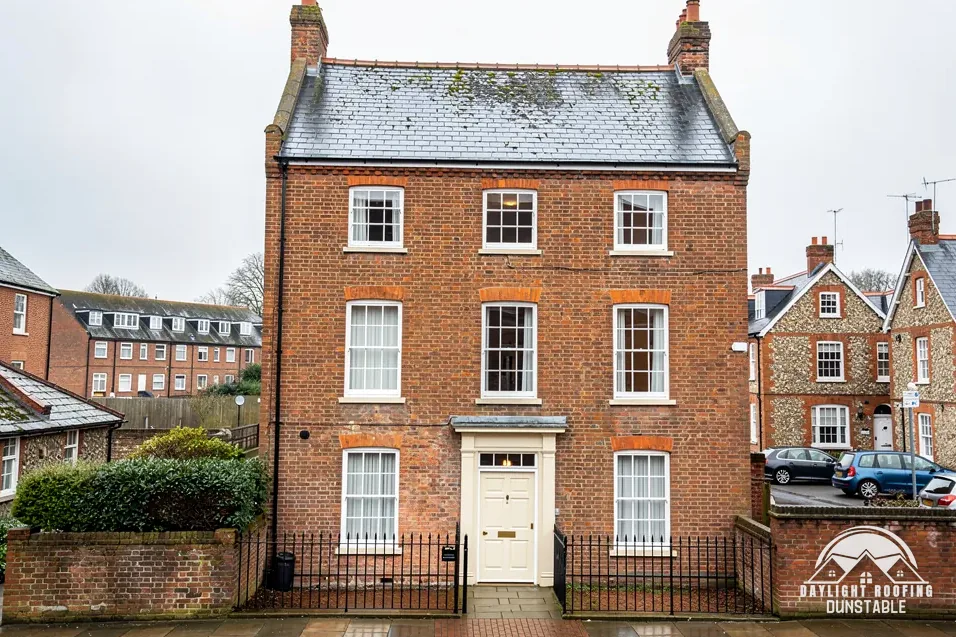
A Georgian-style brick house with a slate roof and two chimneys

Kings Langley terms

Chimney breast
The masonry standing out from a room wall, with the flue running up through it.
Cover board
A board fixed over the end of rafters or a fascia to give a neat edge.
Coping
The capping on top of a wall that sheds water off it.
Gable
The triangular end wall under a pitched roof.

The plain-as-day roof check

Four checks, from the loft breast to the gable

4 checks about 3 minutes to read

  1. The chimney breast in the loft
  2. Fascia boards and cover boards
  3. Gable copings and wall heads
  4. A leak diary for the ceiling

01 The chimney breast in the loft

Where a chimney passes through the loft, it is visible as a brick column rising from the floor to the roof. Torch around its base and up its sides. Dark stains on the brick, a damp smell, white salts on the surface or a wet patch on the timber beside it point to water coming down the stack from above. A stain on the breast in the room beneath, level with the loft floor, belongs to the same picture, and shows where the damp has travelled. Raking a torch beam across the brick picks out damp that overhead light flattens.

The two places water enters are the flashing at the roof line and the top of the stack, so a leak seen in the loft starts at one or the other. Chimney work is looked at from the roof, where the flashing, pointing and pots can be seen close up. See chimney repairs for the range of stack work, from repointing to a rebuild above the roofline. A photograph of the stack from the garden, taken on a clear day, shows pots and pointing.

02 Fascia boards and cover boards

The fascia is the board that runs along the eaves, carrying the gutter and closing the ends of the rafters. Some roofs also have a cover board laid over the old fascia for a neat edge. Look for peeling paint, dark patches, soft spots, and gaps where two boards meet. A thumbnail pressed in sound timber leaves little mark; in rotten timber it sinks. Plastic boards can crack at the corners, and timber boards rot from the bottom edge upwards.

A new board has to be fixed so that the gutter's fall is kept, and the underlay is dressed over it into the gutter. Brett Martin gives the fall as 1 mm for every 600 mm towards the outlet. Replacement boards are made of timber or of plastic, and each has its own fixing method. Rotten rafter ends can come to light once the old fascia comes away, and a rafter end that has gone soft is repaired before the new board goes on. Colour-matching a replacement is straightforward with a painted board.

03 Gable copings and wall heads

Some gable walls rise above the roof line as a parapet, finished with a coping that sheds water off the top. If the coping is cracked or the joints between stones are open, water enters the wall from above and travels down. Look for a stained face below the coping, a coping stone that has slipped, or lead flashing at the roof junction that has lifted. A line of damp staining under the coping on the inside of the gable points at the same thing.

Where the wall meets the roof slope, a lead flashing steps along the line and the coping sits on top. Lead sheet comes in codes 3 to 8 to BS EN 12588, and code 4 is 1.80 mm according to Calder; each detail has its code set in the specification. A coping that has moved can need resetting on a new bed of mortar, which means lifting it off first. The lead roofing and leadwork page covers the metalwork.

04 A leak diary for the ceiling

A stain on a ceiling can appear well away from the hole that feeds it, because water runs along timber and pipes before it drops. Draw round a stain's outline with a pencil and put the date alongside. If it grows after rain and holds still in dry weather, it is a roof leak; if it grows in cold, dry weather, it may be a plumbing or condensation problem. Check the airing cupboard and the bathroom pipes on the same floor.

A note of the dates, the size of the stain and the weather helps the survey narrow the search. Photographs from the same spot each time make the change easy to compare. Send them on WhatsApp to 07880 284133 and the picture is looked at before anyone climbs a ladder. Even a rough sketch of which room is wet and which wall it sits against is a help when the survey starts.

The dashed ring takes in the nearest towns and villages we cover around Kings Langley. Map tiles © Esri; map data © OpenStreetMap contributors.

Roof queries from Kings Langley, with answers

01What does a damp chimney breast in a Kings Langley loft mean for the roof?

It means water is entering the stack from above, through the pots, the pointing, the lead flashing at the roof line, or a mixture. The survey climbs to the stack and looks at each, reports the findings in plain words together with anything else spotted on the roof, and gives one written price. A stain that grows after rain points at the roof; one that stays the same size in dry weather may be an older leak, so dating it with a pencil ring helps the survey. A second photograph of the ceiling below the breast helps place the leak.

02Does the Kings Langley Conservation Area change roof work?

Dacorum Borough Council designated the Kings Langley Conservation Area. For a house inside it, outside changes are weighed more carefully, so a different covering, a rooflight or a rebuilt stack is a subject to raise with the council ahead of any order. An Article 4 direction can remove further permitted development rights, so we check with the council first. Which side of the boundary an address falls on is the council's to say, and a house near the edge of the area deserves the same call. Roof windows on a back slope are worth asking about too.

03Which approval route covers roof repairs at All Saints, Kings Langley?

The parish church of All Saints, Grade II* (list entry 1100442), is part of the Church of England. In the Church of England's system, a church still used for worship goes through the faculty process, and listed building consent is not the route. "The like for like replacement of roof lead or other material covering the roof of a listed building" needs just the archdeacon's written notice; a full faculty is not sought. Exterior changes can still require planning permission, which the council handles. The church's approval process is its own.

04Do Langley House and the Priory buildings share one consent rule?

Langley House (list entry 1100412) and Priory Remains (Now Part of the New School) and Attached Buildings (list entry 1348439) are each Grade II*, and 16, High Street is Grade II (list entry 1173847). Works that touch a listed building "in any manner which would affect its character as a building of special architectural or historic interest" need listed building consent. Dacorum Borough Council is asked first, before any covering is ordered, and the council's view settles whether a like-for-like patch or a different material is in question. An unlisted house next door is dealt with in the ordinary way.

05What does a scaffold licence involve for a Kings Langley street?

Scaffolding that obstructs the pavement or road is licensed by Hertfordshire County Council, as the highway authority. Hertfordshire County Council charges £134 for 14 days and £59 for every week after, and it states: "It usually takes 3 weeks to process an application." Pedestrians keep a 1.2 m clear walkway. We arrange the licence with our scaffolder, and the scaffold that a job calls for is folded into the single written total. A scaffold standing wholly on the plot raises no licence question, which can happen on a house with a wide drive.

06Is a re-roof in Kings Langley a Building Regulations matter?

The Planning Portal gives two tests: no application is normally needed if "Less than 25 per cent of the total 'building envelope'" and "Less than 50 per cent of the roof is affected". Stripping the whole roof is beyond the second. Kings Langley owners should check with Dacorum Borough Council's building control team about the route. The Portal's guide to re-roofing also says: "In most situations, this work will need Building Regulations approval." A covering that adds 15 per cent or more to the weight needs approval too, with a structural check first, because the timbers carry the load.

07What does the Dominican Priory's scheduled status mean for nearby roofs?

Dominican Priory (site of) (excluding inhabited parts) is a scheduled monument (list entry 1005511), near Kings Langley. Any works to the monument must be authorised first: applications are sent to Historic England, and the final decision belongs to the Secretary of State. That route concerns the monument itself. An ordinary roof nearby follows the council's route, with consent for listed buildings arising only where the building is itself listed, so a house close to the priory site is not treated differently for a re-tile or a gutter.

08How thick is the lead used on a Kings Langley roof?

Rolled lead sheet is made to BS EN 12588 in codes 3 to 8. Calder gives code 4 as 1.80 mm thick, and Ecobat publishes weights for each code, which differ from Calder's for codes 3 and 6. The specification sets the code for each detail, such as a flashing, a valley or a gutter lining. MyJobQuote says correctly installed lead flashing "can last for over 80 years", which describes flashing that is fitted well, not every piece of lead on every roof, and it says nothing about valleys. A photograph of any split in lead helps before the visit.

09Could the soffit on a Kings Langley house contain asbestos?

HSE advises: "If the building was built or refurbished before 2000, assume that there is asbestos in it." It lists "AIB white soffit panels to underside of roof eaves" among asbestos insulating board, and the larger share of work on that board needs a licence. Asbestos cement sheeting carefully taken off whole is non-licensed work. Use a lockable skip for asbestos. A photograph of the soffit, taken before anyone drills or breaks it, lets the right questions be asked first, and a suspect board is left alone until then. Boards that look like plain flat sheet can be asbestos insulating board, so appearance proves nothing either way.

Get a written price for your roof

10-year workmanship guarantee, in writing

Tell us about your roof

Call WhatsApp Written quote