
Call 01582 935272

Latimer · 21 road miles south

Roofers in Latimer

Roof repairs, gutter work and re-covering for Latimer and Ley Hill homes in the Chilterns, surveyed first and quoted as one written total price.

Get a written quote

Call 01582 935272WhatsApp us

Council
Buckinghamshire
Road miles
21
Conservation area
Chenies and Latimer
Building control
Buckinghamshire Council

Wooded Latimer and Ley Hill: roofs under the Chilterns rules

Latimer is a Buckinghamshire village 21.1 road miles south of Dunstable, roughly 39 minutes away by car. Its parish, Latimer and Ley Hill, had 993 usual residents at the 2021 Census. Planning decisions rest with Buckinghamshire Council, which designated the Chenies and Latimer Conservation Area. The village is also inside the Chilterns National Landscape, where the Chilterns Conservation Board advises and responds to consultations but does not decide applications. The listed buildings include the Church of St Mary Magdalene and a group of Grade II cottages and houses, so the question of what the address carries comes before any quote.

A roof here can sit close to trees and boundary planting, so leaf fall, overhanging branches and damp shade are part of the picture. Nothing gets a price until the survey is finished; what it shows is relayed in everyday language, followed by one total. If water is already coming in, sending a photograph over WhatsApp lets us begin; the work then follows the survey, whether it turns out to be a repair or a job on the guttering and roofline.

  1. 01St Mary Magdalene churchGrade II (list entry 1124772) and used by the Church of England, so the faculty system, not listed building consent, governs repairs to its roof.
  2. 02Cottages with listingsCavendish Cottage Holly Tree Cottage and Anne Cottage are Grade II (entries 1159523 and 1159516); Foliots is Grade II too (entry 1124775).
  3. 03Chenies and Latimer areaA conservation area designated by Buckinghamshire Council; changes to a roof's appearance are raised with the council first.
  4. 04Tree-shaded slopesShade keeps a roof damp, and moss and leaf litter gather in valleys, gutters and the lower courses.
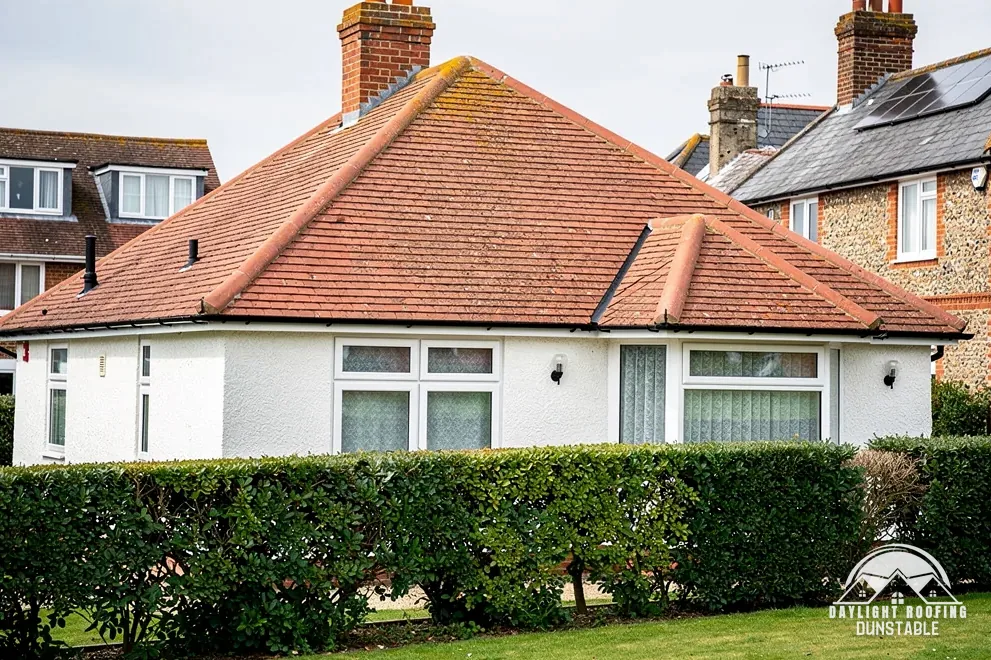
An interwar hipped bungalow with a clay tile roof and a bay window

Latimer words, made plain

Chilterns Conservation Board
The public body that advises councils on the Chilterns National Landscape.
Eaves
The part of a roof that projects past the wall at the foot of each slope.
Step flashing
Stepped pieces of lead that seal a roof where it rises against a side wall.
Retrospective licence
A scaffold licence applied for after the scaffold is already up.

The plain-as-day roof check

Under the trees at Latimer: four checks on a roof

4 checks about 4 minutes to read

  1. Branches over the slope
  2. Gutter joints and brackets
  3. Dormer cheeks and flat tops
  4. Side wall flashings

01 Branches over the slope

Look up from the garden at any tree whose branches reach the roof. Twigs rub the surface of tiles when the wind moves them, and a heavy limb can crack a covering in a gale. Leaves and seed carry moss spores and sit in the lower courses, where they stay wet long after the rest of the roof has dried out. Check the roof after a spell of windy weather, and again once the leaves are down; a few minutes with binoculars from the lawn shows slipped tiles, broken ridge ends and any branch lying across a slope.

A roof that is shaded for much of the day dries slowly, so moss gets a hold on the lower rows and the gutters collect a layer of rotting leaf. Cutting back a tree is for the tree's owner, and sometimes for the council where a tree is protected, so ask before you cut. Our survey looks at what the shade has done to the covering underneath, slope by slope. Where a tree stands very close, rainwater carries debris from the canopy into the gutter, so the runs beneath it need clearing sooner than a run in the open would.

02 Gutter joints and brackets

A gutter is a chain of short lengths, and each joint is somewhere a seal can fail. After rain, look for drips along the underside of a joint, a green or black stain on the wall beneath it, or a gutter that overflows at one corner while the rest runs clear. Brackets that have pulled out of rotten fascia timber let a whole run drop. Some gutters have leaf guards fitted; guards slow the build-up of leaf but do not stop it, and the guards themselves are worth checking for gaps and displaced sections.

Cast iron, aluminium and plastic gutters wear differently, but the faults look alike from the ground. If a joint leaks, it can be resealed; if the run has sagged or cracked, it is replaced. The same visit looks at the downpipe base, because a blocked drain at the foot sends water back up to wet the wall. A short length of new gutter costs less than a whole run, but old and new sections can leave a step at the joint, so the survey says whether a partial run is sensible or a full run is the better route.

03 Dormer cheeks and flat tops

Dormers project from the slope with a roof of their own and two side walls, the cheeks. Each junction between dormer and main roof is a place that depends on flashing. Look for dark streaks below the cheek, cracked render or lifted lead, and for moss gathering on a flat top. A flat-topped dormer is covered with felt, a single-ply membrane, lead or GRP, and the survey identifies which one is on your roof, because each ages and is repaired differently.

Whether a dormer can be added or enlarged in a National Landscape or a conservation area is a planning question, and it is dealt with on our planning guide. A repair to an existing dormer is a different job: the survey finds where the water gets in and the repair is made to that junction, with the rest of the dormer left alone. Windows set into the dormer face have their own cill and flashing detail, and a leak there can be mistaken for a leak in the roof itself.

04 Side wall flashings

Where a roof rises against the side wall of a house or an extension, the joint is sealed with stepped pieces of lead that follow the brick courses, each tucked under a tile or slate. Look for a step that has lifted, a gap above it where the mortar has dropped, or a line of damp inside the wall that matches the roof edge. Some side-wall joints use soakers, small pieces of lead woven under each course, instead of stepped flashings on the surface. They do the same job, but a soaker cannot be seen without lifting tiles.

Lead sheet for roofs is rolled to BS EN 12588 in codes 3 to 8, and the specification sets the code for each detail. MyJobQuote says correctly installed lead flashing can last for over 80 years, so a failing step flashing is worth examining for the cause, whether a poor fix, a moving wall or physical damage, before it is simply replaced. If the wall itself is moving, a new flashing will not stay sealed, so cracks running across the brickwork are raised before any lead is replaced.

The dashed ring takes in the nearest towns and villages we cover around Latimer. Map tiles © Esri; map data © OpenStreetMap contributors.

Latimer roofing questions, plainly answered

01Why does a roof near trees in Latimer need more looking at?

Shade and leaf fall change what the roof surface has to cope with. A covering that stays damp grows moss, gutters fill with rotted leaf and valleys can block, which pushes water under the tiles around the edges. The survey checks each of those on your roof and reports its findings in plain words, any other fault noticed along the way included, with a single written sum to follow. Photographs of the damp patches help to start the conversation. A roof that is shaded on one side and in sun on the other can show very different wear on the two slopes, which is why both are surveyed.

02What does the Chilterns Conservation Board do about my roof?

The Board is a public body with an advisory role over the Chilterns National Landscape, and its influence comes from responding to consultations. A planning decision for Latimer is made by Buckinghamshire Council. In its roofing note the Board calls plain clay tiles "universally predominant" on traditional Chilterns buildings, and its note on flint says it "is often combined with brick" in older buildings and boundary walls. That is design guidance, not a rule for your address. Cutting back a branch that rubs the roof is a sensible first step where the tree is yours, and a photograph of it sent on WhatsApp tells us where to look first.

03What is the Chenies and Latimer conservation area?

Buckinghamshire Council designated the Chenies and Latimer Conservation Area. Buckinghamshire Council can confirm where its line runs past a particular house. Roof work that would alter a building's look from the road, a different covering for instance, goes to the council before it is ordered. For a plain like-for-like repair the conversation is shorter. Ask the council, and mention your address, when you ring. Because the council designated the area, the council is the single place to ask whether your own roof lies inside it. Hence a call to the council, quoting the house number and road, answers the question faster than any map would.

04How are repairs to St Mary Magdalene church roof approved?

The Church of St Mary Magdalene is Grade II (list entry 1124772, first listed 22 December 1958) and a Church of England church. As a church within the faculty jurisdiction of the Church of England, it is dealt with by the faculty system in place of listed building consent. Exemption does not remove planning rules for the outside of a building, which can still bite on exterior work, so the council is asked about that part. The archdeacon's written notice, which covers certain matching roof repairs on a church, is a lighter step than a full faculty, and the church can say which one applies.

05What is St Mary Magdalen's Church, Flaunden, and does it affect Latimer?

It is a scheduled monument near Latimer (list entry 1006928). Roof work to ordinary homes is not affected. Scheduled monuments have their own regime: works need authorisation, which comes as scheduled monument consent from the Secretary of State on requests that go to Historic England. That is a separate route from listed building consent, and nobody should assume a repair to a scheduled building can be carried out under the church's own system. A call to the Historic England local office is the right first step for any work on scheduled land. St Mary Magdalen's Church, Flaunden is the name on the list entry.

06What if scaffolding goes up before the licence is arranged?

Buckinghamshire Council lists a retrospective scaffold licence at £777.63, against £402.78 for the standard 28 days and £69.09 for a renewal. Buckinghamshire Council takes applications only from a registered scaffolding company. We arrange the licence with our scaffolder. A scaffold that stays wholly within your own boundary does not obstruct the highway, and the frame's position is the thing that decides whether the licence question arises at all. Scaffold that must stay up beyond the first 28 days brings in the renewal fee, so say at the survey how long you expect it to stand.

07Is building approval required to remove a chimney breast at Latimer?

Building Regulations approval will always apply when removing chimney breasts, as they are part of the building's structure. Buckinghamshire Council's own building control service lists contact details on the building control page of the council's website. A breast on a party wall also brings a notice to the neighbour, served at least two months ahead, and party wall questions go to a party wall surveyor, not to building control. Where the whole stack comes out and not only the breast, the roof above has to be made good, and building control and the neighbour are both part of that question.

08As a homeowner, what are my duties under CDM 2015?

Under CDM 2015, a homeowner's client duties pass to the contractor, or to the principal contractor when there is more than one, and every project has a construction phase plan. HSE's definition reads: "A domestic client is any individual who has construction work carried out on their home, or the home of a family member, that is not done as part of any business." The duty to plan and manage the work safely therefore sits with the contractor you hire. A construction phase plan is a short written plan for managing the health and safety of the site, and the contractor draws it up for a single-contractor job.

09Could an Article 4 direction apply to my Latimer house?

Directions are recorded in the area round Latimer. An Article 4 direction can remove further permitted development rights, so we check with the council first. What a particular direction covers cannot be read from a general guide, and a neighbouring plot's direction says nothing certain about yours. Ask Buckinghamshire Council whether an Article 4 direction applies at your address before any roof alteration is planned. A direction is drawn for particular land and particular works, which is why a general answer is not safe for your own plot. Ask in the same call whether the house is listed or inside the conservation area.

Get a written price for your roof

10-year workmanship guarantee, in writing

Tell us about your roof

Call WhatsApp Written quote