
Call 01582 935272

Coleshill · 22 road miles south

Roofers in Coleshill

Roof repairs, re-roofing and loft ventilation questions for Coleshill homes, in the Chilterns National Landscape, with a survey first and one written total after it.

Get a written quote

Call 01582 935272WhatsApp us

Council
Buckinghamshire
Road miles
22
Conservation area
Coleshill
Building control
Buckinghamshire Council

Coleshill under the Chilterns rules: what the roof must breathe

Roughly 41 minutes by road and 22.4 road miles south of Dunstable, Coleshill is a Buckinghamshire village. Coleshill parish had 567 usual residents at the 2021 Census. It lies inside the Chilterns National Landscape. Buckinghamshire Council designated the Coleshill conservation area and takes planning applications. The Chilterns Conservation Board is only an adviser: it answers consultations and decides nothing itself. Several of the village's buildings carry listings, which you can check by address on the National Heritage List before you ring.

A pitched roof has to shed rain and also let moisture out of the house, and Coleshill's Grade II* church, and its Grade II school building make the covering only part of the question. The survey comes ahead of any quote; what it finds is put to you in everyday words, and the price is written as one total. For the work itself see roof repairs and guttering, soffits and fascias.

  1. 01Church of All SaintsGrade II* (list entry 1239441), a Church of England church, so repairs to its roof go through the faculty system.
  2. 02Stock Place and Friars VaneStock Place (entry 1273706) and Friars Vane (entry 1239053) are Grade II, and roof changes there turn on their character.
  3. 03The village school buildingThe original building of Coleshill Church of England Primary School is Grade II (entry 1239357); the listing is for that part only.
  4. 04Cold roof ventilationThe eaves, the underlay and the insulation decide whether a loft stays dry; a leak and condensation can look alike.
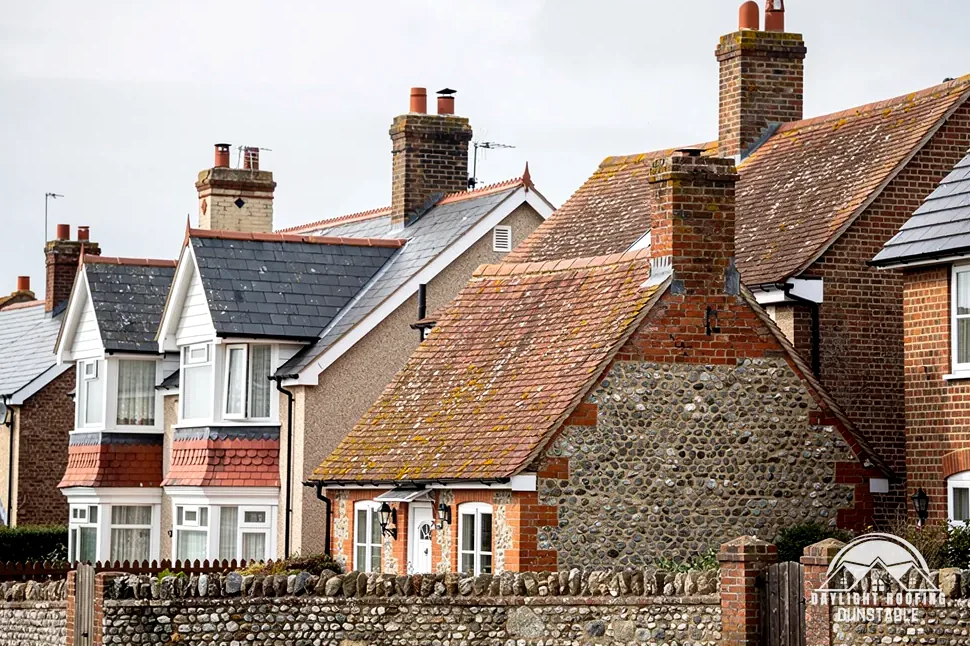
A flint and brick cottage with a weathered clay tile roof

Coleshill words, made plain

Cold roof
A pitched roof whose insulation lies over the bedroom ceilings, so the loft stays unheated.
Condensation
Moisture that forms when warm damp air meets a cold surface.
Underlay
The membrane under the tiles or slates that sheds any water passing the covering.
Eaves vent
An opening at the roof edge that lets air into the loft space.

The plain-as-day roof check

Leak or condensation? Four checks for a Coleshill loft

4 checks about 4 minutes to read

  1. Telling a leak from condensation
  2. Air at the eaves
  3. Which underlay is under the tiles
  4. Insulation and what hides beneath

01 Telling a leak from condensation

A damp patch on a loft rafter or a drip on a ceiling is not always a leak. Warm, damp air from the house rises into the loft and condenses on cold surfaces, and the result can be water on the underside of the roof covering that looks like rain coming in. A leak leaves a stain that follows rainfall; condensation appears in cold weather whether or not it rained. Everyday moisture makes it worse: washing dried indoors, cooking without an extractor and showers in a room with no vent all add water to the air that rises towards the loft.

Compare the dates: write down when the marks appear, and whether it had rained in the previous day. Check around the chimney, the valleys and the eaves first, because leaks start at details. If the stains turn up over the whole underside of the roof, ventilation is the thing to look at. Photos of both, sent on WhatsApp with the dates, help the survey a great deal. A leak that follows a straight line up the slope to a chimney, a valley or a ridge has a source you can name; patchy dampness across a whole slope does not.

02 Air at the eaves

A cold roof needs a path for air at the eaves so that moisture can leave. Marley gives, with a high-resistance underlay in a cold roof, 25 mm of eaves ventilation at 15 degrees or less and 10 mm above 15 degrees. Look from the hatch towards the eaves: if insulation is stuffed hard into the gap above the wall plate, the air cannot move. Some roofs also have vents at the ridge, so that air can enter low and leave high, and the combination keeps air moving through the loft.

Lifting the insulation back from the eaves, or fitting a tray that keeps a clear gap, is a small fix with a large effect. Sealing the ceiling is the other half, since a well-sealed ceiling stops warm, damp air entering the loft in the first place. When the underlay has low resistance, the ceiling is well sealed and the covering is air-permeable, Marley says fortuitous ventilation through normal eaves construction (3 mm) is all that is required, provided the UKAS certification requirements are met. With high-resistance underlay, the larger 25 mm figure belongs to pitches of 15 degrees or less, so a shallow extension roof needs a wider gap than a steeper main roof does.

03 Which underlay is under the tiles

Underlay comes in two broad kinds. High-resistance (HR) underlay is not vapour-permeable, which means the loft needs its own ventilation. Low-resistance underlay lets moisture pass through, and then air permeability is a matter for the covering. You can sometimes see the type from the loft, printed on the back of the membrane between the rafters. Underlay can also be damaged by age: look for splits near the eaves, where it is exposed to light, and for any place a nail or cable staple has punctured it.

When a roof is re-covered, the underlay is replaced, and the choice of type affects how the loft is ventilated afterwards. Marley's guidance is the reference, and the survey establishes what your roof has now before any change is suggested. A mismatch between the underlay type and the ventilation is a cause of condensation after a re-cover, so the two are specified together. A breathable membrane does not replace ventilation where the product guidance calls for it, so the two choices are made together, from the maker's guidance, and not from habit.

04 Insulation and what hides beneath

Loft insulation lies between and over the ceiling joists. Look for gaps, for compressed or damp patches, and for insulation pressed against the roof covering. Spray foam applied to the underside of the roof is a different case: the RICS consumer guide says that if the timber roof structure is covered with spray foam it cannot be fully seen or inspected. Pipes and cables that pass through the ceiling into the loft need sealing where they cross, since a small gap lets damp air through, and sealing it is a quick job.

That is one reason a surveyor is asked about foam. Government guidance published on 22 October 2026 says that, for lenders, removal will not always guarantee that they will still lend, and advises taking advice from a specialist surveyor. Before you put anything onto a roof structure, work out how it would be checked in future, and tell us about it at the survey so it is taken into account. A water tank in the loft should be insulated and covered, because an open tank adds moisture to the air in the roof space.

The dashed ring takes in the nearest towns and villages we cover around Coleshill. Map tiles © Esri; map data © OpenStreetMap contributors.

Coleshill roof and loft questions, answered

01How do I tell a roof leak from condensation in a Coleshill loft?

A leak follows rain: stains appear after a downpour and sit below a particular detail, such as a chimney or a valley. Condensation follows cold, damp weather and spreads across the underside of the roof covering. Write down the dates of what you see and send photographs, with the room and the road name. The survey checks the covering, the flashings and the eaves, tells you plainly what it found, and the price follows as one written total. Both causes can be present at once. A damp meter reading is not the answer on its own; the pattern of the marks and their timing say more.

02Does the Chilterns National Landscape stop me changing a roof in Coleshill?

It does not stop anything by itself, because it is not a planning authority. Applications are made to Buckinghamshire Council, with the Chilterns Conservation Board offering advice and answering consultations. What the designation does is change which planning rules apply to some roof alterations, and our planning permission guide sets those out so they are not repeated on every town page. A like-for-like re-roof stays under the ordinary tests, and the council can confirm how that applies to your house. If you plan a new window in a slope or an enlargement, read the guide before you commission drawings.

03What does the Coleshill conservation area cover?

Buckinghamshire Council designated the Coleshill conservation area, and the council is the place to find where its boundary runs. Ask it about your address before the work is planned, since its answer decides which further questions apply. The same call can raise the question of an Article 4 direction. Keep a note of who you spoke to, the date and what they said, since a plan can take shape over several weeks. A quick call quoting your road, with a photograph of the front of the house to hand, is enough to get a clear answer.

04Whose approval is needed for repairs at All Saints church?

All Saints, the church at Coleshill, is Grade II* (list entry 1239441, first listed 22 December 1958) and in Church of England use. In use, such a church comes under the faculty system rather than listed building consent, and replacing roof lead like for like can sometimes be covered by the archdeacon's written notice. The church's exterior can still fall under planning control, so Buckinghamshire Council is asked as well, and the church tells any contractor which route it is following. Matching repairs to a church roof are a different order of job from putting on a new covering, and the church says which one is planned.

05Does the school listing mean the whole school is protected?

The listing reads Coleshill Church of England Primary School (Original Building Only), Grade II (list entry 1239357, first listed 17 May 1984), so it covers the original building and not later additions. Stock Place (entry 1273706, first listed 17 May 1984) and Friars Vane (entry 1239053) are also Grade II. Work to any listed roof needs consent where it would affect the building's character, and Buckinghamshire Council can say how that applies to a particular roof. The school's own roof is its owner's matter; the point for a neighbour is only that a listing applies to a named building, not to the street.

06What does it cost to clear or replace gutters near Coleshill?

In November 2025 Which? Trusted Traders priced a gutter clear-out, front and back, at £75 to £350 excluding VAT. According to MyJobQuote, the average gutter replacement cost in the UK is around £1,000 to £1,600, while capping existing fascias and soffits averages around £800 on its figures. Those are national figures that show scale. A gutter is laid to a fall, and Brett Martin gives 1 mm for every 600 mm. For your own house, the survey comes first and a single written figure follows. Cleaning moss from the roof surface is a different job from clearing gutters.

07Does a re-roof mean the loft insulation must be upgraded?

It can. AD L says that once more than 50% of a roof's surface is renovated, all of it is brought up where that is feasible, to an improved 0.16 W/m²K in Table 4.3, where the threshold figure is 0.35 W/m²K. Where the full upgrade is impractical, AD L allows the roof to be taken as far as feasible, so long as it can achieve a simple payback of 15 years or less. A loft conversion is judged the same way for the roof that is retained. The survey establishes how much of the roof the job reaches, which is what the percentage depends on.

08Can an Article 4 direction affect roof work at a Coleshill house?

Directions are recorded close to the village. An Article 4 direction can remove further permitted development rights, which is why we check with the council first. What any one direction removes cannot be read from a guide, so the safe step is to ask Buckinghamshire Council whether an Article 4 direction applies at your address, quoting the road and house number, before an alteration is planned, and to do that before you ask anyone for a price. Ask in writing if you can, so that the reply can be kept with the house papers.

09How does scaffolding on a Coleshill road get licensed?

Scaffolding that obstructs the road or pavement is licensed by Buckinghamshire Council, whose licences go only to registered scaffolding companies. Its listed charges are £402.78 for 28 days, £69.09 to renew and £777.63 retrospectively. We arrange the licence with our scaffolder. A frame inside the boundary of your own garden is not a highway matter, so it falls outside the licence, and the position of the frame is therefore worth deciding at the survey. If the lane is narrow, mention it at the first call so the position of any scaffold can be worked out early.

Get a written price for your roof

10-year workmanship guarantee, in writing

Tell us about your roof

Call WhatsApp Written quote