
Call 01582 935272

Chipperfield · 17 road miles south

Roofers in Chipperfield

Chipperfield, on the Hertfordshire side, is 16.8 road miles from Dunstable; its house roofs, outbuildings, chimney trays and drainage get a survey, then one written figure.

Get a written quote

Call 01582 935272WhatsApp us

Council
Dacorum Borough
Road miles
17
Conservation area
Chipperfield Conservation Area
Building control
Check with the council

Roofs near Pale Farm and the Manor House

Chipperfield is a Hertfordshire village beside a common; the drive from Dunstable is 16.8 road miles to the south, about 32 minutes. At the 2021 Census, Chipperfield parish had 1,793 usual residents. The Chipperfield Conservation Area was designated by Dacorum Borough Council. Its listed buildings include The Pale Farm and its barn and The Manor House, both Grade II*, and its common carries a scheduled barrow. Barns, stores and garages have roofs of their own, so mention any outbuilding with a fault when asking for a survey, and the survey says which roofs need attention.

Planning applications for a Chipperfield house go to Dacorum Borough Council, and the planning guide explains the permitted development rules for a house roof. Outbuilding and barn roofs are covered on the pitched roofing page, and the chimney repairs page deals with stacks, trays and flashings. A short call to the council about a listed barn or outbuilding saves a surprise later.

  1. 01Church of St PaulA Church of England church, listed Grade II, National Heritage List entry 1100458, first listed on 2 December 1986.
  2. 02The Pale Farm and barnThe Pale Farm and barn adjoining on east is listed Grade II*, entry 1173068, first listed on 22 October 1952.
  3. 03The Manor HouseListed Grade II*, National Heritage List entry 1348423, first listed on 22 October 1952, so roof work is tested against its character.
  4. 04Barrow on Chipperfield CommonOne of two barrows on Chipperfield Common is a scheduled monument, entry 1012405, where any works must be authorised.
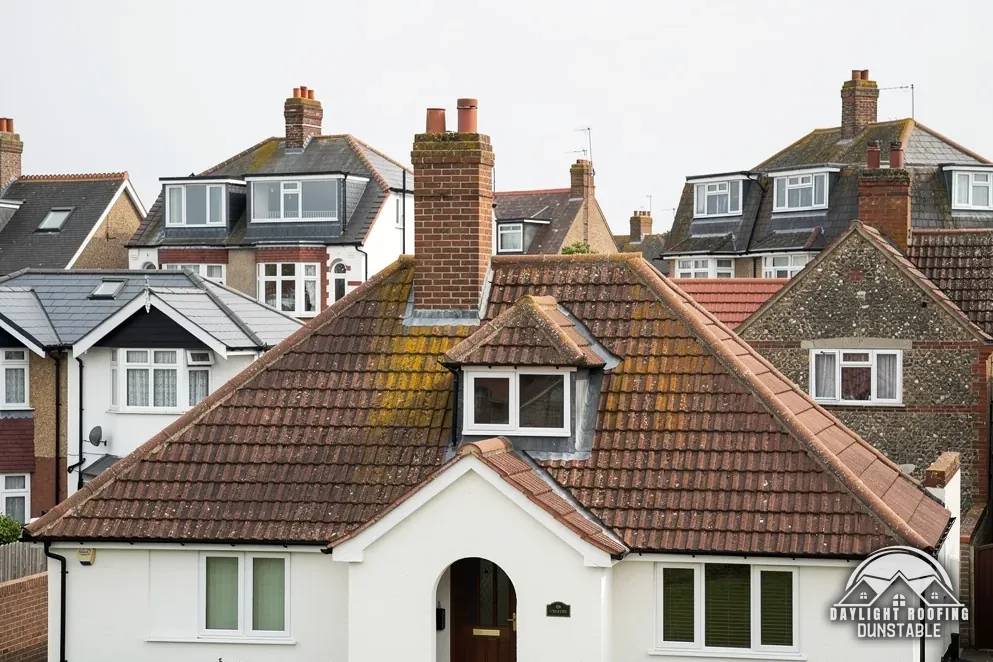
An interwar bungalow with a clay tile roof, a small dormer and an arched porch

Chipperfield roof terms

Batten
The thin timber strip across the rafters that each tile hangs from.
Cavity tray
A waterproof layer in a chimney that sends water out of the wall.
Soakaway
A pit of stone that lets rainwater drain slowly into the ground.
Zinc sheet
A metal covering formed into seams, used on whole roofs and on flashings.

The plain-as-day roof check

Four checks, from the batten to the soakaway

4 checks about 3 minutes to read

  1. Battens and their nails
  2. Outbuilding and barn roofs
  3. The tray inside a chimney
  4. Downpipes to soakaways

01 Battens and their nails

Each tile hangs from a batten, and each batten is nailed to the rafters beneath. If the nails rust or the timber softens, tiles slide. From the loft, look at the battens for dark stains, splits, and nail heads with a rusty halo. A batten that gives under a gentle push is spent. Slipped tiles in a row along the same line suggest the batten behind them has failed. A torch laid flat along a batten shows its grain and any cracks.

Replacing battens means lifting the tiles above them, so the repair is judged at the survey and not guessed from outside. Marley says installing to BS 5534 "isn't required by law", and since the 2015 amendments mortar "could no longer be relied upon as the only means of securing the roof covering". The survey sees what is holding the tiles now, whether that is nails, clips or mortar, and what the new battens would be fixed with.

02 Outbuilding and barn roofs

A garage, store or barn has a roof of its own, and it can get less attention than the house. Look for sagging ridges, missing tiles, holes where an old fixing has pulled out and stained walls inside. A roof that cannot be seen from the house can fail without notice, so a walk round the plot with binoculars is a fair habit. An old tarpaulin or sheet metal laid over a small hole by a previous owner is worth noting when it is seen.

For a listed barn the first question is consent. The Pale Farm's barn is Grade II* (list entry 1173068), and Dacorum Borough Council says whether a repair affects the building's character. Smaller jobs on outbuildings follow the same routes as a house roof, and the survey sets out what a larger one involves. A tarpaulin over a hole is a stopgap, not a repair, and it needs weighting along its edges so wind cannot lift it.

03 The tray inside a chimney

Where a chimney passes through a roof, a waterproof tray built into the stack, where one was fitted, sends any water that gets in back out through the wall, instead of down into the house. If the tray fails, water runs down inside the stack. Look for damp patches on the chimney breast that appear only after rain, and for stains that start above the ceiling line. A damp patch that only shows after a long wet spell can point to the tray rather than the flashing.

The tray cannot be seen from outside, so a damp breast with sound flashing and pointing points to it. A stack in poor repair also lets water into the brickwork through open joints and cracked mortar, so it deserves attention for more than one reason. The chimney page covers stack repair in more detail.

04 Downpipes to soakaways

Where a house has no mains surface-water drain, roof water may run to a soakaway, a pit that lets it soak into the ground. If the pit clogs, water backs up the downpipe and spills at the joints. Look at the ground at the foot of each pipe for a soggy patch, staining on the wall or a pool that does not clear. A short length of clear hose dropped down the pipe shows where a blockage sits.

Once a downpipe has overflowed it can soak the wall for months before the damp shows inside. Brett Martin gives the fall for a gutter as 1 mm for every 600 mm towards the outlet, but the pipe below only works if the drain accepts what it is given. Digging out a soakaway is groundwork, not roofing. The gutters, soffits and fascias page deals with the roof end. A garden hose run for a few minutes over a downpipe, with someone watching the foot, shows where the water goes.

The dashed ring takes in the nearest towns and villages we cover around Chipperfield. Map tiles © Esri; map data © OpenStreetMap contributors.

Chipperfield, the roof, and the questions that follow

01How can I tell if the battens under a Chipperfield roof have failed?

From the loft, look for battens that are dark, split or soft, and for nail heads ringed with rust. A batten that gives when pressed gently has lost its strength. From the garden, tiles that slip in a line along one course suggest the batten behind them has failed. The survey lifts what it needs to, reports plainly what was found along with anything else seen, and gives one written price for the repair. A photograph of the line of slipped tiles is a useful first send. Slate and tile roofs both depend on the batten beneath. Where only a few battens have failed, the repair can be local; where the whole slope has gone soft, it is a re-batten and relay.

02Does the Chipperfield Conservation Area apply to my roof?

The Chipperfield Conservation Area exists because Dacorum Borough Council designated it, and for a house in or near it the council has a say in outside alterations. Ask it about a covering, a roof window or a stack before ordering. An Article 4 direction can remove further permitted development rights, so we check with the council first. On which side of the boundary a given address sits, the council has the final word, and asking before a covering is bought avoids finding out too late. A roof window on the rear slope of an older house is worth including in the question.

03How are roof repairs at St Paul's church in Chipperfield approved?

St Paul's church, Grade II (list entry 1100458), is in the Church of England. Roof work to it is not a listed building consent matter, because the Church of England's faculty system takes that place for a church in use. "The like for like replacement of roof lead or other material covering the roof of a listed building" calls for just the archdeacon's notice in writing. Planning permission can still come into it for exterior work, and Dacorum Borough Council is the body to ask about that.

04Do The Pale Farm, The Manor House and the Tile House outhouse need consent for roof work?

The Pale Farm and barn adjoining on east (list entry 1173068) and The Manor House (list entry 1348423) are Grade II*, and the Outhouse at the Tile House, 40 Metres to North East of House, is Grade II (list entry 1173110). Works that touch a building "in any manner which would affect its character as a building of special architectural or historic interest" need listed building consent. Dacorum Borough Council is asked first, before a covering is ordered, and its answer governs the outhouse as much as the farmhouse. A photograph of the roof slope taken from the lane gives the council a first view.

05What licence does scaffolding need on a Chipperfield road?

Hertfordshire County Council is the highway authority for Chipperfield, and where scaffold stands on the road or footway it licenses it. Hertfordshire County Council's fee is £134 for 14 days and £59 for each week after, and its own words are: "It usually takes 3 weeks to process an application." We arrange the licence with our scaffolder, and any scaffold the roof calls for is built into the one written price. Scaffold built wholly within the plot needs no licence, and the 1.2 m footway walkway is one of the council's conditions.

06Does re-roofing a Chipperfield house need Building Regulations approval?

Chipperfield owners should check with Dacorum Borough Council's building control team about the route, because the Planning Portal's test is narrow: no application is normally needed if "Less than 25 per cent of the total 'building envelope'" is affected and "Less than 50 per cent of the roof is affected". A full re-roof exceeds the second limit. The Portal's main page says: "In most situations, this work will need Building Regulations approval." A covering made heavier by 15 per cent or more requires approval too, with a structural engineer or surveyor looking first. Asking the council to confirm its answer in writing gives something to refer back to. Asking about the route before work is planned avoids a stop part-way through.

07Does the barrow on Chipperfield Common change how nearby roofs are dealt with?

One of two barrows on Chipperfield Common is a scheduled monument (list entry 1012405), near Chipperfield. Works to a scheduled monument must be authorised: Historic England is where applications go, and the Secretary of State gives consent. That route concerns the mound. House and outbuilding roofs in the village go through Dacorum Borough Council, with listed building consent added only where the building itself is listed, so living near the common changes nothing for an ordinary roof, a chimney or a set of gutters.

08How long can a zinc or lead roof last at a Chipperfield property?

VMZinc, the maker, says a zinc roof "can last in excess of 100 years" when correctly designed and installed. MyJobQuote says correctly installed lead flashing "can last for over 80 years". Both are claims about metal fitted well, not promises for any given roof, and neither covers a poorly detailed junction. A survey of a metal roof looks at the seams, the fixings and the falls, and reports plainly on what it finds, with the written price covering any repair or replacement. A lead roof that looks dull and grey is not necessarily failing.

09What counts as storm damage if a Chipperfield roof is damaged?

The Financial Ombudsman Service says that "Rain, hail or snowfall by itself can constitute a storm" and that "a storm usually involves violent winds, usually with rain, hail or snow". It will "usually look at expert reports and photos". Take photographs where the damage lies before anything is shifted, and tell the insurer. For a complaint, "For most complaints, a business has up to 8 weeks to consider a complaint". The Ombudsman's number is 0800 023 4567, and a roof survey can run alongside the claim. Keep any receipts for temporary repairs.

Get a written price for your roof

10-year workmanship guarantee, in writing

Tell us about your roof

Call WhatsApp Written quote