
Call 01582 935272

Thornborough · 24 road miles north-west

Roofers in Thornborough

Slate and tile repairs, guttering, flat roofs and full re-roofs for Thornborough homes: the roof is looked over first, then you get one written total price.

Get a written quote

Call 01582 935272WhatsApp us

Council
Buckinghamshire
Road miles
24
Conservation area
Thornborough
Building control
Buckinghamshire Council

St Mary's tower, Chapel Cottage and the Thornborough skyline

Thornborough is a village in Buckinghamshire, 23.5 road miles north-west of Dunstable; it takes about 35 minutes by road. At the 2021 Census Thornborough parish had 645 usual residents. Buckinghamshire Council designated the Thornborough Conservation Area, so any roof visible from the street starts as a question for the council. Buckinghamshire Council has Article 4 entries on its planning records; before any materials are ordered, ask Buckinghamshire Council whether one of them reaches your house.

Church of St Mary is Grade II*, with Grade II cottages standing nearby, so the roofs of the village are read with their age in mind. A survey comes first, and what it finds, plus any other defect noticed on the way up, reaches you in plain words with one written total price after it. A worn covering replaced as part of a new roof is a different job from gutter and fascia work, and the survey sorts out which one your house needs.

  1. 01Church of St MaryGrade II* (entry 1232681, first listed 13 July 1966) and a Church of England church, which puts repairs to its roof in the faculty system.
  2. 02Chapel CottageListed Grade II (entry 1232671, first listed 22 August 1983); consent is needed for any roof alteration bearing on its character.
  3. 03Cottage east of Garden CottageThe cottage to the east of the entry to Garden Cottage is Grade II (entry 1276999, first listed 22 August 1983).
  4. 04The CroftGrade II under entry 1232617, so a re-cover or a new chimney detail is discussed with Buckinghamshire Council first.
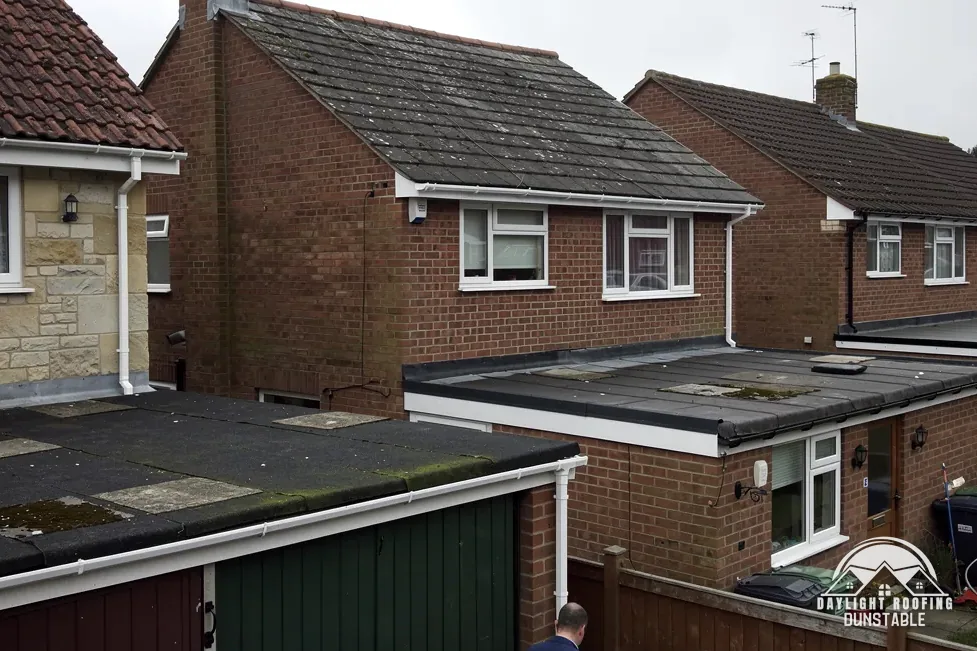
Flat-roofed garages behind brick semi-detached houses

Short definitions

Article 4 direction
A planning order by which the council removes chosen permitted development rights in one area.
Lap
How far each slate overlaps the course two rows below it, in millimetres.
Hopper
The funnel-shaped box on a downpipe's top end that receives water from the gutter.
Fall
How much a flat roof drops towards its outlet, so rain does not sit on it.

The plain-as-day roof check

What a Thornborough roof shows from the road

4 checks about 3 minutes to read

  1. Slate edges and slips
  2. Hoppers and downpipes
  3. Soffit boards and vents
  4. Back-extension flat roofs

01 Slate edges and slips

A slate roof shows its age along the edges and at the nails. Look for slates that have slipped down their course and left a gap you could slide a finger into, a slate with a corner broken off, a line of tails that no longer sits flat, or small fragments in the gutter. A slate is held by a nail or a hook, and one that has moved tells you its own fixing has gone, though the slates beside it may be perfectly sound.

Pitch sets limits on slate. According to Cupa, the figure BS 5534 "indicates" for natural slate is a 20 degree minimum where exposure is moderate, assuming a 500 mm slate lapped by 115 mm; Cupa adds that "hook fixings should not be used on any pitch below 25º". A survey therefore measures the pitch. A few slipped slates are re-fixed in their own course, while a slope shedding slates across its width is a re-slate, which is slate work from the ridge down. Fragments of slate in the garden show roughly where to look.

02 Hoppers and downpipes

Rainwater leaves the gutter through a hopper and runs down a pipe to the drain, and every joint in that route is a place to stop and look. In a downpour, watch for water spilling over a hopper's lip, a downpipe that sweats at a joint, a fixing bracket torn out of the brick, or a shoe that empties against the wall instead of into the gully. A green stain below a joint marks one that has dripped for a long while.

If you can reach a hopper safely from a ground-floor window or a step, check that leaves have not packed into it. A blocked hopper behaves like a failed gutter: it overflows into the wall. The survey takes in the whole run, so a worn bracket and a cracked pipe turn up together and are priced as one total, not as two visits. A pipe knocked by a ladder or a vehicle can crack a joint without marking the paint. Leave first-floor gutters to someone with a proper access tower. A tower or a scaffold is the safer way to reach the eaves of a two-storey house.

03 Soffit boards and vents

Soffits are the boards under the overhang, and some carry small vents that admit air to the loft. Look at them from below, ideally in good light, and note the following: a soffit that sags, a board that has lost paint along a joint, a vent grille that has been painted shut, or a hole where a bird has found its way in. Dark streaks across a soffit mean that water has been running down the fascia and onto it.

If a soffit board has gone, the sound ones either side get checked to see how far the damage runs, and the fascia above it is tested with a screwdriver tip at the same time. When boards are renewed the vents go back, since the air they let in matters to the timbers above. You can examine a soffit with a torch from the ground, and a photo of the worst length helps before the survey.

04 Back-extension flat roofs

A house can have a flat-roofed extension or lean-to at the back, and the tell-tale signs show from an upstairs window. Look for a puddle that stays a day after rain, a bulge in the covering, a split in the upturn where the covering climbs the house wall, or a gutter sagging beneath the roof's edge. NFRC gives "a minimum 1:80 finished fall for general roof areas and internal gutters", so a roof that holds water has lost part of its slope.

BS 6229:2025 governs flat roofs covered with continuously supported flexible membranes, while IKO's reading of that code is to design for 1:40. A flat roof that has ponded is checked for fall, upstands and outlet before a covering is chosen, because a new membrane laid over the same hollow will hold the same pool. The upturn at the wall shows how the old covering let go, which is why it gets a close look.

The dashed ring takes in the nearest towns and villages we cover around Thornborough. Map tiles © Esri; map data © OpenStreetMap contributors.

Thornborough roofs: the questions that matter

01How do I tell whether Thornborough slates need re-fixing or a full re-slate?

Count them and place them. A handful of slipped slates in different spots is a repair, each one re-fixed on its nail or hook. A whole slope where slates drop along a line, or where nails have rusted through, shows that the fixings are at the end of their life, and that is a re-slate. The survey also measures the pitch, because Cupa's reading of BS 5534 sets limits for natural slate, and a roof below those limits needs a different answer from one above them, whichever fixing is chosen. A few photos of the roof from the lane, sent on WhatsApp, make a useful start.

02Should the village conservation area come up before any roof work?

If the house lies inside the designated area, yes, and Buckinghamshire Council can place an address against its boundary. It designated the Thornborough Conservation Area. A roof change that alters the look of the building is worth raising before materials are ordered, and as Buckinghamshire Council has Article 4 entries on its planning records, the same enquiry should check with Buckinghamshire Council whether a direction applies to the house. Our planning permission guide explains how a designated area alters the tests, and the council's reply is worth keeping alongside your quote.

03Which authorisation applies to work on St Mary's roof?

Thornborough's church is St Mary's, a Church of England building listed Grade II* (list entry 1232681, first listed 13 July 1966). In use, it follows the faculty system rather than listed building consent; List B, the like-for-like category, needs only the archdeacon's written notice. Separately, planning runs on a different track, since a change to the exterior can need planning consent of its own, and Buckinghamshire Council would be consulted on that part. A faculty cannot be assumed to settle everything, and the church's own advisers are the people to ask.

04Which of the village cottages carry a listing?

Chapel Cottage (entry 1232671) and the cottage to the east of the entry to Garden Cottage (entry 1276999) were both first listed on 22 August 1983, and both are Grade II, as is The Croft (entry 1232617). For any listed home, work done "in any manner which would affect its character as a building of special architectural or historic interest" needs listed building consent. Your house is unlisted unless its own entry says otherwise, though a neighbour's listing shows how roofs of that age are read.

05Who licenses scaffolding for a Thornborough job?

Where a frame would stand on a footway or the carriageway, Buckinghamshire Council's licence is needed, because the council is the highway authority; its fee is £402.78 for 28 days, with £69.09 to renew and £777.63 if the licence comes after the event. Buckinghamshire Council states: "You must be a registered scaffolding company to apply for a licence." We arrange the licence with our scaffolder. A frame on your own drive that does not overhang the lane involves no highway licence, so say at the survey where the frame would stand, whether on grass, gravel or the lane itself.

06What does a whole-roof replacement cost on a three-bedroom house?

Which? Trusted Traders gave a range of £7,000 to £21,000, excluding VAT, for "Replacing entire roof on an average three-bedroom house", in a survey of 11 traders in November 2025. That range belongs to Which?, not to us, and its width shows how far access, size and covering can move a figure. A bigger roof, a hard-to-reach one or a heavier covering all push the total up, and a survey of your own roof replaces guesswork with an actual sum. Ours is written up as one total after your Thornborough roof has been surveyed, so you see the whole sum for your roof and can set it beside any other firm's total.

07Is a downpour on its own a storm for insurance purposes?

The Financial Ombudsman Service says "Rain, hail or snowfall by itself can constitute a storm", and also that "a storm usually involves violent winds, usually with rain, hail or snow". Whether a claim succeeds turns on the policy and the insurer, and no roofer can promise it, so the useful step for the roof itself is a dated survey of what the damage is. Take pictures of the damage before it is disturbed, tell the insurer, and note dates and times as you go, with anything that blew in from a neighbouring plot. The ombudsman will "usually look at expert reports and photos", so having both is sensible.

08What should I do about a cement-sheet garage roof in the village?

Do not touch it; get it identified first. Only a test can say what a garage roof is made of, and no one should guess. HSE says: "If the building was built or refurbished before 2000, assume that there is asbestos in it." It treats carefully removed cement sheets as non-licensed work, while broken-up sheets fall into a different category, so a sheet is never snapped, drilled or swept for convenience, and children and pets are kept clear of the area. Waste goes in "a lockable skip", never an open one, and the household exemption from consignment notes covers waste "other than asbestos waste".

09Is a roof lantern on a conservatory a rooflight or a roof window?

Approved Document L settles it by position. Under that document a rooflight is glazing "out of plane with the surface of the roof on a kerb or upstand", so a lantern or a flat-roof skylight on a kerb counts, whereas a unit "in the same orientation as, and in plane with, the surrounding roof" is a roof window. Each carries its own thermal figure, which matters when a unit is replaced. A conservatory's solid roof is also a point to check with building control before work begins.

Get a written price for your roof

10-year workmanship guarantee, in writing

Tell us about your roof

Call WhatsApp Written quote