
Call 01582 935272

Whaddon · 20 road miles north-west

Roofers in Whaddon

Whaddon's roofs are seen in person before a price is set: leak and storm repairs, slate and tile re-covering and rainwater goods, ending in one written total.

Get a written quote

Call 01582 935272WhatsApp us

Council
Buckinghamshire
Road miles
20
Conservation area
Whaddon
Building control
Buckinghamshire Council

Rooflines on Church Hill and High Street

Whaddon sits north-west of Dunstable, 19.5 road miles away, so a visit means a drive of about 31 minutes. The parish is small: at the 2021 Census, Whaddon parish had 520 usual residents. Planning matters in Whaddon are for Buckinghamshire Council, which provides building control as well; the team's details are on the council's building control page. A conservation area at Whaddon was designated by Buckinghamshire Council, which makes it sensible to ask there before a roof change that would show from the street. The two Article 4 directions closest to the village are Milton Keynes City Council's, covering changes of use to houses in multiple occupation within its own area, so for a Whaddon house check with Buckinghamshire Council whether any direction applies. Our planning permission guide deals with the roof rules themselves.

Among the listed buildings in the National Heritage List for Whaddon are the Church of St Mary (Grade I, entry 1216538), 2, Nash Road (Grade II, entry 1287548), 2, High Street (Grade II, entry 1216643) and The Lowndes Arms (Grade II, entry 1287547). A bowl barrow on Church Hill is a scheduled monument close to the village. Wherever the roof is, the survey is first, and any other fault noticed is mentioned to you in plain words. If the building is a listed one, the listing sits alongside any conservation designation and the council can explain how the two interact.

  1. 01Grade I parish churchGrade I; a Church of England church where worship continues, so its roof work is decided inside the faculty system.
  2. 022, Nash RoadGrade II (entry 1287548, first listed 29 May 1984). Altering the roof of a listed house is a consent question first.
  3. 032, High StreetGrade II (entry 1216643), also first listed on 29 May 1984, so the same listed building consent rule applies to its roof.
  4. 04The Lowndes ArmsGrade II (entry 1287547). Discuss a changed covering, new ridge or rebuilt stack with Buckinghamshire Council before engaging anyone.
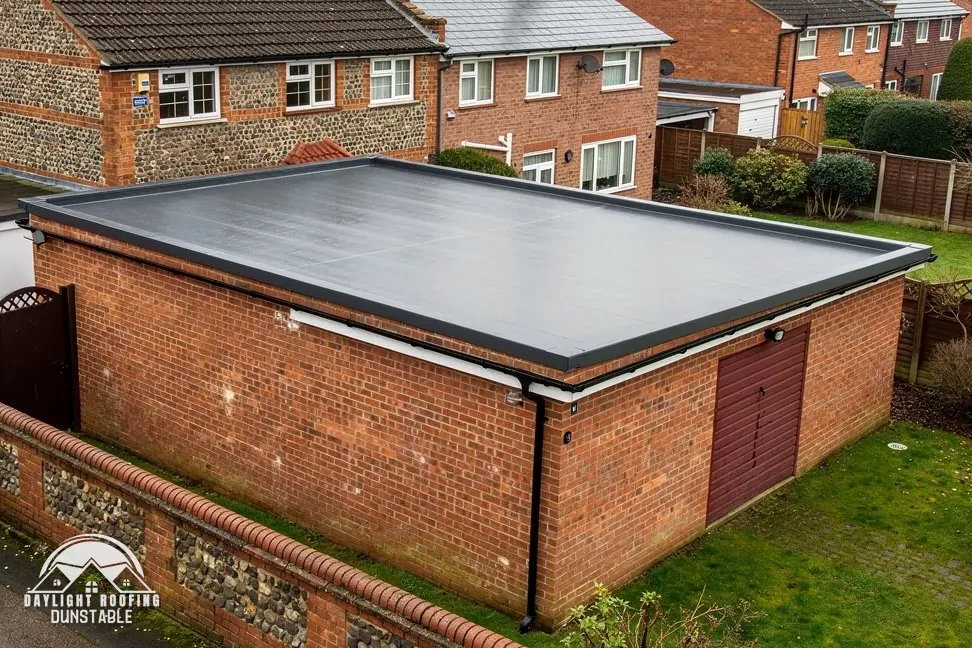
A brick garage with a new flat roof in a back garden

The roof, in plain words

Slate
Split stone cut into thin plates and laid in overlapping courses.
Tile nib
A small projection on the back of a tile, which hooks over a batten.
Ridge tile
A capping piece, curved or angled, laid along the top where slopes meet.
Make-safe
Temporary cover over damage to keep rain out until repair.

The plain-as-day roof check

Four roof questions a Whaddon house can answer

4 checks about 3 minutes to read

  1. Telling slate from tile
  2. Replacing a ridge tile
  3. After a storm, what to photograph
  4. Tiles lifted by wind

01 Telling slate from tile

A slate roof looks flat and thin-edged, with a fine grain and a dull sheen, and each piece is nailed or hooked. A tile roof is thicker, with a curve or a stepped edge and a nib on the back that hangs it from a batten. Clay tiles are fired in a kiln and concrete tiles are pressed in a mould, so a broken piece in the garden shows the difference. A fresh break through clay is gritty and orange or red; concrete is grey right through. Where only a few are damaged, a repair with matching units is possible, and the survey says whether matching ones can be found.

The distinction matters when a quote arrives. HomeBuilding gives approximate lifespans of 100+ years for Welsh slate, 60-80 for clay and 40-50 for plain concrete. A survey confirms what is on the roof before any figure is set, and the slate roofing page describes the work if you have slate.

02 Replacing a ridge tile

A cracked or missing ridge tile exposes the join between two slopes. The job is small: the old tile and its bedding are cleared, and a new tile is laid and fixed. Which? Trusted Traders give £80 to £300, excluding VAT (November 2025), for one new ridge tile. MyJobQuote says in 2026 the average ridge tile replacement costs between £225 and £550 (page dated 1 October 2026). The two sources disagree, and neither covers a long run. Check, too, that the neighbouring tiles are sound, since a new tile laid beside a brittle one can be damaged during fitting. Over a long ridge, a crack that runs through several tiles at the same height suggests the bedding below has moved, not only the tile itself.

The reading from the road is easy: a gap in the line, a tile with a crack along its length or a dark patch of moss on one side only. Count the affected tiles and note whether the ridge is dry-fixed or bedded in mortar. Hips are priced after a survey, in the same way as the rest of the roof.

03 After a storm, what to photograph

After a storm, look from the ground before you go near the roof. Photograph slipped tiles, a ridge that has shifted, debris in the gutters and any stain that has appeared indoors. Take pictures from several angles with a landmark such as a chimney in each, and keep the originals with their dates. A close shot of a stain beside a wide shot of the room shows both position and scale. Wait for a dry spell before any rooftop checks of your own, and stay on the ground. Keep a note of the gutters, since a full gutter beside a leak is a clue to where water is going.

On 22 October 2026 MyJobQuote's emergency roofer page quoted typically £150 to £300 for a call-out, and £1,200 or more once the storm damage repairs are extensive. Those are third-party ranges. If water is coming in, stay clear of a bulging ceiling and call for help to make the area safe before you think about the repair itself. Write down the time and weather when you notice each leak, because a pattern shows whether it follows wind direction or heavy rain.

04 Tiles lifted by wind

A tile that has been lifted and dropped back has lost its fixing. Marley says the site's own fixing specification always overrules BS 5534's minimum fixings, and that ridge and hip tiles need mechanical fixing to resist the calculated wind uplift force. The exposure of a roof is a property of its site, and no figure for it is assumed for the village. A tile that rattles in a wind is one to point out when you describe the roof.

From the ground, look for gaps in the verge, tiles standing slightly proud along a row and clips that have slipped. Marley says installing to BS 5534 isn't required by law. The code remains the basis on which a sound specification is built, and what the roof was fixed with shapes the repair that follows. Ask for the fixing method to be named in any written price, whether nail, clip or screw, which lets you set one quote against another.

The dashed ring takes in the nearest towns and villages we cover around Whaddon. Map tiles © Esri; map data © OpenStreetMap contributors.

Whaddon roofs: questions before work starts

01Does Whaddon's conservation area change a roof repair?

Whaddon's conservation area was designated by Buckinghamshire Council, which keeps the map, so an address can be placed only by asking there. The two Article 4 directions nearby are the HMO directions Milton Keynes City Council made for its own area, not roof controls. Raise your house with Buckinghamshire Council, ask whether an Article 4 direction reaches it, and have the reply in writing before the survey. The planning guide explains how a repair differs from a change to the roofline. A phone call is quicker than a letter, but keep the reply that comes in writing.

02How does the Church of St Mary's roof get consent?

St Mary's, Whaddon, carries a Grade I listing (entry 1216538, first listed 19 August 1959), and it is a Church of England church. While St Mary's is used for worship the faculty system applies, with listed building consent set aside. The Faculty Jurisdiction Rules list some jobs, among them swapping worn roof lead or another covering for matching material, which the archdeacon can clear on a written notice. The exemption goes no further than listed building consent, so exterior work may still need a decision from the council on planning permission.

03What is listed along Nash Road and High Street?

2, Nash Road (entry 1287548) and 2, High Street (entry 1216643) were both first listed on 29 May 1984, and The Lowndes Arms (entry 1287547) is Grade II as well. Where a listing is involved, anything that changes the building's character needs consent, so a new covering, ridge or chimney rebuild begins with the council. The survey of a roof describes the condition of what is there, and the council rules on what may change. A neighbour with a listed house is a useful person to talk to about the process, though the council is the authority.

04Does the bowl barrow on Church Hill affect nearby roofs?

A bowl barrow on Church Hill, 200m south of church, is a scheduled monument (entry 1012632) near Whaddon. Any work to a monument of that kind needs advance authorisation, with the request going through Historic England to the Secretary of State. That is a rule about the monument. Houses in the village follow the ordinary routes, and the list entry is a way of finding the barrow by name and number, not a measure of how far it is from you. The monument is protected in its own right, and ordinary roof repairs on a village house are a separate matter from it.

05How is a scaffold licence arranged on a Whaddon job?

A scaffold that obstructs a street falls under section 169 of the Highways Act 1980, and Buckinghamshire Council issues the licence. For scaffold licences Buckinghamshire Council asks £402.78 per 28 days, £69.09 to renew and £777.63 for a late application, and it insists on this: "You must be a registered scaffolding company to apply for a licence." We arrange the licence with our scaffolder, and the written quote covers scaffold as part of the job. A scaffold kept entirely inside your own boundary, away from the pavement, involves no highway licence.

06What does a slate roof cost on average?

For a slate roof fitted new, MyJobQuote's average is around £7,800 (page of 6 October 2026). HomeBuilding's Welsh slate figure for a semi with a 65m² roof is that it "might reach £18,000". The two figures cover different houses and different slates, and neither one prices your own roof. After the survey you receive one written total, shaped by the size of the roof, the way in and the slate chosen, covering the whole job. Welsh slate and plain concrete tiles also differ in lifespan, and the covering is named in the quote.

07What does a roof window cost, and which type is it?

MyJobQuote's page of 22 September 2026 puts the average standard mid-range Velux at £1,100, and says "Velux window replacement costs around £100 less for a straightforward swap, as the opening is already in place." Approved Document L asks a roof window for 1.4 W/m2K, or Window Energy Rating Band B in its place; for a rooflight the figure is 2.2 W/m2K, so find out which a product is. Whether cutting a new opening needs permission is covered in the planning guide. Ask for the opening size and the frame type to be written into any quote, so that two prices are comparing like with like. Roof windows set in a slope are a different job from a flat-roof lantern, which is a rooflight in the Approved Document sense.

08What should I do when water comes through a ceiling?

Shift belongings clear, stand a container where the drip lands and keep away from a ceiling that is bulging. Photograph the stain, and photograph the slope above it too, then let your insurer know. Send the pictures to WhatsApp on 07880 284133 and we will look at them, or ring 01582 935272. Our written total price follows a survey, because the cause of a leak need not sit directly above the stain you see indoors: water can run along a rafter for some distance before it drops onto the ceiling.

09Where can I complain if a storm claim is refused?

The Financial Ombudsman Service is on 0800 023 4567. The Financial Ombudsman Service accepts that rain, hail or snowfall alone can amount to a storm, and it will usually look at expert reports and photos. Up to 8 weeks is allowed for the firm to consider most complaints before you take one to the Ombudsman. Keep dated photographs, any survey and each letter from the insurer, since together they make the sequence of events easy to show, and note the date of every call you make.

Get a written price for your roof

10-year workmanship guarantee, in writing

Tell us about your roof

Call WhatsApp Written quote