
Call 01582 935272

Sandy · 27 road miles north-east

Roofers in Sandy

Sandy is 26.5 road miles from Dunstable, north-east of the town, and about 44 minutes away by road. The roof is looked over before a price exists, and the price then arrives as a single written sum.

Get a written quote

Call 01582 935272WhatsApp us

Council
Central Bedfordshire
Road miles
27
Conservation area
Sandy
Building control
Central Bedfordshire

Roofs by Pleasant Place and the Queens Head

At the 2021 Census Sandy parish had 12,172 usual residents. The Church of St Swithun is listed Grade II* (National Heritage List entry 1137790, first listed 21 December 1979). Three Grade II listings share that 1979 date: 10 and 11, Pleasant Place (entry 1312125), the Queens Head Public House (entry 1321432) and, along the High Street, 51 and 51a (entry 1114512). Each carries the rule that work affecting the character of the building needs listed building consent, and a listing does not take away the householder rights to carry out roof work.

Sandy has a conservation area, designated by Central Bedfordshire Council, the same council that decides planning applications here. Central Bedfordshire says permitted development rights are stricter for properties within conservation areas, so the address is checked with it. The planning guide carries the roof tests, and the roof replacement and slate roofing pages describe the work.

  1. 01St Swithun's churchGrade II* and Church of England: roof work runs through the faculty system, and any planning question for the exterior is separate.
  2. 0210 and 11 Pleasant PlaceListed Grade II (entry 1312125), first listed 21 December 1979, so any roof change is read against its entry.
  3. 03Queens Head Public HouseGrade II listed (entry 1321432); any roof alteration touching its character requires listed building consent before it proceeds.
  4. 0451 and 51a High StreetA Grade II listing (entry 1114512) covers the pair, and the council is asked before covering or chimney work.
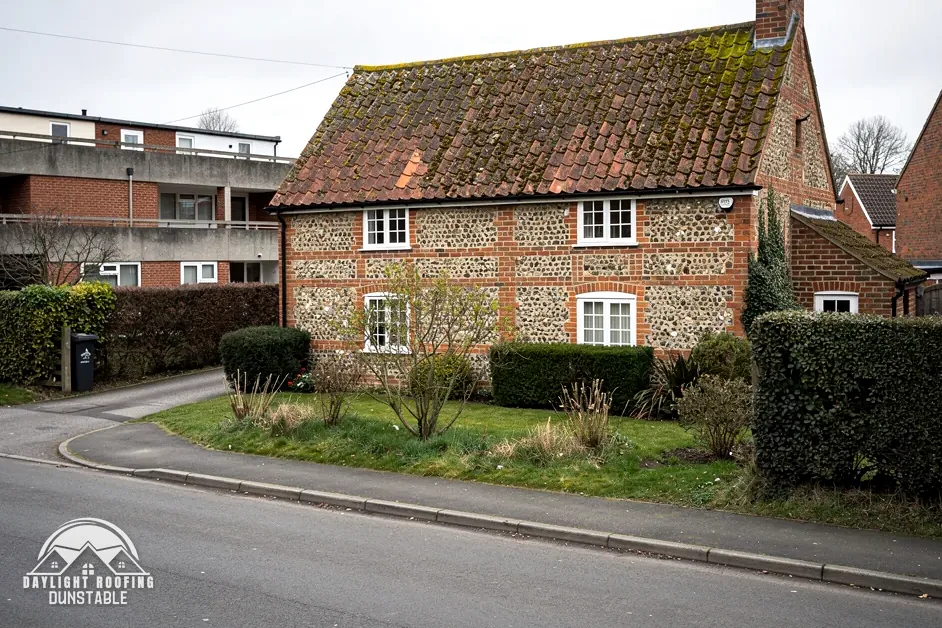
A flint and brick cottage with a clay tile roof beside a quiet road

The roof, in plain words

Open-cell foam
A soft, air-filled kind of spray foam insulation.
Hip
The angled line running down an outward corner of a roof.
Asbestos cement
A hard sheet material, once used for corrugated roofing, that holds asbestos fibres.
Final certificate
What a registered building control approver issues once work is complete.

The plain-as-day roof check

Four roof topics in Sandy, from tile life to asbestos cement

4 checks about 3 minutes to read

  1. How long tiles are expected to last
  2. Spray foam under the covering
  3. Ridge and hip repairs
  4. Asbestos cement on outbuildings

01 How long tiles are expected to last

Published lifespans differ by source, so each is kept separate. Marley quotes the BRE on clay: "For clay roof tiles, the BRE determined a minimum life expectancy of 60 years". Nothing in that line speaks for concrete. In HomeBuilding's guide (last updated 30 September 2025) the approximate lifespans are 60-80 years for clay and 40-50 years for plain concrete.

Both sources are quoted as they stand. A figure describes a kind of tile in good condition, never one particular roof, because nails, battens and underlay each age on their own timetable and any one of them can end the useful life of a covering that its tile figure says is part-way through. Mortar bedding at the ridge and verge is another part that can give out ahead of the tile. Check at the edges as well as across the slopes: the ridge, hips, verges and eaves are secured and pointed in their own way, apart from the slopes between them, so a survey takes each on its own.

02 Spray foam under the covering

Applied under the slope, foam leaves the rafters out of sight. In March 2023 RICS reported "concern within specific sectors of the lending market, such as equity release mortgages". Its consumer guide says "If the timber roof structure is covered with spray foam it cannot be fully seen or inspected" and adds "Do check with your mortgage provider whether their lender policy allows the installation of such products." The Energy Saving Trust says the rot "risk should be much lower with open-cell foam", which falls short of saying there is none. Anyone looking for a leak or rot behind foam has to rely on the outside of the covering and on moisture readings, because the timbers themselves are out of sight.

On removal, MyJobQuote's page of 17 September 2026 gives an average of £40 per m², and says a standard three-bedroom home with roughly 80m² of roof space comes to around £3,200 in total. Checkatrade's July 2026 guide puts the total near £3,200 for a detached three-bedroom house, with £50 to £75 per m² quoted for open-cell foam. Those are guides and not a Sandy price. DESNZ adds that removal "will not always guarantee that they will still lend".

03 Ridge and hip repairs

Ridge tiles run along the top of a roof and hips run down its outer corners. Which? Trusted Traders give £80 to £300 for putting a ridge tile in; that guide excludes VAT and dates from November 2025. MyJobQuote's page of 1 October 2026 gives £225 to £550 as the 2026 average for replacing ridge tiles. They are different guides and are not merged into one range. Pricing for hips waits for the survey.

A ridge that needs a few tiles replaced is a different job from one that needs rebedding or fixing along its whole length, and the survey follows the full line before the extent is decided. From the garden, watch for a dipping ridge, a tile slid sideways or a vertical gap between neighbouring ridge tiles, since each marks where to look closely. Photographs of the ridge from two sides, taken on a bright day with the light falling on the slope, show cracks and gaps better than a single view, and they give the survey something to compare against.

04 Asbestos cement on outbuildings

Corrugated sheeting on a garage, shed or outbuilding can be asbestos cement. HSE's page on non-licensed work lists asbestos cement, with roof sheeting and rainwater goods among the examples, so long as the material is "carefully handled/removed without breaking up". Where sheeting has been "substantially damaged or broken up", say by fire or flood, the job moves into the notifiable category. "AC roofs are always fragile", so a sheet must never take anyone's weight. Check from the ground for cracked or lifting sheets, patched sections held down with sealant and corroded fixings where sheets overlap, and never test a sheet by weight.

MyJobQuote's average cost of asbestos removal from a roof in the UK is around £2,750, and its average survey around £325, on pages dated 9 September 2026. They are not Sandy prices. HSE advises "If the building was built or refurbished before 2000, assume that there is asbestos in it." Waste leaves in a lockable skip, and a sheet you suspect should be left untouched until a person qualified to identify it has done so.

The dashed ring takes in the nearest towns and villages we cover around Sandy. Map tiles © Esri; map data © OpenStreetMap contributors.

Sandy roof questions: church, conservation area, costs

01What can be read from the ground on a Sandy roof before anyone climbs?

Sight along the ridge for any sag or a slid tile, along the eaves for a gutter that sags or has lost a bracket, and at the chimney for open joints or a stack that leans. Gaps in a course of tiles show slipped coverings, and a dark stripe on a slope can mark an overflowing joint above. A few photographs taken square-on, one for each elevation, sent on WhatsApp give us enough for a first opinion, though only a survey reads what is under the covering. Take them in dry weather with the light on the roof, since shadow hides cracks and slipped edges.

02Does the conservation area reach the roof of a house on Sandy High Street?

Sandy has a conservation area, designated by Central Bedfordshire Council, and the council confirms from the address whether a house stands inside it. The council says permitted development rights are stricter for properties within conservation areas. Listed houses, such as 51 and 51a on the High Street, are covered by their listing as well, which brings listed building consent into play for changes that affect their character, whether or not the house is inside the conservation area boundary. An Article 4 direction can remove further permitted development rights, so we check with the council first.

03Which body decides about a roof repair at St Swithun's?

St Swithun's belongs to the Church of England, is in use and is listed Grade II*, so work is dealt with under the Church of England's own faculty system and not by listed building consent. List B treats the renewal of roof lead or covering to match as a lighter case, which the archdeacon can clear by notice in writing. Central Bedfordshire Council decides, separately, whether exterior work needs planning permission, so the two answers are kept apart. Listed houses nearby go through listed building consent instead, wherever the work touches their character.

04What do guides give for a slate roof in Sandy?

MyJobQuote's page of 6 October 2026 puts fitting a slate roof at around £7,800 on average. On HomeBuilding's guide, last updated 30 September 2025, a three-bedroom semi with a 65m² roof in Welsh slate "might reach £18,000", where plain concrete tiles on the same house "may cost between £10,000 and £15,000". The guides measure different things and the figures are not merged. A Sandy total is written after the survey, and it reflects what the roof needs and not a figure from a guide.

05Who sorts out a scaffold licence at a Sandy house?

A licence under section 169 of the Highways Act 1980 covers scaffolding on a pavement or carriageway, and Central Bedfordshire Council is the highway authority for Sandy. We arrange the licence with our scaffolder. Say if the house has a drive or sits on a through road, because that decides whether the scaffold can stand on private ground or has to use the footway, and the licence is only needed for the second case. Where the roof can be reached across private ground, the scaffold can stay off the highway altogether, and the survey says which case applies.

06Does a Sandy re-roof go to the council or a private approver?

Building control is carried out by the council's building control team or by a registered building control approver. What began on 6 April 2024 is registration of private approvers; private building control was there before it. The council's certificate at the end is a completion certificate, and an approver's is a final certificate. Central Bedfordshire Council's building control team is on 0300 300 8635, and the council's own note says the number is not for planning enquiries; a homeowner can choose either route.

07What do guides give for swapping a roof window in Sandy?

MyJobQuote's page of 22 September 2026 values a mid-range Velux of the standard kind at £1,100 on average, with £100 off for a straight swap into the existing opening, which is why a swap and a new window are priced differently. That is a guide to one window and not a Sandy price. A fresh opening cut into the slope is more work than swapping one window for another, and the planning guide is worth reading first, since the rules depend on which side of the house the window faces.

08Do bats in a Sandy roof stop a re-cover?

Not necessarily, but they change how the work is planned. Damaging or destroying "a breeding site or resting place of such an animal" is an offence under regulation 43 of the Habitats Regulations, with no word about intent, and GOV.UK's bat guidance lists "repairing or replacing a roof" among its activities and points to Natural England for licences. If there are droppings or staining at the eaves, say so in your enquiry, and the question can be settled before any covering is lifted. A bat roost can sit in a small gap, so signs matter more than the size of the roof.

09Is following BS 5534 compulsory for tiles on a Sandy roof?

Marley says installing to BS 5534 "isn't required by law". It also says the 2015 amendments made it clear that mortar "could no longer be relied upon as the only means of securing the roof covering". BS 5534:2014+A2:2018 is the current edition, and the +A1:2015 version is withdrawn. Fixings are set by a site-specific specification, so the code is followed as good practice in any case, and the written total reflects the fixings. Mortar can still have a place at the ridge, as a bedding and not as the sole fixing, and the survey says which each ridge relies on.

Get a written price for your roof

10-year workmanship guarantee, in writing

Tell us about your roof

Call WhatsApp Written quote