
Call 01582 935272

Potton · 28 road miles north-east

Roofers in Potton

Potton, a north-east village, is 27.6 road miles from Dunstable and about 47 minutes by road. Before a price exists there is a visit to the roof, and the figure we give is one written total.

Get a written quote

Call 01582 935272WhatsApp us

Council
Central Bedfordshire
Road miles
28
Conservation area
Potton
Building control
Central Bedfordshire

Roofs round Market Square and St Mary's

Potton parish recorded 5,728 usual residents at the 2021 Census. St Mary's church carries a Grade I listing (National Heritage List entry 1321657, first listed 31 October 1966). In Market Square, 22, 23 and 24 is listed Grade II (entry 1138015, first listed 31 October 1966), 25 is listed Grade II (entry 1321660, first listed 31 October 1966) and 19 and 20 is listed Grade II (entry 1114079). A listed building keeps the permitted development rights a house has for roof work, with listed building consent added for anything that changes its character. A listing attaches to the building rather than the street, so two neighbours can face different first questions about the same kind of roof.

Potton has a conservation area, designated by Central Bedfordshire Council, which is also the body that decides planning applications in the village. The council says permitted development rights are stricter for properties within conservation areas, so the address goes to it first. The planning guide carries the roof tests, while the lead roofing and leadwork and flat roofing pages cover the jobs themselves.

  1. 01St Mary's churchGrade I listed and Church of England, so the faculty system governs its roof work and planning for the exterior is a second question.
  2. 0222 to 24 Market SquareA Grade II listed group (entry 1138015), first listed 31 October 1966, so roof changes are read against the listing.
  3. 0325 Market SquareListed Grade II (entry 1321660): an alteration touching the building's character needs listed building consent.
  4. 0419 and 20 Market SquareGrade II listed (entry 1114079); the council confirms whether a covering change is repair or alteration.
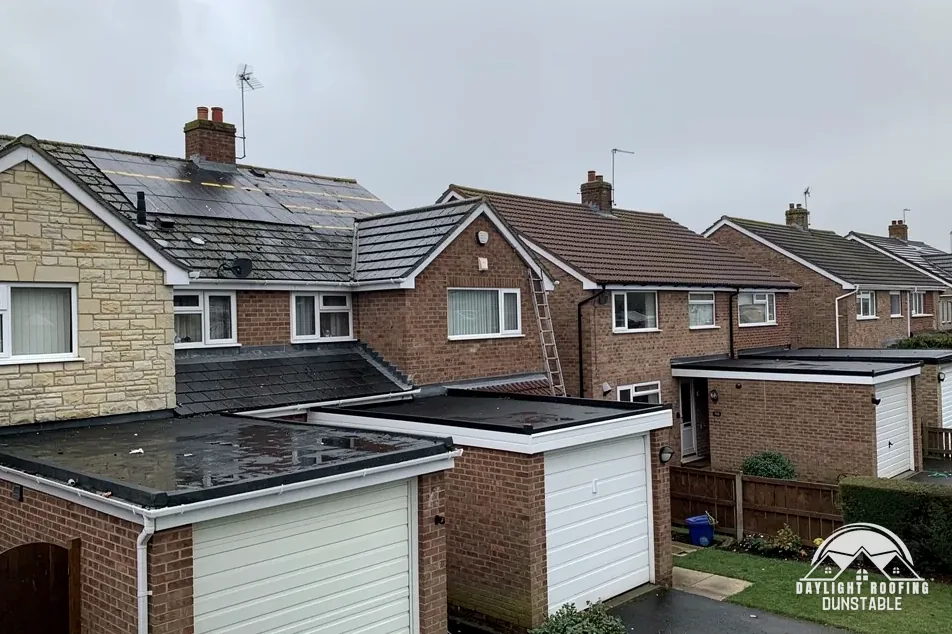
Brick semis with concrete tile roofs and flat-roofed garages

The roof, in plain words

Valley gutter
The trough formed along the inner angle between two roof slopes.
Fortuitous ventilation
Air movement through the normal gaps of an eaves, with no vents added.
EPC
An Energy Performance Certificate, rating a home from A to G.
Beaufort Scale
A numbered rating of wind strength, from calm to hurricane.

The plain-as-day roof check

Four roof topics for Potton, from lead to the insurer's questions

4 checks about 3 minutes to read

  1. Lead flats and valley gutters
  2. Low-resistance underlay and eaves air
  3. Insulation schemes and VAT relief
  4. Storm damage and what insurers ask for

01 Lead flats and valley gutters

Lead can last a long time, and the sources give ranges. MyJobQuote says "When correctly installed, lead flashing can last for over 80 years (over 100 years for higher codes) with minimal maintenance." HomeBuilding lists a lead flat roof at 60-100 years, while Less says "Lead is the longest-lasting option at 50 to 100 years". The figures describe a flashing and a flat roof, and they are kept apart.

Behind a frontage, a lead valley gutter or flat can be out of sight from the street, so it is read from a window, an upper room next door or a ladder. Look for splits along folds, a seam that has opened, a patch worn through and a damp mark on the ceiling underneath it. Sealant smeared over lead hides the symptom and leaves the cause, which is why a repair starts by finding where the water is entering.

02 Low-resistance underlay and eaves air

Eaves ventilation differs with the underlay. Marley's guidance for the other case, an air-permeable covering over a low-resistance underlay with a well-sealed ceiling, is "fortuitous ventilation at the eaves via normal eaves construction (3mm) is all that is required, provided the requirements of UKAS Third Party certification are fully met". A high-resistance underlay in a cold roof calls for 25 mm of eaves ventilation at 15° or less and 10 mm above.

Which underlay sits under a covering cannot be told from the road. The survey reads the underlay and the openings at the eaves from the roof, and you can check the seal of the ceiling from your own loft hatch. Moisture in buildings is handled under BS 5250:2021, which BSI lists as current and under review. A roof space that sweats on a cold morning points to one of those three being wrong. Insulation laid over the ceiling joists keeps the roof space cold, so the ceiling seal matters: a gap round a pipe or a light fitting lets warm, moist air up into the space.

03 Insulation schemes and VAT relief

The schemes available in England fund insulation and heating work; roof replacement and roof repair are not among them. GOV.UK says the Energy Company Obligation "is closing on 31 December 2026", while Ofgem's wording for the Great British Insulation Scheme is "This scheme is now closed to new installations." For the Warm Homes: Local Grant the home must "have an Energy Performance Certificate (EPC) of D, E, F or G" and the household income "must usually be £36,000 a year or less". Eligibility is checked on GOV.UK. The GOV.UK energy adviser line is 0800 098 7950.

Under HMRC Notice 708/6, putting energy-saving materials into a home, insulation in roofs or lofts included, is zero-rated for supplies "made between 1 May 2023 and 31 March 2027", with the reduced rate of 5% after that. The relief belongs to the insulation and not to a roof repair. How a council runs its local grant is a question for the council, and nothing here promises a payment.

04 Storm damage and what insurers ask for

Rainfall on its own is not how a storm is defined. The Financial Ombudsman Service says "a storm usually involves violent winds, usually with rain, hail or snow", and also that "Rain, hail or snowfall by itself can constitute a storm". It adds "We take into account the Beaufort Scale." Should an insurer rely on an exclusion, "The insurer has to prove that the exclusion applies - for example, with an inspection report."

The Ombudsman will "usually look at expert reports and photos", so photographs with a visible date, taken before anything is shifted, are worth having. If tiles or lead have fallen, store them somewhere dry, as the insurer or its surveyor may ask to look at them. Tell your insurer promptly. MyJobQuote's emergency page of 22 October 2026 says call-out costs "typically range from £150 to £300" and that extensive storm damage repairs can cost £1,200 or more, third-party figures for the whole country.

The dashed ring takes in the nearest towns and villages we cover around Potton. Map tiles © Esri; map data © OpenStreetMap contributors.

Potton roof questions for Market Square and beyond

01How can lead on a Potton flat roof be checked from a window or ladder?

Look for a fold that has split, a seam lifting at the edge, a ripple where a sheet has slid down and a patch worn thin by foot traffic. Check the lead where it turns up a wall, for open joints in the brickwork above, or a smear of sealant. A damp patch on the ceiling directly below shows where water has reached the deck. Photographs of the lead, taken square-on in dry light and passed to us on WhatsApp, can be reviewed ahead of any visit, and the survey does the rest. Lead is laid over a timber deck, with an underlay beneath it, and dressed into rolls or over drips so water runs off in the direction of the fall; those joints are where the checking concentrates.

02Do the conservation area and a Market Square listing both apply to a roof?

They can, and they are separate layers. Potton Conservation Area is designated by Central Bedfordshire Council, which says permitted development rights are stricter for properties within conservation areas. A listing is attached to the building itself, so a roof change on a listed house that reaches into its character needs listed building consent, whether the house is inside the conservation area or outside it. An Article 4 direction can remove further permitted development rights, so we check with the council first, using the full address. Where an address is both listed and inside the boundary, the two answers are taken together, and the council's reply is kept with the written price.

03How are roof repairs at St Mary's church put through the consent system?

Because St Mary's is Church of England, in use and Grade I listed, "the faculty jurisdiction of the Church of England" covers it, in place of listed building consent. A List B item is the like-for-like change of roof lead or other covering, handled by the archdeacon's written notice. Any wider alteration needs more than that, and the council or the church authorities are asked about it before work is priced in detail. A faculty is not a planning permission, and the two are sought separately. Planning permission for exterior work is a distinct matter for the council, whose reply may still be that it is required.

04Does a repair to a roof in Market Square need listed building consent?

The test for listed building consent is whether work would touch the building "in any manner which would affect its character as a building of special architectural or historic interest". Whether a repair does that depends on what is done and with what. Repairing to match is a different question from changing the covering, and the council confirms which applies. The listings in the square, 19 and 20, 22 to 24 and 25, are each Grade II, and each entry can be looked up on the National Heritage List by its number.

05What do the guides say a new roof costs for a three-bedroom house?

Which? Trusted Traders' November 2025 survey of 11 traders gives £7,000 to £21,000 to replace the whole roof of an average three-bedroom house, with VAT excluded. HomeBuilding's page, last updated 30 September 2025, gives plain concrete tiles on a 65m² roof as something that "may cost between £10,000 and £15,000" and Welsh slate as something that "might reach £18,000". MyJobQuote's average of around £5,250 comes from its page of 3 November 2026. These are separate guides covering different surveys, and your written total follows the survey of your own roof, so none of them is a quote. Roof size, slope angle and the scaffold access needed carry more weight than any guide's average.

06How does scaffolding work on a busy Potton frontage?

Section 169 of the Highways Act 1980 requires a scaffold licence where scaffolding blocks a pavement or road. The highway authority in Potton is Central Bedfordshire Council. We arrange the licence with our scaffolder, and the layout drawn for it follows the survey. Round a square, pedestrians, parked vehicles and shop doors all shape where the scaffold stands and how a walkway is kept, so mention the frontage and any deliveries when asking for a price, so the layout follows them. A walkway past a shop door that stays usable is part of any workable plan.

07When does building next to a Potton neighbour's wall call for a party wall notice?

The Party Wall etc. Act 1996 has two notice periods. For party-structure work such as cutting a chimney breast away, the building owner gives at least two months' notice; for a new boundary wall, or digging beside a neighbour's building, at least one month. Any neighbour who stays silent for 14 days is deemed to have dissented. If the neighbour dissents, a party wall surveyor comes in under section 10; that is no veto, and building control is not the body for party wall questions.

08How long might an asbestos soffit be a concern on an older Potton building?

HSE advises "If the building was built or refurbished before 2000, assume that there is asbestos in it." It lists "AIB white soffit panels to underside of roof eaves" among the materials. Most work on asbestos insulating board is licensed. Before anything is done to a suspect panel, someone qualified identifies it. No drilling, sanding or scrubbing of a suspect panel: ask for it to be identified first, and mention it when you request a price. Fibres are released when a panel is disturbed.

09Where can a Potton homeowner turn if a roofing contract goes wrong?

Section 49 of the Consumer Rights Act 2015 requires "Service to be performed with reasonable care and skill". The Citizens Advice consumer helpline is 0808 223 1133. Keep the written total and the dates, because they are what any adviser will want to see. Dated pictures of the roof from before and after the work help if the dispute is about the workmanship. Photographs from the same spots, taken on the same side of the house, make the comparison simple.

Get a written price for your roof

10-year workmanship guarantee, in writing

Tell us about your roof

Call WhatsApp Written quote