
Call 01582 935272

Shefford · 18 road miles north-east

Roofers in Shefford

High Street shop roofs, flats above them and parapet gutters in Shefford, 17.5 road miles to the north-east of Dunstable, with a survey first and the price written afterwards.

Get a written quote

Call 01582 935272WhatsApp us

Council
Central Bedfordshire
Road miles
18
Conservation area
Shefford
Building control
Central Bedfordshire

High Street, flats and a Grade II* Catholic church, Shefford

Shefford is a town in Bedfordshire, 17.5 road miles north-east of Dunstable (30 minutes by road). At the 2021 Census, Shefford parish had 7,307 usual residents. Where a Shefford building has a shop below and a flat above, or joins its neighbours along the street, its roof can carry gutters between parapets as well as plain slopes. In Shefford the price waits for the survey, whose findings are put plainly, along with whatever else the survey notices. The flat roofing page covers membranes and falls.

Central Bedfordshire Council deals with planning in Shefford, and it designated the Shefford Conservation Area. For an address near the centre, ask the council whether it falls inside. The Catholic Church of St Francis of Assisi is Grade II*, and 32 High Street, 34 High Street and The Tudor House are Grade II. The planning guide describes the planning checks a house faces; flats are a separate case. Photographs of any listed neighbour help the council see the context.

  1. 01Shops and flatsA roof over flats is shared, and a building of flats sits outside the householder permitted development rules that apply to a house.
  2. 02Parapet guttersA gutter set behind a front wall needs its falls, outlets and lead lining checked together.
  3. 03Listed High Street32 and 34, High Street are Grade II (first listed 10 January 1985), so a covering change affecting their character needs listed building consent.
  4. 04St Francis of AssisiThe church is Roman Catholic, in use and Grade II*, so its roof work follows that Church's own consent system, with planning a question for the council.
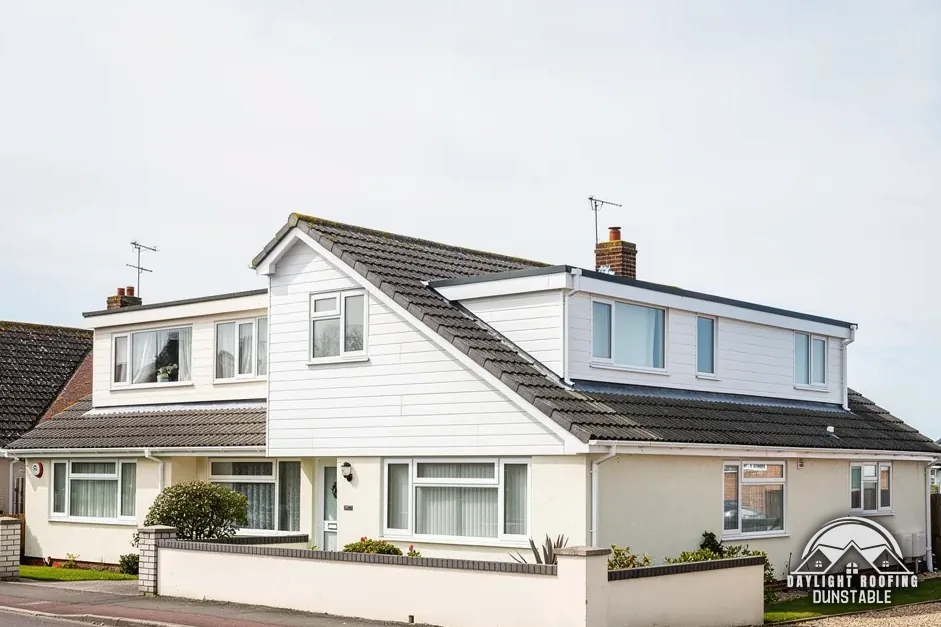
A pair of chalet bungalows with flat-roofed box dormers

The roof, in plain words

Parapet
A low wall that rises along the edge of a roof.
Box gutter
A metal-lined channel sitting beside a parapet or in the valley between slopes.
Dwellinghouse
A house, which in planning law is not a building made up of flats.
Building envelope
The walls, floor, roof, windows and doors of a building together.

The plain-as-day roof check

Four things to check on a Shefford shop, flat or town roof

4 checks about 3 minutes to read

  1. Roofs over flats
  2. Parapets and box gutters
  3. Lifespans of roof coverings
  4. Birds and bats in the roof

01 Roofs over flats

A block of flats under one roof is a shared structure, and a leak in it can show up several floors down from the fault. Check the top-floor ceilings for stains that spread, walls with blistered paint under the roofline and any water marks near a stair or a lift housing. Planning law treats a building of flats as something other than a dwellinghouse, so householder permitted development rights are not available there, and the council answers questions about changes.

On re-roofing, the Planning Portal gives these limits for work that normally needs no application: it must affect "Less than 25 per cent of the total 'building envelope'" while "Less than 50 per cent of the roof is affected". Its main page adds "In most situations, this work will need Building Regulations approval." A full re-roof of a block goes past the second limit. Central Bedfordshire Council's building control team is on 0300 300 8635, a line for building control and not planning enquiries.

02 Parapets and box gutters

Where a roof ends behind a parapet wall, the water has to go somewhere, and a lined box gutter takes it to an outlet. Look from across the street for a parapet that leans, copings that have slipped, and wet staining below the roofline. Inside, a damp patch directly under a parapet calls for a look at the gutter behind it. NFRC says BS 6229:2025 sets "a minimum 1:80 finished fall for general roof areas and internal gutters", so a box gutter that ponds has a fall problem. A parapet that is cracked at its top edge is worth recording with the date.

Rolled lead sheet comes in codes 3 to 8 to BS EN 12588, and code 4 is 1.80 mm thick; the job's specification names the code for each detail, and weights are quoted only with the maker named. MyJobQuote says correctly installed lead flashing "can last for over 80 years". Parapet leadwork is looked at close up, and the lead roofing page describes the work.

03 Lifespans of roof coverings

HomeBuilding (30 September 2025) gives approximate lifespans of 100+ years for Welsh slate, 75-100 years for Spanish natural slate, 50-80 years for reclaimed Welsh slate, 60-80 years for clay tiles and 40-50 years for plain concrete tiles. Marley reports that the BRE determined a minimum life expectancy of 60 years for clay roof tiles, a figure it does not give for concrete. All of these are guide figures, and none promises anything about a given roof. A heavy moss cover on a tile does not by itself settle whether it needs replacing.

A covering that has worn out shows it in slipped or cracked pieces, flaking surfaces and sagging lines, though a survey is what tells you whether repair or replacement makes sense. Which? lists "Replace one to six broken or missing standard roof tiles" at £75 to £400, excluding VAT, from its November 2025 survey of 11 traders. Larger repairs and whole roofs get their price after the survey.

04 Birds and bats in the roof

Roofs over old buildings can shelter wildlife, and the law protects it. The Wildlife and Countryside Act 1981 s1 covers anyone who intentionally "takes, damages or destroys the nest of any wild bird while that nest is in use or being built". For bats, GOV.UK says "All bat species, their breeding sites and resting places are fully protected by law", and under the Habitats Regulations damage to a roost is an offence even without intent.

Natural England licences can apply where work includes "repairing or replacing a roof". Signs worth noting before any work are droppings below an entry gap, chattering or scratching in the roof space, and a nest at the eaves. Do not block a gap or move a nest. Note the place and date, and a picture sent to 07880 284133 gives the survey something to plan around. A roof void in an old building can also carry old nests that are no longer in use.

The dashed ring takes in the nearest towns and villages we cover around Shefford. Map tiles © Esri; map data © OpenStreetMap contributors.

Shefford shop, flat and church roof questions

01Can a householder's permitted development rights be used on a Shefford flat?

They cannot. Planning law counts a building of flats as something other than a dwellinghouse, and householder permitted development rights belong to a dwellinghouse. Roof changes on a block therefore go to Central Bedfordshire Council. The block's roof is also shared by every flat beneath it, which brings the other residents into any large job. Ask the council before anything is agreed, and take a picture of the roof from the street so the survey can start from a clear view of its form and of any parapet. A building of flats may have a managing agent, whose contact details are worth finding before the survey.

02How would roof repairs at the Catholic Church of St Francis of Assisi be consented?

The Catholic Church of St Francis of Assisi is listed Grade II* (National Heritage List entry 1113767, first listed 10 January 1985), and the list entry names it as a Roman Catholic church. As a Roman Catholic church in use it keeps the ecclesiastical exemption, and the Roman Catholic Church's own system handles its roof work, while Central Bedfordshire Council answers the planning side. An ecclesiastical exemption replaces listed building consent only; a planning application may also be wanted for work to the outside, since the exemption does not cover planning. A written enquiry to both, with a photograph of the damage, starts that conversation, and it avoids a repair being agreed on the wrong footing. Early contact with the church also avoids work being priced before the route is known.

03What do 32 High Street, 34 High Street and The Tudor House being listed mean for roofs?

32, High Street is listed Grade II (National Heritage List entry 1113764, first listed 10 January 1985) and 34, High Street is Grade II (entry 1311710, same date). The Tudor House is Grade II (entry 1321819). Even with a listing, a house retains its permitted development rights where roofs are concerned; consent hinges on character, so Central Bedfordshire Council is told about any change of covering first. That includes a new rooflight, a different ridge detail or a change in the lead work, and a photograph of the roofline makes that conversation quicker.

04Is my Shefford address inside the Shefford Conservation Area?

Shefford has a conservation area designated by Central Bedfordshire Council, and the council alone can say whether an address is within the boundary. An Article 4 direction can remove further permitted development rights, so we check with the council first. The planning guide goes through the usual tests for a house. Nothing in a conservation area stops a roof being repaired, and a picture of the building's front helps the council answer quickly. The same call can cover a listed neighbour.

05What does a roof survey cost, according to published guides?

MyJobQuote says "The average cost of a roof survey is around £300." (12 October 2026). That is a guide figure for a survey commissioned on its own, and it is not our price, which arrives as one written total for the work after our survey of your roof. The figure does not say what a survey of a High Street building or a block would come to, since those have longer gutters, parapets and more access to plan. Third-party figures are only a starting point for a conversation. Asking each quote which of these figures it relies on shows how it was built.

06How are flat-roof lifespans described for a Shefford shop extension?

The two sources differ. HomeBuilding gives EPDM 25-30 years, GRP 25-30 years and felt 10-15 years. Less says EPDM "typically lasts 30 to 50 years", GRP "lasts 25 to 40 years with minimal maintenance" and torch-on felt "lasts 10 to 20 years depending on quality and installation". Both are guides. How a particular roof was laid, its falls and its outlets count for more, and the survey reads those on the roof itself. A particular Shefford roof gets its figure from that reading, not from a range.

07Who handles the scaffold licence on a Shefford High Street job?

Under section 169 of the Highways Act 1980, any Shefford scaffold that blocks a pavement or the carriageway must be licensed, and Central Bedfordshire Council licenses scaffolding on its roads. We arrange the licence with our scaffolder. Poles kept entirely within a Shefford property's own boundary need none. The High Street frontage decides how much of the footway a scaffold takes up, so the survey measures the pavement in front before anything is planned. Mention whether the shop front has a canopy, a hoarding or a parking bay in front, since each changes where the poles can go.

08Which building control route applies to a Shefford re-roof?

Either the council's team or a registered building control approver can do the checking. Central Bedfordshire Council's own team is on 0300 300 8635, a line for building control and not planning enquiries. Once work complies, the council hands over a completion certificate and an approver hands over a final certificate. Replacing a whole roof touches more than "50 per cent of the roof", so Building Regulations approval is required; the same applies to a covering "15 per cent or more" heavier. Private approvers have been through a registration regime since 6 April 2024.

09Which towns and villages around Shefford share the same round?

Campton, Clifton, Meppershall, Southill and Henlow all have pages of their own, carrying the council, the listed buildings and the consent notes for each place. For a postcode close to a boundary, WhatsApp 07880 284133 adding a photograph of the building front, and the reply says which page applies. Please say whether the building is a shop, a flat or a house, because the notes differ for each, and the planning position for a block of flats is not the same as for a house. A reply comes back with the council's name.

Get a written price for your roof

10-year workmanship guarantee, in writing

Tell us about your roof

Call WhatsApp Written quote