
Call 01582 935272

Slip End · 6 road miles south-east

Roofers in Slip End

Slip End lies 5.8 road miles from Dunstable, south-east of the town. A roof visit comes before any price, and the price is a lone written sum.

Get a written quote

Call 01582 935272WhatsApp us

Council
Central Bedfordshire
Road miles
6
Building control
Central Bedfordshire

Slip End roofs, with St Andrew listed at Grade II

Slip End is 5.8 road miles south-east of Dunstable, some 10 minutes' drive; its local authority is Central Bedfordshire Council. At the 2021 Census, Slip End parish had 1,842 usual residents. St Andrew's church holds a Grade II listing (list entry 1114661). Conservation areas lie close to Slip End, among them Caddington and Markyate, and the council confirms whether any address stands inside one.

With a single listing to name, the Slip End roof questions below deal with planning, building control and the covering itself. The planning guide sets out the national planning rules, and the roof replacement page describes a full re-cover. We survey before we price, and anything else that we notice on the roof is named when the written total is given. An owner holding another firm's quote can check what it covers before comparing totals, and a photograph of the roof sent on WhatsApp is a first step with us.

  1. 01St Andrew's churchGrade II, list entry 1114661, first listed 26 September 1980. Church of England: its roof is a faculty matter.
  2. 02Caddington and MarkyateConservation areas lie close to both. "Close to" describes it, and the council confirms individual addresses.
  3. 03Neighbouring villagesCaddington, Kensworth, Markyate and Flamstead are covered by separate pages, built from their own local facts.
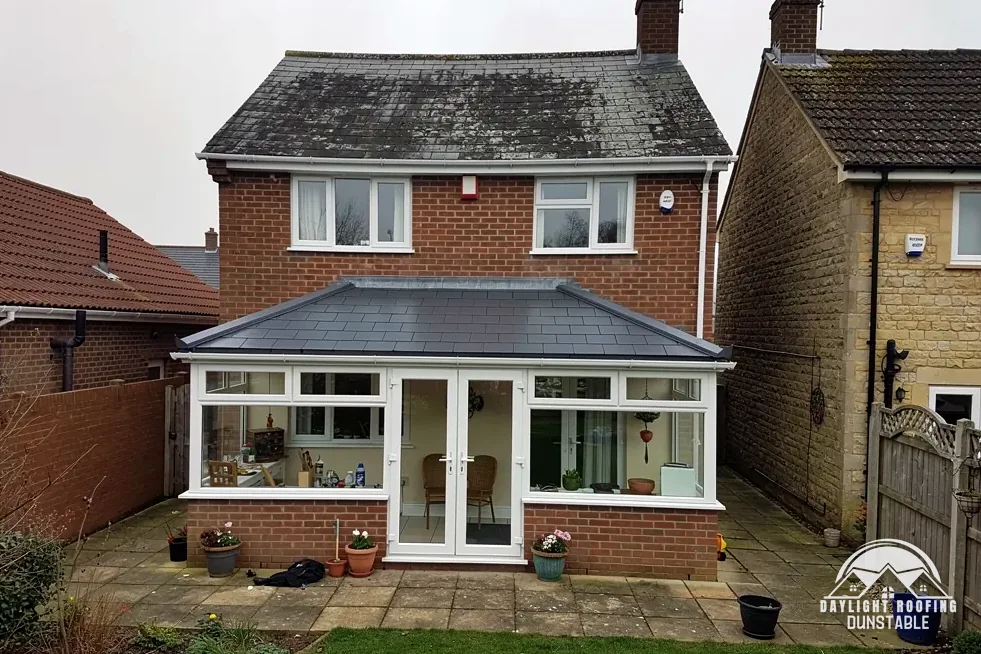
Lean-to conservatory with a new solid slate-effect roof Brick house with a new grey tiled conservatory roof

Slip End roofing terms

Strip-back
Removing the old covering down to the rafters before the new one goes on.
Flashing kit
The metal pieces supplied with a roof window to seal it into the covering.
Reveal
The inside edge of a window opening, where wall or ceiling meets the frame.
Ceiling joist
The timber that carries a ceiling and the loft floor above it.

The plain-as-day roof check

Four Slip End roof topics, from the strip-back to the ceiling

4 checks about 3 minutes to read

  1. What a re-roof strips back to
  2. Roof windows set into the slope
  3. Aerials, dishes and other fixings
  4. The ceiling below the roof

01 What a re-roof strips back to

On a re-roof the old covering is stripped right back to the rafters, leaving every timber in plain view for checking. Battens are replaced or checked, underlay is laid, and the new covering is fixed to BS 5534:2014+A2:2018, the current code. Marley says following that code "isn't required by law", yet it also says the 2015 amendments made it clear that mortar "could no longer be relied upon as the only means of securing the roof covering". The tiles and the fixings are therefore chosen together, and an old roof's nail holes tell their own story about how long it has been up.

A whole new covering touches more than 50% of the roof, and the Planning Portal says "In most situations, this work will need Building Regulations approval." It also names a trigger: "You use a new covering material which increases the weight of the roof covering by 15 per cent or more." For that case the Portal advises that you "check with a structural engineer or surveyor before commencing with works". Which covering suits the existing rafters is a question the strip-back answers, so the choice is confirmed with the timbers in view.

02 Roof windows set into the slope

A roof window sits in the plane of the slope, framed by a flashing kit that seals it into the covering. The weak points are the flashing along the sides, the seal around the glass and the reveal inside. Look for ring-shaped stains on the lining, peeling paint beside the frame, or misted glass between panes. MyJobQuote's page of 22 September 2026 says: "Average cost for a standard mid-range Velux window is £1,100."

The same page adds: "Velux window replacement costs around £100 less for a straightforward swap, as the opening is already in place." Those are MyJobQuote's averages for one window and not our price. A new opening cut into a slope is more work than a straight swap, because rafters are trimmed and the covering is cut around the frame. The skylights and roof windows page covers both kinds of work, and the council is asked about any opening that alters the roof's shape. For a window cut into a side slope, read the planning guide before anything else is decided.

03 Aerials, dishes and other fixings

Anything bolted through the covering is a potential entry for water: a satellite dish bracket, an aerial mast, a washing-line post or a sign. Look for a bracket that has loosened, a tile that has cracked where a bolt passes through, or a stain on the underlay beneath the fixing. The hole made by a fixing is small, so a leak from it can run for a long time before it shows indoors, and the damp can travel along a rafter first, which makes the leak hard to place from indoors.

A fixing should go into a rafter and be sealed with a purpose-made flashing, and a dish or mast that is no longer used is a candidate for removal, with the hole made good. Tiles around the fixing should be checked for cracks, and a cracked one replaced before the bracket is reused. A photograph shot from the garden through a zoom, showing the bracket and the tiles around it, lets the problem be understood before anyone has to climb up and look at it.

04 The ceiling below the roof

Ceilings tell the story of the roof above. A brown ring with a darker edge points to a slow leak. A sagging or bulging patch means plaster is holding water, and that is a risk to people below. Cracks that follow the line of a joist suggest movement, and a pattern of small dark spots can be mould from condensation. Trace the outline of a stain in pencil and note the date, so that any growth shows up on the next look.

A ceiling that is bulging with water should not be left alone for long, because the plaster can come down without warning. Keep clear of the area, put a bucket beneath it and, only if it is safe, make a small hole at the lowest point so the water drains in a controlled way. Photograph the stain before and after. The survey of the roof surface then looks for where the water enters, which may be some distance from the stain along a rafter or a pipe.

The dashed ring takes in the nearest towns and villages we cover around Slip End. Map tiles © Esri; map data © OpenStreetMap contributors.

Slip End roof questions, church to loft

01How safely can a Slip End owner look in the loft after a leak?

Switch on the loft light or take a bright torch, and step only on the joists or on a board laid across them, never on the plasterboard between. Look for drips, darkened timber, damp insulation and daylight where none should be. If the loft floor is not boarded, take photographs from the hatch and send them through WhatsApp. If a ceiling below is bulging, stay out of that room until the water has been dealt with, and phone before anything is moved or switched on.

02Who decides about work to St Andrew's church roof?

St Andrew is a Church of England church, listed Grade II (list entry 1114661, first listed 26 September 1980). A church in use within "the faculty jurisdiction of the Church of England" is governed by the faculty system and not by listed building consent, so no consent application goes to the council for the church itself. Where roof covering is renewed like for like, a notice in writing issued by the archdeacon may then be enough on its own. Where the outside changes, planning permission may be a further requirement under the ordinary tests, which sit apart from the faculty.

03Do conservation areas close to Slip End affect a village house?

Conservation areas lie close to Slip End, including Caddington and Markyate. "Close to" is as far as that goes for any address here, and Central Bedfordshire Council confirms whether a house falls inside one. An Article 4 direction can remove further permitted development rights, so we check with the council first. Where an area does apply, the council's guidance says permitted development rights are stricter for properties within conservation areas. Request the council's answer as a letter or email and place it with the quote.

04Who arranges scaffold licences in Slip End?

Section 169 of the Highways Act 1980 makes it an offence to leave scaffolding obstructing a road or pavement when the highway authority has not licensed it. In Slip End that body is Central Bedfordshire Council. Stated plainly, our part is that we arrange the licence with our scaffolder. Scaffold hire sits within the written quote, so one sum covers the lot. A narrow lane or a parked-car problem is raised in the application. A scaffold set wholly inside the owner's boundary is a question for the council, not an assumption.

05Does re-roofing a Slip End house need Building Regulations approval?

The Planning Portal's test is that no application is normally needed when "Less than 25 per cent of the total 'building envelope'" and "Less than 50 per cent of the roof is affected". A whole-roof job is beyond the second figure, so the starting position is that an application is made. Central Bedfordshire Council's building control team is on 0300 300 8635, a number for building control only. Where the work complies, the council issues a completion certificate, which belongs with the house papers for any future sale.

06How do weight and fire performance affect a new covering in Slip End?

The Planning Portal gives two triggers for approval: a new covering that "increases the weight of the roof covering by 15 per cent or more", and one whose performance in a fire will be "significantly different" from the existing covering. Approved Document A puts it as "A significant change in roof loading is when the loading upon the roof is increased by more than 15%." Before work, a structural engineer or surveyor is asked. No material is assumed to be heavier or lighter than another.

07How much is a roof window swap in Slip End?

MyJobQuote (page dated 22 September 2026) gives £1,100 as the average it lists for a standard Velux in the mid range, and a straightforward swap around £100 cheaper since the hole already exists. Those are published averages for a single window, from one website, and say little about a particular slope. A new opening, a larger unit or an awkward slope changes the work, and a roof window in a conservation area may need the council's view. Our own figure follows our survey of that Slip End roof and is set down as a single written total, which can sit higher or lower than any published average for one window.

08When does a party wall notice apply to Slip End work near a boundary?

The Party Wall etc. Act 1996 requires a building owner to serve notice "at least one month before he intends the building work to start" for a new wall on the boundary or nearby excavation. Where a chimney breast on a party wall is to be cut away, the Act wants notice "served at least two months before the date on which the proposed work will begin". A silent neighbour is treated as dissenting, and a surveyor then settles it, with the neighbour's dissent leading to that procedure and never to a veto. Building control does not handle party wall disputes, and nor does a roofer.

09What can a Slip End owner do if an insurer disputes storm damage?

The Financial Ombudsman Service says "Rain, hail or snowfall by itself can constitute a storm", and that it will "usually look at expert reports and photos". Photograph the damage before it is disturbed, and tell the insurer. If a final response is unwelcome, a limit of 6 months applies, counted "from the date on the final response". The ombudsman's number is 0800 023 4567. Keep the photographs, any report and the insurer's letters together, because each is evidence if the case goes further, and note the dates on which each was received or sent.

Get a written price for your roof

10-year workmanship guarantee, in writing

Tell us about your roof

Call WhatsApp Written quote