
Call 01582 935272

Great Gaddesden · 9 road miles south

Roofers in Great Gaddesden

Roof repairs, new roofs and leadwork in Great Gaddesden, a Hertfordshire village 8.8 road miles south of Dunstable, where each job is described in full and then priced as a single sum, written down, once the roof has been seen.

Get a written quote

Call 01582 935272WhatsApp us

Council
Dacorum Borough
Road miles
9
Conservation area
Great Gaddesden Conservation Area
Building control
Check with the council

Roofs round Church Farm and Glebe House

Great Gaddesden lies south of Dunstable, 8.8 road miles away and about 15 minutes by road. At the 2021 Census, Great Gaddesden parish had 991 usual residents. The conservation areas of Great Gaddesden, Nettleden and Water End, all designated by Dacorum Borough Council, lie in and round the village. A roof here can sit near a listed farm building or inside one of those areas, and the first question is which protection, if any, covers the address.

The village is inside the Chilterns National Landscape. Dacorum Borough Council still receives the planning applications, and the Chilterns Conservation Board advises and responds to consultations. The planning guide deals with the permitted development rules, and a chimney stack on a listed or conservation-area house is a question for the council before the stack is touched. For anything else on the roof, the survey describes what is there in plain words, one part at a time, so the choice between repair and replacement rests on facts.

  1. 01Parish church of St JohnListed Grade I, National Heritage List entry 1101262, first listed on 26 January 1967; a Church of England church.
  2. 02Church Farmhouse and StablesListed Grade II*, National Heritage List entry 1173686, first listed on 26 January 1967, so roof work affecting its character needs consent.
  3. 03Eastern Barn, Church FarmListed Grade II*, National Heritage List entry 1296091, first listed on 21 February 1978, a barn south-east of the parish church.
  4. 04Glebe HouseListed Grade II*, National Heritage List entry 1173673, where listed building consent is asked about before a roof is touched.
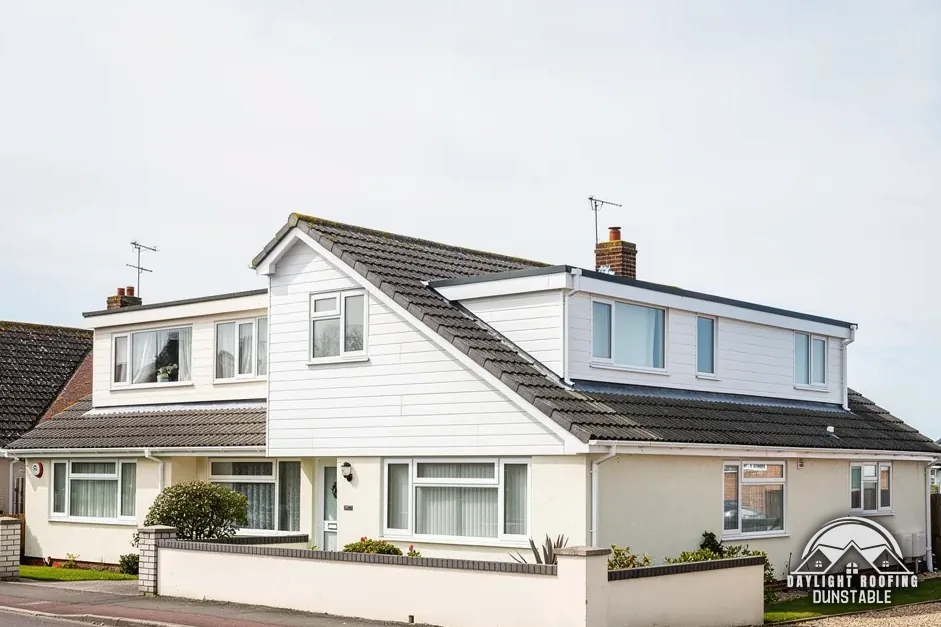
A pair of chalet bungalows with flat-roofed box dormers

Gaddesden words, simply put

Grade II*
The listing grade that sits between Grade I and Grade II.
Wall plate
The timber bedded along the wall head, carrying the feet of the rafters.
Hopper head
The funnel on a downpipe's upper end, taking the flow from a gutter outlet.
Conservation area
A designated area where outside changes meet extra planning control.

The plain-as-day roof check

Four checks, from Water End to Nettleden

4 checks about 3 minutes to read

  1. Rafter feet at the eaves
  2. Hopper heads and downpipes
  3. Lead on a porch or bay roof
  4. Condensation marks in the loft

01 Rafter feet at the eaves

Rafters rest on a timber wall plate along the wall head, and the lower ends, the rafter feet, sit under the eaves where a leaking gutter can reach them. Look along the eaves from a ladder-free spot for a gutter that sags or spills, and for dark staining on the fascia or the wall just below. Timber that has stayed wet softens, and a screwdriver pushed lightly into a soft board gives it away.

Replacing a rotten rafter foot is structural carpentry. It can mean lifting part of the covering to reach the timber, so the repair is judged from a survey and not from the ground. The gutters, soffits and fascias page covers the roofline, and the fascia boards that hide the rafter ends belong to the same detail. A gutter that has been spilling for a while can be the cause, so look at the board directly behind it.

02 Hopper heads and downpipes

A hopper head is the funnel where a gutter outlet or a waste pipe empties into the top of a downpipe. Check that it is not full of leaves, that the joint to the downpipe is tight, and that no green line runs down the wall below it. A downpipe that has parted at a joint pours water against the brickwork instead of into the drain.

Brett Martin's figure for gutter fall is 1 mm for every 600 mm towards the outlet, so a long run has its brackets set to a slope, never level. A gutter that holds a puddle is either blocked or sitting out of fall. Look at the run just after rain, when a standing pool shows plainly, and note where the water stands so the survey can go straight to the right bracket. Cast iron, aluminium and plastic all follow the same rule about fall.

03 Lead on a porch or bay roof

Little roofs over a porch or a bay window can be covered in lead sheet, and the seams, plus the joint where the lead meets the main wall, are the weak spots. Look for a split along a seam, a roll of lead that has lifted, or a brown mark on the ceiling beneath the bay. Warming and cooling make the sheet shift, and fixings set too tight crack it. A dull grey surface is normal for old lead; a hairline split is not.

Lead sheet comes in codes 3 to 8 to BS EN 12588, and Calder gives code 4 as 1.80 mm. The code is chosen detail by detail in the specification, so a small bay and a long valley need not use the same weight. The lead roofing and leadwork page sets out the work.

04 Condensation marks in the loft

Water vapour from kitchens and bathrooms drifts up into the loft, and where it meets cold felt or timber it condenses. Black mould spots, dampness on the felt's underside or beads of water on a nail tip show it happening. That differs from a leak, because the moisture comes from inside the house instead of through a hole in the covering. A loft that smells of damp after a dry spell points the same way, and so does a hatch that drips when opened on a cold morning.

Ventilation at the eaves carries moist air out. For a cold roof whose underlay is the HR type, Marley's figure is 25 mm of eaves ventilation at 15 degrees pitch or less and 10 mm above 15 degrees, and HR underlay is not vapour-permeable. Loft insulation pushed hard into the eaves blocks that gap. Sending a photograph on WhatsApp gets a leak-or-condensation question answered sooner, and the survey then sorts out the rest.

The dashed ring takes in the nearest towns and villages we cover around Great Gaddesden. Map tiles © Esri; map data © OpenStreetMap contributors.

Questions about roofs in Great Gaddesden

01What does a rotten fascia say about the rafter feet behind it in Great Gaddesden?

A fascia board that has gone soft shows that water has been sitting at the eaves, and the rafter ends sit directly behind it. The survey checks the board, the soffit beneath, the gutter above and the timber at the top of the wall, then tells you plainly what it found, including anything else on the roof. A rafter foot that has rotted needs replacing or strengthening, and that work is priced within the single written figure after the survey has seen it. A photograph of the stained board is a useful start before the visit, and so is a note of where the stain sits in relation to the nearest downpipe.

02Do the Great Gaddesden, Nettleden and Water End conservation areas change roof work?

Dacorum Borough Council designated the Great Gaddesden, Nettleden and Water End conservation areas. For a house near any of the three, a call to Dacorum Borough Council about the exact address comes before the work is planned, because closeness alone does not settle which controls apply. An Article 4 direction can remove further permitted development rights, so we check with the council first. Only Dacorum Borough Council can say whether your address falls inside a boundary. Our pitched roofing page explains how a tiled slope is stripped and re-covered.

03How does the faculty system apply to the roof of St John the Baptist church?

St John the Baptist church (list entry 1101262, Grade I) belongs to the Church of England, so approval for building work follows the faculty system and not listed building consent. Within that system, putting back roof covering of the same sort needs just the archdeacon's written notice. The exemption covers church buildings in "the faculty jurisdiction of the Church of England". It does not remove planning questions for exterior work, which can still arise where the ordinary tests apply. A house near the church is for the council; the church roof itself is a faculty matter.

04Does a roof on Church Farmhouse or the Eastern Barn need listed building consent?

Church Farmhouse and Stables carries Grade II* status (list entry 1173686), and so does the Eastern Barn at Church Farm, 50 Metres South East of Parish Church (list entry 1296091). The legal test is whether works would affect the building "in any manner which would affect its character as a building of special architectural or historic interest". If they would, listed building consent is required. Whether a given repair has that effect is a question for Dacorum Borough Council, because a few replaced tiles and a full re-cover may land either side of that line.

05Who pays for scaffold licences on a Great Gaddesden road?

Hertfordshire County Council is the highway authority for Great Gaddesden, and a scaffold that stands on the footway or in the lane needs its licence. Hertfordshire County Council's fee is £134 for 14 days plus £59 for each further week, with pedestrians left a clear walkway of 1.2 m, and it says: "It usually takes 3 weeks to process an application." We arrange it with our scaffolder. Any scaffold the job needs is carried within the one written total, and a drive or garden wide enough for the tower can sidestep the licence altogether.

06Which Planning Portal tests decide whether a re-roof in Great Gaddesden needs Building Regulations approval?

The Planning Portal quotes two limits: "Less than 25 per cent of the total 'building envelope'" and "Less than 50 per cent of the roof is affected". A small repair that stays inside both does not normally need an application. Replacing the whole covering passes the roof limit, so Building Regulations approval is needed. For the route in Great Gaddesden, check with Dacorum Borough Council's building control team. The Portal adds that a covering 15 per cent or more heavier needs approval, with advice to consult a structural engineer or surveyor before starting, because the rafters were sized for the old covering.

07Could a Great Gaddesden roof or soffit contain asbestos?

HSE says: "If the building was built or refurbished before 2000, assume that there is asbestos in it." Roof sheets made of asbestos cement can be taken off whole, with care, as non-licensed work, and cement that has been broken up is notifiable non-licensed work. On asbestos insulating board, most work is licensed, and HSE names white soffit panels under roof eaves as one place the board turns up. Use a lockable skip for asbestos. Do not drill, scrub or break a board you suspect, and send a photograph of it so it can be looked at before anyone touches the eaves.

08Who judges a re-roof in Great Gaddesden's Chilterns setting?

Planning applications go to Dacorum Borough Council, and the Chilterns Conservation Board gives advice and answers consultations without ruling on anything. In the Board's roofing note, plain clay tiles are "universally predominant" on the Chilterns' traditional buildings, while its flint note says flint "is often combined with brick" in older buildings and boundary walls. Both are design notes, not a rule for your roof. Dormers and other roof enlargements follow separate rules in a National Landscape, which the planning guide covers in one place, so that detail is left there.

09How much slope does a flat porch roof in Great Gaddesden need?

Flat roofs are not flat. NFRC gives a minimum 1:80 finished fall for general roof areas and internal gutters under BS 6229:2025, and under the same code IKO reports 1:40 as the fall to design for. BS 6229:2025 covers continuously supported flexible membranes, not lead. A porch roof that holds a puddle for days after rain has lost its fall or has a blocked outlet, and the membrane edges and the upstand against the house wall are worth a look at the same time. Whether a patch, a new membrane or a pitched replacement suits the porch is settled at the survey, which also gives the figure for the work.

Get a written price for your roof

10-year workmanship guarantee, in writing

Tell us about your roof

Call WhatsApp Written quote