
Call 01582 935272

Kensworth · 4 road miles south

Roofers in Kensworth

Kensworth sits 4.3 road miles south of Dunstable, inside the Chilterns National Landscape. We survey its roofs and give each one a written price, as a single total.

Get a written quote

Call 01582 935272WhatsApp us

Council
Central Bedfordshire
Road miles
4
Building control
Central Bedfordshire

Kensworth roofs, inside the Chilterns landscape

Kensworth is 4.3 road miles south of Dunstable and takes about 8 minutes by road. Kensworth sits within the Chilterns National Landscape. At the 2021 Census, Kensworth parish had 1,517 usual residents. Holly Trees, Grove Farmhouse and Old Grove Farmhouse are listed Grade II. Several conservation areas lie close to Kensworth, among them Kensworth Church End, Kensworth Lynch and Markyate, and Central Bedfordshire Council confirms where any particular address stands.

Applications for Kensworth go to Central Bedfordshire Council. The Board that looks after the Chilterns landscape offers advice when asked, and decisions are not its to take. Our planning guide sets out the national rules, including what a National Landscape changes. The pitched roofing page describes how a tiled slope is built, and each job starts with a survey and ends with a written total as one sum, and anything else spotted on the roof is said plainly.

  1. 01Holly TreesListed Grade II, list entry 1321302, first listed 26 September 1980. A roof job there is raised with the council first.
  2. 02Grove FarmhouseListed Grade II, list entry 1114722, first listed 26 September 1980, so listed building rules sit alongside planning.
  3. 03Old Grove FarmhouseListed Grade II, list entry 1114721. The council weighs any roof repair there against the building's character.
  4. 04Chilterns National LandscapeKensworth lies inside it. Applications go to the council; the Chilterns Conservation Board is consulted.
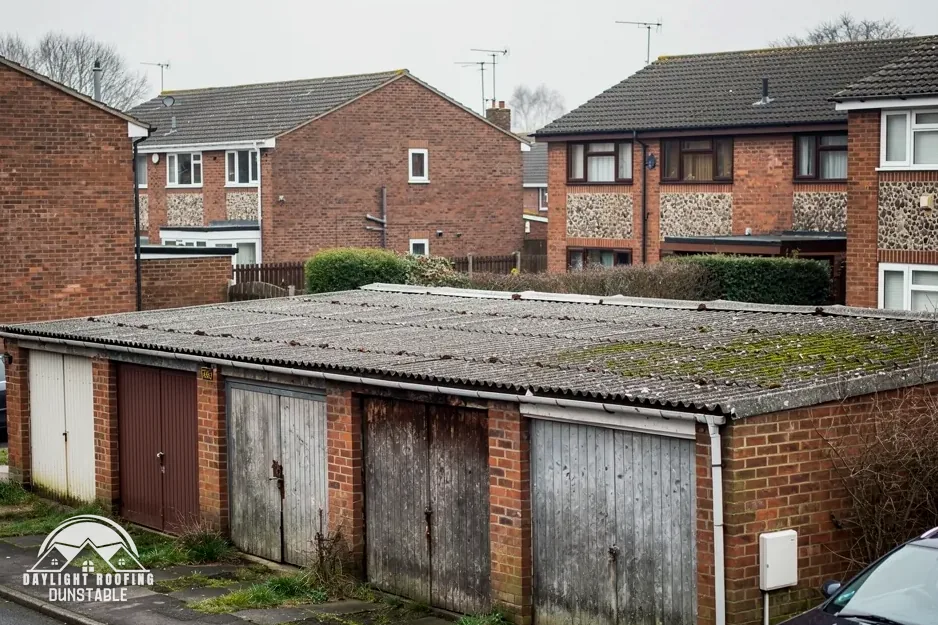
A row of brick garages with an old flat roof behind houses

Kensworth tiled-roof words

Plain tile
A small flat tile, hung in overlapping courses up the slope.
Dry verge
A gable-end edge secured mechanically, with no mortar bed beneath.
Consultee
A body asked for its views on an application, without power to decide it.
Gable
The triangle of end wall that follows the two roof slopes up to the ridge.

The plain-as-day roof check

Four checks for a Kensworth roof, from tiles to verge

4 checks about 4 minutes to read

  1. Plain clay tiles
  2. Verges and gable ends
  3. Slipped tiles and the battens
  4. Pitch against the tile

01 Plain clay tiles

In the roofing note of the Chilterns Conservation Board, plain clay tiles are "universally predominant" on the Chilterns' traditional buildings, which is design guidance for the landscape and no count of Kensworth's roofs. A clay tile that is sound rings when tapped and sheds water; one with a crack, a chipped nib or a flaked face does neither. Binoculars from the road show the pattern of a failing slope, with tiles lighter or darker than their neighbours.

Lifespan figures come with their sources. Marley reports that the BRE determined a minimum life expectancy of 60 years for clay roof tiles, and HomeBuilding gives clay tiles 60-80 years. Those are approximate figures for the material, and the battens and fixings beneath decide what a given roof has left. A tile that has come adrift is worth a photograph before anyone moves it. Moss and lichen can sit on a sound tile. Marley says high-powered jet washing "is not recommended as it can damage the surface of the slate or tile, thus reducing its expected life considerably", so look for cracks before booking a clean.

02 Verges and gable ends

At a gable end the roof covering stops at the verge, the exposed edge, and the verge takes the full push of the wind. Look for edge tiles that have shifted, a mortar line with gaps in it, or a bargeboard that has come away from the wall. A failed verge lets water in behind the last tiles of the slope, and that is where the timber behind begins to rot.

BS 8612:2018 is the specification covering dry-fixed systems at the ridge, hip and verge, which hold the tiles mechanically rather than on a bed of mortar. MyJobQuote says a dry verge usually falls between £500 and £2,000, a figure from its page last updated 8 October 2026. Where in that range a particular roof lands depends on how long the verge is and how easy the access is, and a written total after the survey puts one sum in place of the range. The underside of a verge is hidden behind the bargeboard, so staining is easiest to find on the gable wall: a damp stripe running down from the roof edge, or paint blistering near the top of the wall. Photograph it in dry light.

03 Slipped tiles and the battens

A tile drops out of its course when the nail or clip holding it has failed, or when the batten beneath has split. From the garden, a tile hanging low or a gap in a row is plain to see. Which? Trusted Traders priced one to six tiles that are cracked or gone at £75 to £400, excluding VAT (November 2025). MyJobQuote gives an average of around £215 for replacing roof tiles, on a page dated 6 October 2026.

The cause matters more than the gap. One slipped tile after a gusty night is a small repair. A run of them in one patch points to batten rot or fixings that have failed across the whole area, and the roof repairs page explains how the two cases are told apart. Nobody should stack fallen tiles back loose on the roof, because a loose tile slides. Battens are timber laths, and once their nail holes enlarge the tiles lose their grip. In the loft, with a torch, look at the batten faces behind a patch of slipped tiles for dark, soft or split timber. A fingernail that sinks into a batten is a finding worth reporting, and the repair then covers the whole patch.

04 Pitch against the tile

Every tile has a minimum pitch below which water can blow or creep up the slope. Marley lists 35 degrees for its clay Ashdowne tile, 30 degrees for the Hawkins, 40 degrees for the Canterbury and 15 degrees for the Lincoln pantile. Canterbury and Lincoln are product names, not places. A re-roof that changes the tile has to suit the pitch already there, because the roof timbers cannot simply be bent to fit the tile.

Cupa, the slate maker, reports that BS 5534 "indicates" a minimum of 20 degrees for natural slate in moderate exposure with a 500 mm slate and a 115 mm overlap, and that "hook fixings should not be used on any pitch below 25º". Fixings are calculated for the site's exposure, under a site-specific fixing specification. A survey measures the pitch, and the choice of covering follows from that figure. Where a loft room sits under the slope, the same measurement decides which tile can be laid. A lower pitch on an extension beside the main slope may call for a different tile from the house, which is why the pitch is measured slope by slope and never assumed from the main roof.

The dashed ring takes in the nearest towns and villages we cover around Kensworth. Map tiles © Esri; map data © OpenStreetMap contributors.

Kensworth roof questions, answered in order

01How can a Kensworth owner tell a failing clay tile from one that is merely stained?

Staining on its own tells little, because lichen and weathering darken a sound tile. What matters is whether the tile still sits tight in its course, rings when tapped from below in the loft, and keeps an intact face and nibs. Tiles that have shed their surface in layers are on their way out, and so are tiles with cracks across the width. Photograph a few from the lawn with a zoom lens and send them through WhatsApp for us to view. The survey then covers the rest of the slope, and anything else seen is reported alongside, so the written total reflects the whole roof.

02Is Kensworth inside the Chilterns National Landscape, and who decides?

Kensworth lies inside the Chilterns National Landscape. Applications are still decided by Central Bedfordshire Council, as the local council. The Chilterns Conservation Board responds when it is consulted and gives its advice, and it grants or refuses nothing. A dormer is treated differently from a straightforward re-cover, and the planning guide covers both in one place, so it is the page to read before any change to the shape of the roof. Ask the council about a specific address, because a general answer cannot settle one house.

03What do the Board's notes say about roofing tiles and flint?

The Chilterns Conservation Board's roofing note calls plain clay tiles "universally predominant" on the Chilterns' traditional buildings. Its flint note, dated 2003, says flint "is often combined with brick" and mentions older buildings and boundary walls. These notes are design guidance for the Chilterns. They describe what the landscape's traditional buildings look like, and neither is a rule the council applies to a particular roof. We do not lay flint or thatch, so the notes are mentioned here for context only, and a flint wall repair is a job for another trade.

04Which Kensworth buildings are listed, and what does listing change?

Holly Trees (list entry 1321302), Grove Farmhouse (entry 1114722) and Old Grove Farmhouse (entry 1114721) are each listed Grade II. Listed building consent is needed for works "in any manner which would affect its character as a building of special architectural or historic interest", so a roof repair is raised with Central Bedfordshire Council, which asks what it does to the building's character. A house standing beside a listed one does not become listed through the neighbour, and its own entry on the national list decides, which an owner can search before asking anyone to price work.

05Do the conservation areas near Kensworth cover a village house?

Conservation areas lie close to Kensworth, including Kensworth Church End, Kensworth Lynch, Studham, Whipsnade and Markyate. Nothing firmer than close to can be said of any one house, and Central Bedfordshire Council confirms for an address whether it falls inside one. An Article 4 direction can remove further permitted development rights, so we check with the council first. A house outside every conservation area still lies inside the National Landscape, so the council is asked about both when a roof is more than a like-for-like repair, and its answers are worth keeping in writing.

06Who obtains the scaffold licence for a Kensworth roof?

Whenever scaffolding would block a road or pavement, section 169 of the Highways Act 1980 requires the highway authority's licence. For Kensworth's roads the authority is the council itself, and we arrange the licence with our scaffolder. The scaffold sits within the written total. Poles standing wholly within the owner's drive are a different question for the council, and a tower on the verge is not that. Nobody should put poles up on a pavement before the licence exists, and the council can say how long it needs.

07Is a full re-roof in Kensworth a Building Regulations matter?

The Planning Portal's guide treats re-roofing as not normally needing an application only when "Less than 25 per cent of the total 'building envelope'" is affected and "Less than 50 per cent of the roof is affected". Re-covering the whole roof exceeds the second figure, and the Portal's main page says "In most situations, this work will need Building Regulations approval." Central Bedfordshire Council's own building control team is on 0300 300 8635, for building control, not planning. Once the work complies, the council issues its completion certificate.

08Does spray foam under a Kensworth roof affect a mortgage?

RICS reported "concern within specific sectors of the lending market" in March 2023. DESNZ, in guidance published on 22 October 2026, says "Many mortgage providers are open to lending on properties with spray foam, subject to their own requirements." Removal "will not always guarantee that they will still lend", so a specialist surveyor's advice comes first. The Energy Saving Trust adds that foam "doesn't automatically prevent you from getting a mortgage, but some lenders may ask for extra checks". The lender's own policy is the document to read.

09What does a whole new roof on a Kensworth house cost?

For a full roof replacement on an average three-bedroom house, Which? Trusted Traders gave £7,000 to £21,000 before VAT, drawing on 11 traders surveyed in November 2025. HomeBuilding (last updated 30 September 2025) writes "a standard three-bedroom semi with a 65m² roof and plain concrete tiles may cost between £10,000 and £15,000". Those are other people's ranges and not ours. Our figure arrives once the survey is done, as one written total, and the roof replacement page explains what a re-cover involves.

Get a written price for your roof

10-year workmanship guarantee, in writing

Tell us about your roof

Call WhatsApp Written quote