
Call 01582 935272

Dagnall · 4 road miles south-west

Roofers in Dagnall

Clay tile pitches, wall junctions, valleys and hips for Dagnall houses, each ending in one written figure after the survey. Dagnall is 4.4 road miles south-west of Dunstable.

Get a written quote

Call 01582 935272WhatsApp us

Council
Buckinghamshire
Road miles
4
Building control
Buckinghamshire Council

Roofs under the Chilterns edge by All Saints

Dagnall lies in Edlesborough parish, which had 2,952 usual residents at the 2021 Census. It sits inside the Chilterns National Landscape. The parish church of All Saints holds a Grade II listing (National Heritage List entry 1319212). Holly Frindle Bungalow (entry 1321291) is listed Grade II*, and Cross Keys Farmhouse (entry 1117911) and The Gatehouse (entry 1117905) are listed Grade II. Conservation areas at Little Gaddesden, Ringshall and Whipsnade lie close to Dagnall. A listed home keeps its permitted development rights for roof work, but listed building consent is needed for anything affecting its character.

Buckinghamshire Council takes the planning applications for Dagnall and runs its own building control service; contact details are on its building control page. Inside the Chilterns, the Conservation Board advises and answers consultations, and the council makes the decision. The planning guide holds the roof tests that apply here. See pitched roofing for clay tile work and roof repairs for small jobs.

  1. 01All Saints churchA Grade II listed Church of England church (entry 1319212), so roof work is handled through the faculty system.
  2. 02Holly Frindle BungalowListed Grade II* (entry 1321291): any change affecting its character needs listed building consent before work starts.
  3. 03Cross Keys FarmhouseA Grade II listed home (entry 1117911) that keeps permitted development rights but not freedom over its character.
  4. 04The GatehouseListed Grade II (entry 1117905); roof alterations are a question for Buckinghamshire Council.
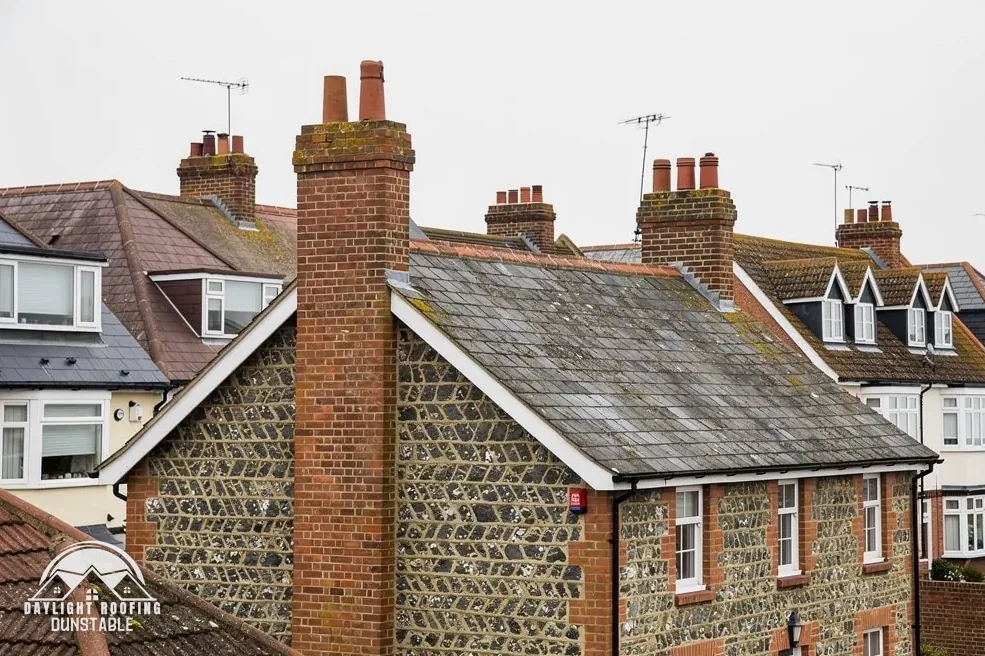
A flint and brick cottage with a grey slate roof

The roof, in plain words

Plain tile
A small flat clay tile, laid in overlapping rows with a curve across the slope.
Hip tile
A tile that caps the outward sloping corner where two roof planes meet.
National Landscape
A protected area of countryside, formerly called an AONB.
Abutment
The line where a roof meets a taller wall.

The plain-as-day roof check

Four things a Dagnall clay tile roof needs checked

4 checks about 3 minutes to read

  1. Clay tiles and their pitch
  2. Where flint and brick meet the roof
  3. Valleys and hips in clay
  4. Moss and washing a clay roof

01 Clay tiles and their pitch

The Chilterns Conservation Board's roofing note calls plain clay tiles "universally predominant" on the Chilterns' traditional buildings. That is design guidance for the Chilterns, and it does not tell you what any one house has on its roof. Marley publishes minimum pitches for its clay products: Canterbury 40 degrees, Ashdowne 35, Hawkins 30, Acme Single Camber 30 and the Lincoln pantile 15. Those names belong to products and not to places, and each figure is that tile's own floor.

A clay tile roof shallower than its product allows can leak in driving rain, however good the tile. Marley says the BRE determined a minimum life expectancy of 60 years for clay roof tiles, and HomeBuilding gives clay 60-80 years. After that long, the fixings and battens behind a tile can be the weak point, not the clay, so the survey looks at the nail heads, the batten ends and the felt as well as at the tile faces, and lifts a few tiles to see what lies beneath.

02 Where flint and brick meet the roof

The Chilterns Conservation Board's flint note says flint "is often combined with brick" in the walls of older buildings and in boundary walls. Where a roof meets a flint and brick wall, the join is an abutment, sealed with a flashing let into the wall or fixed over it. Look for lifted lead, gaps in the pointing above it, and damp on the inside face of the wall, which is where a failed abutment can show.

Old pointing in a flint wall is delicate, and a flashing chased into a wall disturbs it. MyJobQuote says correctly installed lead flashing can last for over 80 years. If a flashing has failed early, the cause may be movement in the wall or a gap in the pointing above it. We survey the roof and where it meets the wall, and a repair to the wall itself is for a specialist in that work. Photographs of the line where roof meets wall, taken from the garden and from the loft, help any roofer see what is happening.

03 Valleys and hips in clay

A valley between two clay-tile slopes carries both runs of water, and a hip carries the wind from two sides. Both are places where tiles have to be cut and fixed with care. Look along the valley for debris and cracked cut tiles, and along the hip for tiles that have shifted. A hip tile out of line leaves the felt bare for the length of the tile.

Marley says that "In all cases, ridge or hip tiles should be mechanically fixed to resist the calculated wind uplift force." A dry-fixed hip, made to BS 8612:2018, uses clips and screws. No figure for hips appears in either guide, and a ridge price cannot stand in for one, so hip work waits for the survey. MyJobQuote gives an average of £225 to £550 for replacing ridge tiles (page dated 1 October 2026), a figure for ridges only, which should not be read across to the hips.

04 Moss and washing a clay roof

Moss and lichen settle on shaded clay slopes, especially under trees. Marley says that "The use of high powered jet washes is not recommended as it can damage the surface of the slate or tile, thus reducing its expected life considerably". A soft treatment, applied from a safe position, is a gentler route, and a roof that is already cracked may not tolerate cleaning at all, because water forced under a tile in washing reaches the felt. A moss-covered slope that holds water behind the tiles is worth a survey before any washing.

Across the UK, Checkatrade says roof cleaning typically costs £8.50 to £14 per m², in a guide dated April 2026 that states no VAT basis. Being a rate per square metre, it gives no total until the roof has been measured, and a steep or awkward roof can change how the cleaning is done. A survey says whether cleaning is sensible or whether tiles need replacing, and trimming an overhanging branch reduces the shade that lets moss take hold again in the following winter.

The dashed ring takes in the nearest towns and villages we cover around Dagnall. Map tiles © Esri; map data © OpenStreetMap contributors.

Dagnall roofs, the Chilterns edge and the paperwork

01What minimum pitch does a clay tile need on a Dagnall house?

It depends on the product. Marley's minimum for its Canterbury clay tile is 40 degrees. Its Ashdowne is 35, its Hawkins and its Acme Single Camber are both 30, and the Lincoln clay pantile goes down to 15 degrees. Canterbury is a Marley tile product, not a place. A roof below the figure for its tile can leak in wind-driven rain, and sealant on the laps will not cure it. The survey takes the pitch of each slope, and the choice of tile follows from that figure, since a lean-to may need a different tile from the main roof.

02What does the Chilterns Conservation Board's roofing note say about tiles?

The Chilterns Conservation Board's roofing note, written in 2007, calls plain clay tiles "universally predominant" on the Chilterns' traditional buildings. That is design guidance for the whole area, and it does not say what roof any given house has, which only a look at the roof can show. Dagnall is inside the Chilterns National Landscape. The Board advises on design, and the choice of covering for a house is settled with Buckinghamshire Council where permission is involved, so ask the council about your own address before tiles are ordered.

03Who decides planning for a Dagnall roof: the Chilterns Board or the council?

Buckinghamshire Council decides. Inside the Chilterns National Landscape the planning application still goes to the local council. The Chilterns Conservation Board is a consultee: it gives advice, and the grant or refusal is not its to make. The roof tests that apply in the Chilterns sit in the planning guide, which is the place to read them. Ask the council about your own address before any work is priced, and keep its reply, so the answer is on paper if the house is later sold.

04What does the flint note say about older walls near Dagnall?

In its flint note of May 2003, the Chilterns Conservation Board says that flint "is often combined with brick" in the walls of older buildings and in boundary walls. For a roofer, that matters at the abutment, where a flashing meets such a wall and has to be fixed without disturbing the pointing. We survey the roof and the junction and say what the flashing needs. A flint repair is a specialist wall job, and the survey describes where the roof ends and the wall begins, so the right trade can be asked to quote for each part, with the roof side and the wall side described separately.

05What does Buckinghamshire Council's scaffold licence mean for a Dagnall lane?

Buckinghamshire Council is the highway authority. Buckinghamshire Council's page gives £402.78 for a scaffolding licence valid for 28 days, with renewal at £69.09 and a retrospective licence at £777.63. Buckinghamshire Council also says: "You must be a registered scaffolding company to apply for a licence." We arrange the licence with our scaffolder, so the application and the dates go with the job. A lane with parked cars or a narrow verge in Dagnall is worth mentioning at the survey, because the position of the poles and the width left for walkers are what the licence describes.

06What route covers roof work on All Saints, Dagnall?

The Church of All Saints holds a Grade II listing (entry 1319212, first listed 9 October 1980) and belongs to the Church of England, so its roof work goes to the faculty system and not to listed building consent. For the like-for-like swap of roof lead or covering on a listed church roof, List B needs nothing more than the archdeacon, once consulted, giving notice in writing. An exterior alteration could still need a planning application, and the church's officials are the first to ask.

07Do the listings of Holly Frindle Bungalow and Cross Keys Farmhouse limit roof work?

They can. Holly Frindle Bungalow is listed Grade II* (entry 1321291, first listed 1 September 1988), and Cross Keys Farmhouse is listed Grade II (entry 1117911, first listed 15 October 1984). A listed home keeps its permitted development rights for roof work, but work that would change its character has to be put through listed building consent. Buckinghamshire Council can say whether a given repair needs consent, and a written reply from it is worth keeping with the house papers, since a later buyer's solicitor can ask for it. Listing grades describe the building, not the roof alone, so the covering is considered as part of the whole.

08Which body provides building control for a Dagnall re-roof?

Dagnall's building control comes from a service that Buckinghamshire Council runs itself, and its building control page lists how to reach it. A registered building control approver is the other route. Compliant work is signed off with a completion certificate from the council's team, or a final certificate where an approver did the checking. A new covering over the whole of the house's roof affects more than 50 per cent of it, so approval is needed. Ask which route suits your house before the job is priced, and note the answer. Keep the completion or final certificate with the deeds, along with the written total price and any plans, since a solicitor acting for a later buyer can ask to see it.

09Is jet-washing a clay roof around Dagnall sensible?

Marley says high powered jet washes are not recommended, because they can damage the surface of a slate or tile and cut its expected life considerably. Checkatrade gives roof cleaning as typically £8.50 to £14 per m² in a guide dated April 2026, a rate that cannot be turned into a total without measuring the roof. A survey says whether cleaning is worth doing, or whether replacement tiles are the better answer for a slope that has gone soft. Tiles that crumble when handled, or flake in layers, are past cleaning. Keep any washing from the eaves, since runoff laden with moss can mark walls below.

Get a written price for your roof

10-year workmanship guarantee, in writing

Tell us about your roof

Call WhatsApp Written quote